

What to Do When You Have a Broken Cast Iron Pipe
A broken cast iron pipe is one of the most common plumbing problems homeowners face in older homes — and one of the most urgent. Here is a quick overview of your main options:
- Minor crack or pinhole leak — Apply an epoxy putty or moisture-curing sealant as a temporary patch.
- Leaking joint — Fit a rubber no-hub coupling over the joint and tighten the stainless steel clamps.
- Severely corroded or fractured section — Cut out the damaged section and replace it with PVC using no-hub transition couplings.
- Hidden or underground break — Call a licensed plumber for a sewer camera inspection before attempting any repair.
Cast iron has been a plumbing staple for over a century. It is strong, quiet, and long-lasting — but it is not invincible. Older cast iron sewer lines corrode from the inside out, shift with the soil, and can fracture without much warning. In fact, a 500 mm cast iron water main in Sydney catastrophically burst in 2013 after a pre-existing longitudinal crack quietly grew over time until the pipe could no longer hold. The same process — slow and silent — happens in residential drain lines every day.
The good news is that many cast iron pipe repairs are manageable with the right tools, materials, and knowledge of when to stop and call a pro.
I’m Dayton Whitworth, a second-generation plumber serving Greater Houston and the Gulf Coast, and I’ve seen how a broken cast iron pipe can go from a slow drip to a full basement backup if left unaddressed. In the sections below, I’ll walk you through everything you need to know — from diagnosing the problem to choosing the right repair method for your situation.
Why Cast Iron Pipes Fail Over Time
To understand how to repair a broken cast iron pipe, it helps to understand why these incredibly tough pipes fail in the first place. This is not just a matter of “old age.” There are specific metallurgical and environmental factors that govern how gray cast iron degrades over decades.
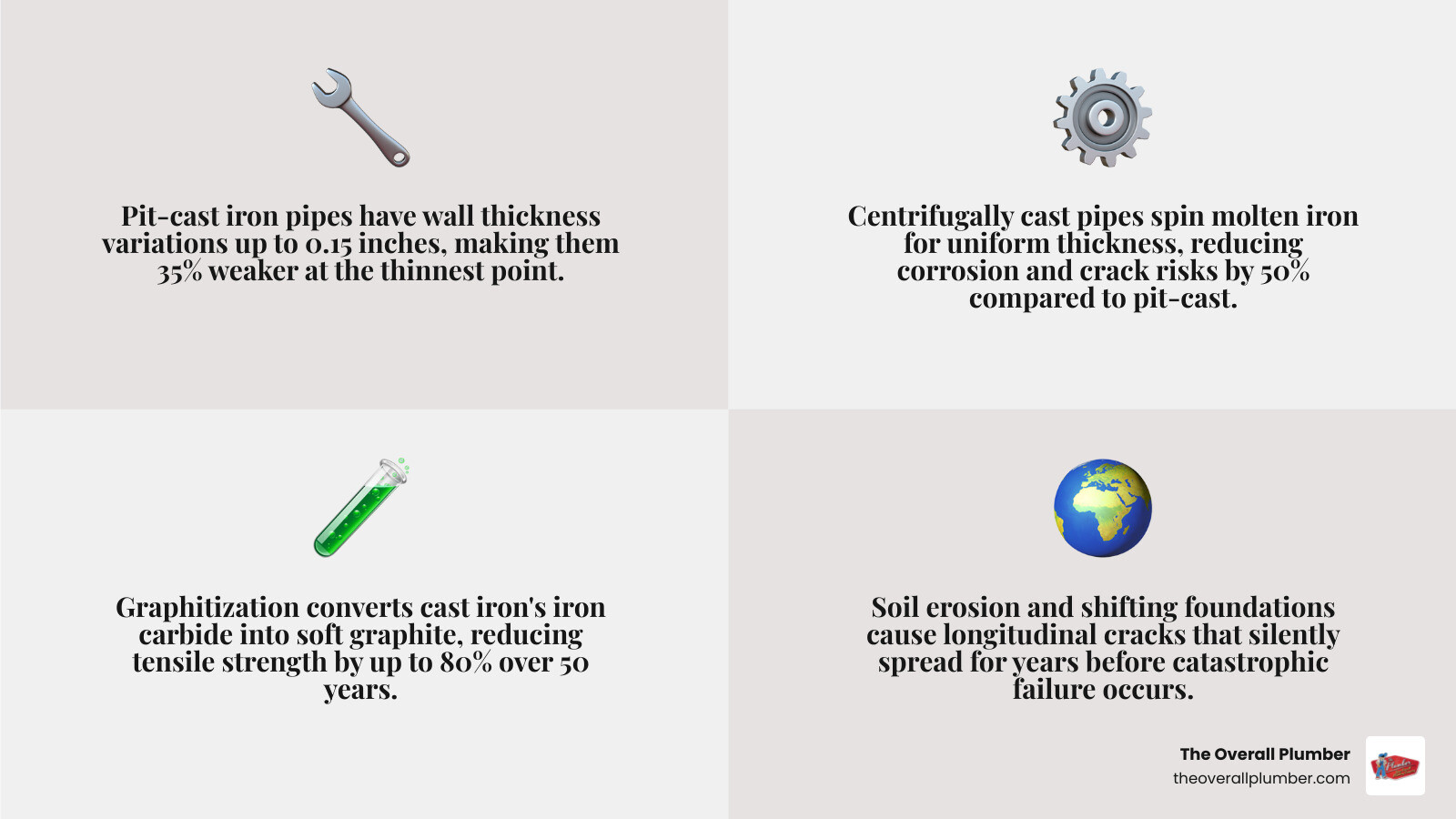
First, let’s look at how these pipes were manufactured. If your home in the Houston area was built before the mid-20th century, your plumbing likely uses “pit cast” pipes. According to a detailed Examination of failed eight inch diameter cast iron pipe natural gas main, Philadelphia, Pennsylvania , pit cast pipes were made by pouring molten iron into vertical sand molds. This old-school method often resulted in non-uniform wall thickness. In examined failed pipes, wall thickness varied significantly around the circumference — from a maximum of 0.57 inches down to a thin, weak 0.42 inches. Modern cast iron pipes are “centrifugally cast,” which spins the molten metal to ensure a perfectly uniform wall thickness.
Another major culprit is the chemical composition of older iron. Many historical pipes contain a phosphorus content of 1.34% to 1.45%, which is much higher than the 0.90% maximum allowed by modern ANSI standards. High phosphorus levels lead to the formation of “steadite,” a hard but highly brittle iron-iron phosphide eutectic. This excess steadite reduces the pipe’s overall modulus of rupture — sometimes dropping it well below the 40,000 psi minimum required by ANSI standards — making the metal highly prone to brittle cleavage fractures.
Over time, this brittle metal is subjected to two slow-motion destructive forces:
- Graphitization: This is a unique form of corrosion where the iron matrix is selectively leached away by water and soil chemicals, leaving behind a weak, soft network of graphite. In failed pipes, graphitization has been shown to extend as far as 0.12 inches inward from the outside wall surface. A graphitized pipe looks completely normal to the naked eye, but it has the structural strength of wet cardboard.
- Soil Erosion and Loss of Support: This is incredibly common in the expansive clay soils of Harris County and Galveston County. When a nearby water pipe leaks or heavy rains shift the ground, the soil beneath a buried cast iron pipe washes away. This creates unsupported spans. Without uniform soil support, the heavy cast iron pipe is subjected to immense bending loads, causing it to snap cleanly in half.
For more technical insights on how these forces combine to cause sudden failures, you can read the academic research on Leak-before-break in cast iron mains: a failure analysis of a catastrophic pipe burst on Harris Street, Sydney .
Signs Your Pipe Has Reached the End of Its Service Life
How do you know if your home’s main line is suffering from these deep structural issues? Because cast iron corrodes from the inside out, a pipe can look solid on the outside while being paper-thin on the inside. Watch out for these key warning signs:
- Yellow, Brown, or Rust-Discolored Water: This is a clear indicator of internal rust scaling.
- Persistent Slow Drains or Frequent Backups: As rust scale builds up inside the pipe, it creates a rough surface that catches hair, grease, and toilet paper, leading to stubborn clogs.
- Foul Sewer Odors: A cracked or broken sewer pipe allows sewer gases (including toxic hydrogen sulfide) to escape into your home’s crawlspaces, walls, or yard.
- An Unusually Lush, Green Patch of Lawn: If one section of your grass in Pearland or Friendswood is suddenly thriving and vibrant, it is likely because an underground sewer line has broken, and the escaping sewage is acting as a natural fertilizer.
If you are noticing these symptoms, it is crucial to address them before they lead to a total washout. You can read more about identifying these warnings in our guide on Sewer Line Problems and How to Avoid a Total Washout.
How to Diagnose a Broken Cast Iron Pipe
Before you grab a wrench or buy any repair materials, you must accurately diagnose the location, type, and severity of the break. Attempting to patch a pipe without knowing the full extent of the damage is a recipe for wasted time and future water damage.
In the engineering world, we often talk about the “leak-before-break” (LBB) concept. This theory states that a pressurized pipe will display a visible, manageable leak before it suffers a catastrophic, explosive structural failure. In residential drain systems, this means a hairline crack or a slow joint drip is your warning shot.
However, because residential drains are not constantly under high pressure, cracks often propagate slowly due to cyclic pressure fatigue (the stress of water repeatedly filling and draining) and ground temperature fluctuations. Cracks typically initiate as small longitudinal fractures near a bell-joint and gradually creep along the length of the pipe barrel.
If you suspect an underground or hidden break, the only reliable way to diagnose it is with a professional Video Camera Sewer Line Inspection. A high-resolution waterproof camera is snaked through your sewer line, allowing us to see exactly where the pipe has cracked, sagged, or been invaded by tree roots.
Locating the Source of the Leak
If the pipe is exposed (such as in a basement, crawlspace, or attic), you can perform some basic troubleshooting yourself:
- Check the Toilet Wax Ring First: If you notice a leak on your ceiling or floor only when a toilet is flushed, the culprit might not be a cracked cast iron pipe at all. It could simply be a failed wax ring sealing the toilet to the floor flange.
- Look for Dampness in Wall Cavities: Run water through your fixtures and use a non-invasive moisture meter on your drywall to trace the path of the dampness.
- Use Your Nose: Sewer gas has a distinct rotten-egg smell. If the smell is strongest near a specific wall cavity, the vertical cast iron stack inside that wall likely has a crack or a failed joint.
To help narrow down the search area, check out our step-by-step tips on Sewer Lines 101: How to Locate Them.
Safety Precautions and Essential Tools for DIY Repairs
Working on a broken cast iron pipe — especially a sewer or drain line — exposes you to serious biological and physical hazards. Before starting, gather the correct Personal Protective Equipment (PPE):
- P100 Respirator: Essential for protecting your lungs from airborne mold spores, dried sewage particles, and harmful sewer gases.
- Heavy-Duty Chemical-Resistant Gloves: Protects your hands from raw sewage, bacteria, and aggressive chemical cleaners.
- Safety Goggles: Protects your eyes from splashes and flying metal shards during cutting.
Cast iron is incredibly heavy and brittle. If you are cutting out a section of pipe, a single foot of 4-inch cast iron pipe weighs about 10 pounds. Always ensure the upper sections of the pipe are fully supported with heavy-duty pipe hangers or riser clamps before making any cuts; otherwise, the upper pipe could fall, crushing your hands or collapsing the entire stack.
If you are planning to tackle this project yourself, you will need a specialized toolkit:
- Snap cutters (chain pipe cutters): This is the best tool for making clean, square cuts on cast iron without creating excessive heat or sparks. You can often rent these from local home improvement stores in League City or Pasadena.
- Angle grinder with a diamond abrasive wheel: Useful for tight spaces where a chain cutter won’t fit.
- Wire brush or abrasive pads: For cleaning decades of rust and scale off the pipe surface.
- Torque wrench (5/16-inch): To tighten no-hub coupling bands to the exact manufacturer-specified torque (usually 60 in-lbs).
For a complete breakdown of basic plumbing safety and preparation, refer to our guide on How to Fix a Broken Pipe in 7 Easy Steps.
Essential Materials for Your Repair Toolkit
Depending on the repair method you choose, you will need to stock up on the following materials:
- Moisture-Curing Polyurethane Sealant: Specialized sealants (like CrackSeal) that can adhere to damp surfaces and form a flexible, water-resistant barrier.
- Two-Part Epoxy Putty: A moldable putty that hardens like steel, perfect for sealing small pinhole leaks.
- No-Hub Transition Couplings: Heavy-duty rubber sleeves wrapped in a stainless steel shield, designed to connect cast iron to PVC.
- Schedule 40 PVC Pipe and Fittings: The modern standard for durable, corrosion-resistant drain lines.
If you are dealing with a minor, active leak and need an immediate fix, take a look at our quick-reference guide on How to Fix a Leak Quickly in 5 Easy Steps.
Temporary Patches vs. Permanent Replacement Solutions
When dealing with a broken cast iron pipe, you must decide between a temporary patch and a permanent structural replacement.
| Repair Method | Pros | Cons | Best Used For |
|---|---|---|---|
| Epoxy Putty / Sealants | Inexpensive, fast, requires no pipe cutting | Temporary, does not stop ongoing internal corrosion | Hairline cracks on accessible, low-pressure vertical drains |
| Fiberglass Repair Wraps | High pressure resistance (up to 30 bar), reinforces the pipe | Hard to apply in tight spaces, temporary | Emergency reinforcement of a split pipe |
| Section Replacement (PVC) | Permanent, eliminates corrosion, highly durable | Requires specialized cutting tools and structural support | Severely corroded, cracked, or sagging sections |
Many DIYers are tempted to rely on epoxy putty or specialized sealants for a permanent fix. While high-quality moisture-curing sealants are incredibly durable, they cannot stop the physical process of rust patina expansion.
When cast iron cracks, moisture enters the fracture and reacts with the raw metal, creating a rust patina. As this rust forms, it expands. This expansion creates immense localized pressure inside the crack, acting like a tiny wedge that slowly forces the crack to grow and propagate right past your surface patch. For a truly deep dive into the physics of why cast iron behaves this way, you can read the How To Repair Cast Iron Sewer Pipe – A DIY Builder’S Comprehensive guide.
Step-by-Step DIY Guide to Patching a Broken Cast Iron Pipe
If you have an accessible vertical stack with a minor hairline crack and need to patch it temporarily, follow these steps:
- Clean the Area Thoroughly: Use a wire brush or abrasive pad to scrape away all rust, scale, dirt, and old paint from the pipe. The metal must be clean and bright for the sealant to adhere.
- Apply a Moisture-Curing Sealant: Use a high-quality sealant like CrackSeal. A standard 310ml cartridge can fill about 1 meter of a 1cm wide crack. Extrude the sealant directly into the crack.
- Smooth the Finish: Dip a spatula or your gloved finger into water mixed with a small amount of dish soap (this prevents sticking) and smooth the sealant flat. It will form a skin in about 10 minutes and has a Shore A hardness of 40 with over 300% elongation, allowing it to flex as the pipe expands and contracts.
- Wrap with a Reinforcing Bandage: For added strength, wrap the area with a water-activated fiberglass pipe repair bandage (like SylWrap HD). This creates an impact-resistant outer shell that can withstand pressures up to 10 bar.
For more tips on handling vertical cast iron lines, see our article on How to Save Your Cast Iron Downpipe Without Losing Your Mind.
Replacing a Damaged Section with No-Hub Couplings
For a permanent structural repair, you must cut out the rotten section of cast iron and replace it with modern Schedule 40 PVC.
- Support the Pipe: Secure riser clamps or heavy-duty hangers to the cast iron pipe above and below the section you plan to cut.
- Cut the Pipe: Use your rented snap cutters to score and cleanly snap the cast iron. Make your cuts at least 6 inches past the visible ends of the crack to ensure you are connecting to solid, uncorroded metal.
- Measure and Cut PVC: Cut a piece of Schedule 40 PVC to match the gap, leaving about a 1/4-inch clearance on each end.
- Install No-Hub Transition Couplings: Slide the rubber sleeves of the no-hub couplings onto the cast iron ends and the PVC ends. Position the PVC pipe in place, slide the rubber sleeves over the joints, and wrap them with the stainless steel shields.
- Torque the Clamps: Use your 5/16-inch torque wrench to tighten the stainless steel bands to 60 in-lbs, alternating between clamps to ensure an even, watertight seal.
To learn more about this permanent repair method, read our detailed guide on Broken Pipe Repair.
When to Call a Professional for a Broken Cast Iron Pipe
While a handy DIYer can easily replace an accessible section of cast iron in a crawlspace, there are many scenarios where you should step back and call a licensed professional:
- Underground or Under-Slab Breaks: If the broken pipe is buried beneath your yard or under your home’s concrete slab foundation, repairing it requires heavy excavation equipment and specialized diagnostic tools.
- Trenchless Pipe Lining (CIPP): Modern plumbing technology allows us to repair a broken cast iron pipe without digging up your yard. We can insert an epoxy-saturated felt tube into the old pipe, inflate it, and let it cure. This creates a brand-new, seamless “pipe within a pipe” that lasts for over 50 years.
- Pipe Bursting: Another trenchless method where a new HDPE pipe is pulled directly through the old cast iron pipe, fracturing the old pipe outward while replacing it instantly.
- Permits and Building Codes: In most parts of Brazoria County, Harris County, and Galveston County, replacing major sections of your main sewer line requires city permits and a professional inspection to ensure the work meets local building codes.
If you want to save your landscaping and avoid the mess of traditional excavation, read about Why Trenchless Sewer Line Replacement Is the Best Way to Save Your Yard.
Frequently Asked Questions About Cast Iron Pipe Repair
Can I connect PVC to an old cast iron pipe?
Yes, you can easily connect PVC to old cast iron using specialized no-hub transition couplings (often called mission bands or Fernco couplings). These couplings feature a thick rubber sleeve that accommodates the slight difference in outer diameter between cast iron and PVC, wrapped in a stainless steel shield to prevent the pipe from sagging or shifting. For quick tips on making these connections, check out How to Fix a Leaking Pipe Quickly.
How long do temporary epoxy patches last on cast iron?
An epoxy patch on a non-pressure drain line can last anywhere from a few months to a couple of years. However, because of rust patina expansion, the crack will eventually continue to grow past the patched area. Epoxy should always be treated as a temporary band-aid while you plan for a permanent replacement. You can read more about how to manage these temporary fixes in How to Deal with Broken Cast Iron Pipe .
Does a broken sewer pipe require a permit to repair?
In most local Texas jurisdictions — including Houston, Pearland, and League City — minor repairs to exposed pipes do not require a permit. However, replacing large sections of a main sewer line, altering the plumbing layout, or performing any underground excavation absolutely requires a permit and a licensed plumber. To understand the broader scope of major pipe replacements, read Everything You Need to Know About Whole House Repipe Costs.
Schedule Your Professional Sewer Inspection and Repair
If you suspect your home has a broken cast iron pipe, don’t wait for a slow leak to turn into a costly, hazardous sewer backup. At The Overall Plumber, we provide advanced video camera sewer inspections, drain cleaning, and complete repiping services across Brazoria County, Harris County, and Galveston County.
We stand by our work with satisfaction guarantees, priority scheduling, and absolutely no trip charges or overtime fees. To understand your options and find a permanent solution that fits your budget, check out our guide on The Real Price of Repiping Your Bathroom and Home.
Ready to get started? Contact Us or call us at (281) 668-5056 today to schedule your professional inspection.