


Everything You Need to Know About Whole House Repipe Costs
What Does It Actually Cost to Replumb a House?
Replumbing house cost typically falls between $4,000 and $15,000, with most homeowners paying around $7,500 for a full repipe. Here’s a quick breakdown to help you estimate your project:
| Home Size | PEX Estimate | Copper Estimate |
|---|---|---|
| ~1,000 sq ft | $4,500 | $7,000+ |
| ~1,500 sq ft | $6,750 | $9,000–$12,000 |
| ~2,500 sq ft | $11,250 | $15,000+ |
| ~3,000 sq ft | $13,500 | $18,000+ |
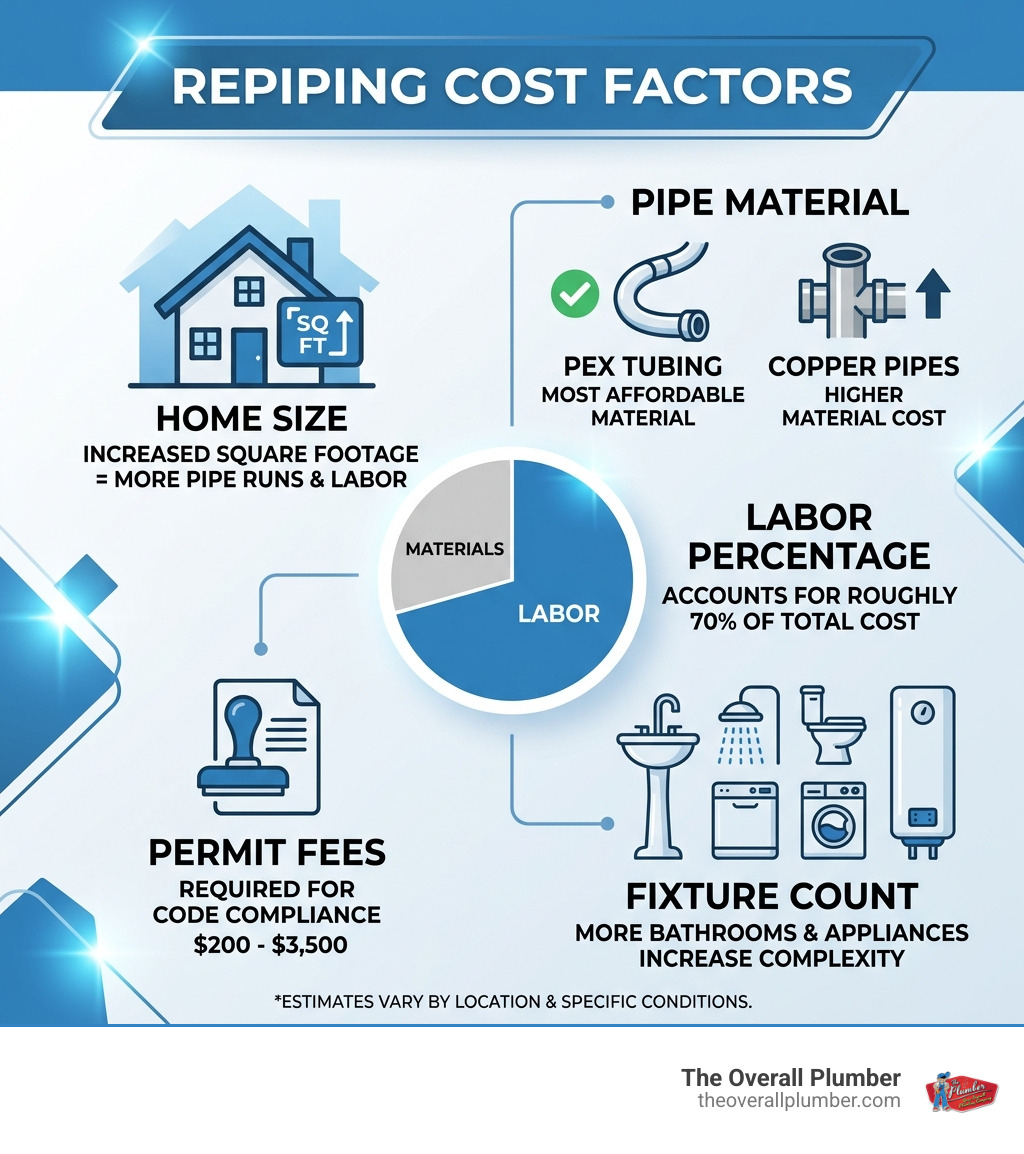
Key cost drivers at a glance:
- Pipe material (PEX is the most affordable; copper costs up to 68% more)
- Home size and number of fixtures
- Foundation type (slab foundations cost more to access)
- Labor (accounts for roughly 70% of the total bill)
- Permits and drywall repairs (add $200–$3,500 depending on scope)
Old pipes don’t announce their failure with much warning. One day the water pressure drops, the next you’re seeing rust-colored water at the tap — and suddenly a repair you’ve been putting off becomes urgent. Whether you’re dealing with aging galvanized steel, failing polybutylene, or just a system that’s well past its 50-year lifespan, understanding the full cost picture before you call a plumber puts you in a much stronger position.
I’m Dayton Whitworth, a second-generation plumber serving Greater Houston and the Gulf Coast, with hands-on experience helping homeowners navigate replumbing house cost decisions across a wide range of home sizes and pipe types. Let’s break down exactly what you can expect to pay — and why.
Average Replumbing House Cost by Material and Size
When we talk about the replumbing house cost, the material you choose is the single biggest “fork in the road” for your budget. In the Houston and Galveston area, we primarily see three materials: PEX, Copper, and CPVC.

PEX (cross-linked polyethylene) has become the industry standard for residential repiping. It’s flexible, which means we can “fish” it through walls like electrical wiring, drastically reducing the number of holes we have to cut in your drywall. Copper, while beautiful and incredibly durable, is rigid. It requires more labor, more wall cuts, and the material cost itself is subject to the whims of the global metal market.
| Material | Cost per Linear Foot (Installed) | Lifespan | Pros |
|---|---|---|---|
| PEX | $0.40 – $2.00 | 40–50+ Years | Freeze-resistant, fast install, no corrosion |
| Copper | $2.00 – $8.00 | 50–70+ Years | Naturally antibacterial, high resale value |
| CPVC | $0.50 – $1.00 | 40–60 Years | Chemical resistant, DIY friendly (but brittle over time) |
According to Angi, the national average for a repipe is around $7,500, but in our neck of the woods—from Pearland down to Galveston—local labor rates and home construction styles play a huge role.
Cost Breakdown by Square Footage
Square footage is a helpful starting point, but it’s really about the linear feet of pipe required to reach every corner of your home. A sprawling 2,500-square-foot ranch in Friendswood will likely cost more to repipe than a compact two-story home of the same size because the horizontal runs are much longer.
On average, you can expect to pay about $2 to $6 per square foot for a PEX repipe. For a standard 1,500-square-foot home, the Residential Plumbing investment usually lands between $4,500 and $8,500. If you move up to a 3,000-square-foot home, those costs can climb to $13,500 or more, especially if the home has multiple stories or complex layouts.
Pricing per Plumbing Fixture
Another way we calculate the replumbing house cost is by “fixture count.” In plumbing terms, a fixture is basically any spot where water comes out or goes away. However, we often count them as “points.” For example:
- Full Fixture (1.0): Kitchen sink, bathroom vanity, washing machine.
- Half Fixture (0.5): Toilet, hose spigot (since they only require a cold water line).
Expect to pay between $250 and $800 per fixture. A home with 2.5 bathrooms, a kitchen, a wet bar, and a laundry room has a much higher “density” of plumbing than a simpler layout, which increases both the material needs and the labor time for hookups and testing.
Key Factors Influencing Your Total Investment
It would be easy if every house was a carbon copy, but as we know in Harris and Brazoria Counties, every home has its own quirks. From the age of the structure to how it was built, several factors can shift your estimate.
Labor and Professional Expertise
Labor is the “lion’s share” of your bill, often accounting for 70% of the total cost. When you pay for a professional repipe, you aren’t just paying for someone to glue pipes together. You’re paying for a team that knows how to navigate the specific building codes of League City or Pasadena.
Specialized crews who do nothing but repiping are often more efficient. While a general plumber might take a week to repipe a house, a dedicated team can often finish the plumbing portion in 2 to 3 days. This efficiency saves you money in the long run and minimizes the time your water is turned off.
Accessibility and Foundation Type
This is a big one for our Texas homeowners.
- Crawlspaces: If your home is on pier-and-beam, we can often run the new lines underneath the house. This is the “dream scenario” for a plumber and usually keeps costs on the lower end ($4,000–$8,000).
- Slab Foundations: Many homes in Houston and Sugar Land are built on concrete slabs. Since we can’t easily tunnel under the concrete, we often have to “reroute” the plumbing through the attic. This requires more pipe and more drywall cuts to bring the lines down to the fixtures, increasing the cost by 20% to 30%.
- Multi-Story Homes: Running pipes vertically between floors adds complexity and time.
HomeAdvisor notes that accessibility is often the “hidden” variable that causes estimates to vary between two seemingly identical houses.
Permits and Local Inspections
You might be tempted to skip the permit to save a few hundred bucks, but please don’t. Permits ensure that the work is inspected by a third party and meets the latest safety codes. In our service areas, permit fees typically range from $50 to $500.
Failing to get a permit can cause massive headaches when you try to sell your home later. If a buyer’s inspector sees new PEX but no record of a permit, it can stall a sale or even lead to Broken Pipe Repair issues if the work wasn’t done to code.
Signs Your Home Needs a Full Repipe
How do you know it’s time to stop patching and start replacing? Your pipes will usually try to tell you, though they aren’t always subtle about it.
- Low Water Pressure: If your shower feels more like a light drizzle, your pipes might be “narrowing” due to mineral scale or rust buildup.
- Discolored Water: If the water looks like tea or has a metallic tang when you first turn it on, your galvanized steel pipes are likely rusting from the inside out.
- Frequent Leaks: If you’re calling us for a “spot repair” every few months, you’re essentially playing a game of Whac-A-Mole. It’s often cheaper to do a full repipe than to pay for five separate emergency repairs and the resulting water damage.
- Pipe Age: If your home was built before 1970 and still has the original pipes, they are likely at the end of their 50-year lifespan.
- Hazardous Materials:
- Lead: Common in homes built before 1986; poses significant health risks.
- Polybutylene: The “ticking time bomb” of the 70s and 80s. These gray plastic pipes are notorious for sudden, catastrophic failure.
- Galvanized Steel: These rust internally, eventually leading to clogs and leaks.
If you are noticing these “red flags” in your Repiping Houston Homes project, it’s time to get a professional evaluation before a small leak becomes a flooded living room.
The Repiping Process: Timeline and Additional Expenses
A whole-house repipe is a major project, but it’s a controlled one. Most homeowners worry about being without water for a week, but that’s rarely the case. We typically only shut the water off for a few hours at a time during the day and ensure you have service back on by the evening.
The Timeline
For a standard 1,500 to 2,000-square-foot home:
- Day 1: Preparation (covering furniture/floors) and initial wall cuts.
- Day 2-3: Running the new PEX or copper lines and connecting to the main supply.
- Day 4: Pressure testing and municipal inspection.
- Day 5: Drywall patching and beginning the cleanup.
Additional Expenses to Budget For
The replumbing house cost isn’t just about the pipes. You should budget for:
- Drywall Repair: Plumbers are great at cutting holes, but we aren’t always the best at making them disappear. Professional drywall patching and texturing can add $500 to $1,500 to the total.
- Painting: Once the drywall is patched, you’ll need to paint the affected areas.
- Debris Disposal: Some quotes include hauling away the old lead or galvanized pipes; others might charge a fee of $100 to $500.
Long-Term ROI: Is the Replumbing House Cost Worth It?
Is it worth spending $8,000 on something you can’t even see? Absolutely.
- Home Value: New plumbing is a massive selling point. It gives buyers confidence that they won’t face a $10k bill three months after moving in.
- Insurance Premiums: Many insurance companies in the Gulf Coast area will lower your premiums—or at least refuse to hike them—if you replace old polybutylene or galvanized lines. Some may even refuse to cover a home with polybutylene pipes at all.
- Appraisal Support: When it comes time to refinance or sell, a modern plumbing system supports a higher home appraisal.
How to Save on Your Total Replumbing House Cost
We know this is a significant investment. Here are a few ways to keep the replumbing house cost manageable:
- Choose PEX: It’s roughly 40% to 60% cheaper than copper in terms of labor and material.
- Handle the “Cosmetics” Yourself: If you’re handy with a putty knife and a paintbrush, you can save over $1,000 by doing your own drywall patching and painting.
- Bundle the Work: If you’re already planning a bathroom remodel, that’s the perfect time to repipe the rest of the house since the walls will already be open.
- Off-Peak Scheduling: While plumbing emergencies happen year-round, scheduling your repipe during “shoulder seasons” (like a mild spring or fall) can sometimes lead to better scheduling availability.
Frequently Asked Questions
How long does it typically take to repipe a house?
For a standard single-story home in the Houston area, the plumbing installation usually takes 2 to 3 days. If you have a larger, multi-story home or a complex slab-reroute, it might take 5 to 7 days. Add another 2 days for drywall repair and texture if that’s included in your service.
Is PEX piping safe for drinking water?
Yes! PEX has been used for decades and is rigorously tested to meet NSF International standards for potable water. It is resistant to chlorine and scale buildup, and because it doesn’t corrode like metal, it can actually improve the taste and clarity of your water. It’s also much more resistant to bursting during those rare Texas freezes compared to rigid copper or CPVC.
Does homeowners insurance cover the cost of repiping?
Generally, no. Insurance is designed to cover “sudden and accidental” damage—like a pipe that bursts and ruins your hardwood floors. It does not cover the “wear and tear” or maintenance of old pipes. However, replacing your pipes is a preventative measure that can save you from a massive insurance claim (and a deductible) down the road.
Conclusion
Investing in a whole-house repipe is about more than just fixing a leak; it’s about protecting your home’s foundation, your family’s water quality, and your long-term peace of mind. While the replumbing house cost can seem daunting, the cost of doing nothing—and dealing with the inevitable water damage—is almost always higher.
At The Overall Plumber, we understand the unique challenges of Texas homes, from the humidity of Galveston to the shifting soils of Harris County. We offer a satisfaction guarantee, priority scheduling, and no overtime fees, ensuring your project is handled with the respect and expertise it deserves.
Don’t wait for a major flood to take action. If you’re ready to upgrade your home’s “circulatory system” with a team that stands behind their work, Schedule Your Repiping Service in Houston today for a transparent, fixed-price quote. We’re here to help you get the water flowing right again.