

Why Trenchless Sewer Line Replacement is the Best Way to Save Your Yard
The Smarter Way to Fix Your Sewer Without Wrecking Your Yard
Trenchless sewer line replacement is a modern method of repairing or replacing damaged underground sewer pipes with minimal digging — protecting your lawn, driveway, and landscaping in the process.
Here’s what you need to know at a glance:
- What it is: A no-dig (or low-dig) approach to fixing broken, cracked, or corroded sewer pipes underground
- Main methods: Pipe lining (CIPP) and pipe bursting
- Average cost: $60–$250 per linear foot, with most residential jobs totaling $6,000–$12,000
- How long it takes: Most projects are completed in a single day
- Lifespan: New pipes typically last 50–100 years
- Best for: Cracked pipes, root intrusion, corrosion, and aging sewer lines that still have structural shape
- Not ideal for: Completely collapsed or severely misaligned pipes
Dealing with slow drains, sewage smells, or soggy patches in your yard is stressful enough. The last thing you want is a crew tearing up your yard to fix it. A decade ago, that was often your only option — heavy equipment, a foot-wide trench dug 3–5 feet deep, and days of disruption. Today, trenchless technology has changed that completely.
I’m Dayton Whitworth, a second-generation plumber serving Greater Brazoria County, Galveston County, Houston, and the surrounding Gulf Coast, with hands-on experience diagnosing and completing trenchless sewer line replacement projects for homeowners across the region. In this guide, I’ll walk you through everything you need to make a confident, informed decision.
What is trenchless sewer line replacement?
In modern plumbing, trenchless sewer line replacement represents a massive leap forward. Simply put, it is a subsurface repair method that allows us to fix or replace your underground sewer pipes without digging a massive, property-destroying trench from your house to the street.
For decades, if a pipe under your rose bushes or driveway cracked, we had to bring in a backhoe and literally “open up” the earth. This traditional excavation was noisy, messy, and often left homeowners with a secondary bill for thousands of dollars in landscaping and concrete restoration. Trenchless technology changes the game by using small access points—usually just two small holes—to reach the pipe.
It is important for homeowners in areas like Houston, Pearland, and League City to understand that the property owner is generally responsible for the sewer line that runs from the home to the city’s main connection. Because this responsibility falls on you, choosing a method that minimizes both the immediate headache and the long-term repair costs is vital. Trenchless methods provide a high-quality, seamless pipe that is often stronger than the original material.
How trenchless sewer line replacement works
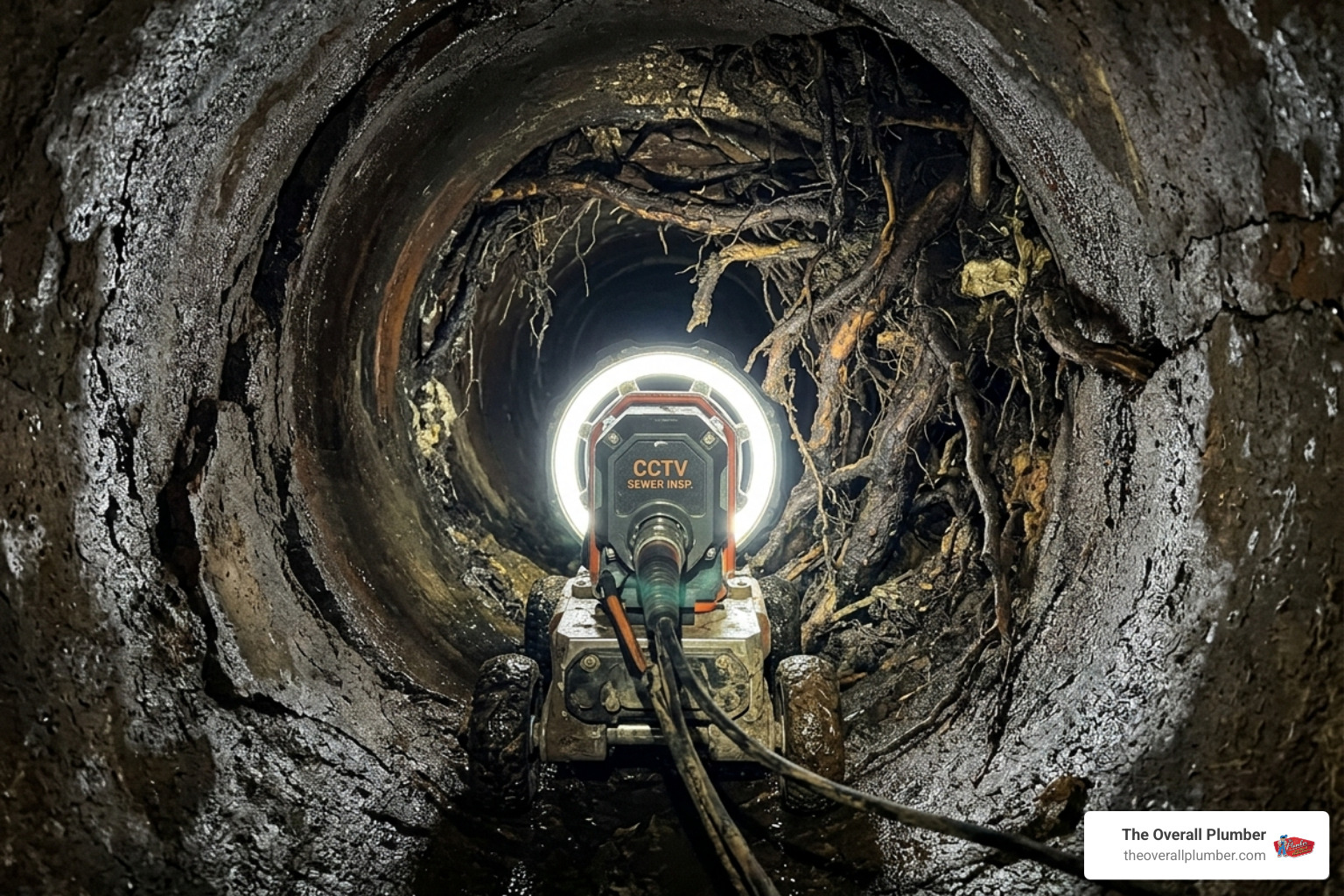
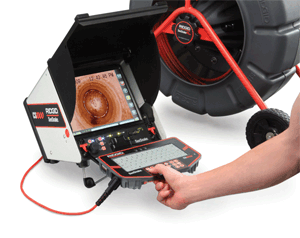
The process begins not with a shovel, but with technology. Before we ever break ground, we perform a Video Camera Sewer Line Inspection to see exactly what’s happening inside the pipe. This allows us to pinpoint the location of cracks, root intrusions, or blockages without any guesswork.
Once we’ve identified the problem, we create small access points at either end of the pipe section being replaced. Using specialized hydraulic equipment, we can either pull a new pipe through the old one or “re-line” the existing structure. This subsurface approach means your patio, driveway, and lawn stay exactly where they are.
Main Methods: Pipe Lining (CIPP) vs. Pipe Bursting
There are two primary ways we handle a trenchless sewer line replacement, and the choice usually depends on the condition of your existing pipes.
- Pipe Lining (Cured-in-Place Pipe or CIPP): This is often called “the pipe within a pipe.” We take a flexible tube coated with a special epoxy resin and pull it through your damaged sewer line. Once in place, we inflate the tube. The resin then cures (hardens) over several hours, creating a brand-new, jointless, and structural pipe inside the old one. While this reduces the diameter of the pipe by about a quarter of an inch, the smooth surface actually improves flow and resists future root growth.
- Pipe Bursting: If your pipe has collapsed or you need to increase the size of your sewer line, pipe bursting is the way to go. We pull a heavy-duty bursting head through the old pipe. As it moves, it shatters the old pipe (whether it’s clay, cast iron, or PVC) and pushes the fragments into the surrounding soil. Simultaneously, it pulls a new, seamless High-Density Polyethylene (HDPE) pipe into place behind it. This method maintains or even increases the original pipe’s diameter.
The Step-by-Step Process of Trenchless Sewer Repair
When you call us for a sewer issue in Galveston or Friendswood, we follow a structured process to ensure the job is done right the first time.
- Initial Diagnosis: We start with a high-definition camera to map out the damage.
- Cleaning the Line: Before we can line or burst a pipe, it has to be clear. We often use a Houston Auger Service or hydro-jetting to blast away roots and debris.
- Preparation: We dig two small access pits—one where the pipe leaves the house and one near the street or septic tank.
- Installation: We insert the liner or the bursting head.
- Curing/Setting: For CIPP, we allow the resin to harden. For pipe bursting, we fuse the HDPE sections together.
- Final Inspection: We run the camera through one last time to ensure a perfect, leak-free finish.
When is trenchless sewer line replacement suitable?
Trenchless technology is incredibly versatile, but it’s not a “one size fits all” miracle. It is most effective for:
- Root Intrusion: When thirsty tree roots have found their way into pipe joints.
- Cracked or Leaking Pipes: Common in the shifting soils of the Texas Gulf Coast.
- Corrosion: Especially in older cast iron pipes found in historic parts of Houston or Galveston.
- Minor Misalignment: Small offsets can often be bridged by a new liner.
If you need to Repair Broken Sewer Line Houston, we will evaluate your soil stability and pipe alignment. However, if the pipe has completely “bellied” (sagged deeply) or has collapsed entirely so that a camera or cable cannot pass through, traditional trenching might still be required to manually reset the line’s grade.
Preparation and Aftercare for Homeowners
Before we arrive, there are a few things you can do to help the process go smoothly. We will handle the utility marking (calling 811) to ensure no gas or electric lines are in the way. You should clear the areas around the expected access points—moving patio furniture or clearing brush helps us get to work faster.
After the trenchless sewer line replacement is complete, maintenance is easy. Because the new pipes are jointless, they are virtually “root-proof.” However, we still recommend:
- Routine Inspections: Every few years, have a camera check-up.
- Flushing Restrictions: Avoid flushing “flushable” wipes, grease, or heavy paper products.
- Professional Cleaning: If you ever do have a clog, stick to professional Brazoria County Auger Service rather than using harsh chemical cleaners that can damage older connecting fixtures.
Comparing Trenchless vs. Traditional Trenching
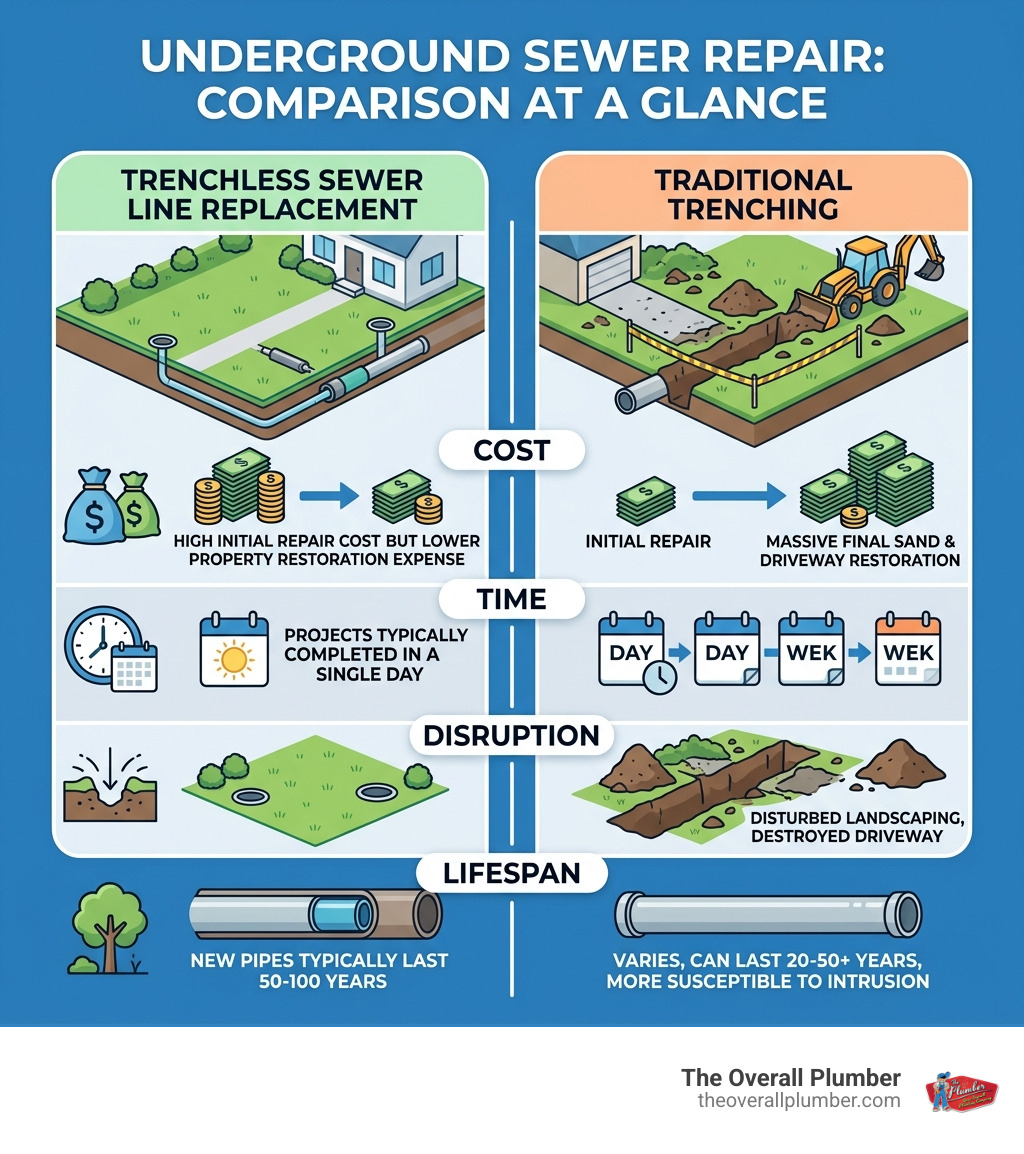
The biggest hurdle for many homeowners is the upfront cost. On paper, the per-foot price of trenchless can look higher. However, when you look at the “total project cost,” trenchless almost always wins.
| Feature | Trenchless Replacement | Traditional Trenching |
|---|---|---|
| Digging | Minimal (2 access holes) | Full-length trench |
| Property Damage | Very Low | High (Lawn, Driveways, Patios) |
| Time to Complete | 1 Day | 3–7 Days |
| Equipment | Specialized Hydraulic Tools | Backhoes & Excavators |
| Restoration Cost | $0 – $500 | $2,000 – $5,000+ |
| Lifespan | 50–100 Years | 50 Years (Material dependent) |
Traditional excavation requires heavy machinery that compacts your soil and destroys your grass. Once the plumber is done, you’re often left with a dirt mound that takes months to settle and a massive bill from a landscaper or paving company.
Pros and Cons of No-Dig Methods
The “Pros” are clear: speed, durability, and property preservation. The new HDPE or epoxy-lined pipes have a 50-year lifespan (and often last up to 100 years). They are resistant to the corrosion that plagues Sewer Lines in Houston.
The “Cons” are mostly related to suitability. Trenchless requires high-end equipment and specialized training. You can’t just rent these tools at a hardware store; you need professional expertise to ensure the resin cures correctly or the bursting head doesn’t snag on a hidden utility. Additionally, if the original pipe was installed with a “back-pitch” (sloping the wrong way), trenchless won’t fix the gravity issue—only manual digging can re-slope a pipe.
Frequently Asked Questions about Trenchless Sewer Services
How much does trenchless sewer line replacement cost?
Pricing for trenchless sewer line replacement typically ranges from $60 to $250 per linear foot. On average, homeowners pay between $155 per foot. While a small-scale repair might cost $3,000 to $4,000, a full replacement usually lands between $6,000 and $12,000.
Factors that affect the price include the depth of the pipe (deeper pipes require more work for the access pits), the diameter of the pipe, and the specific method used (pipe bursting is often slightly more expensive than lining). However, because you aren’t paying to replace a 50-foot section of concrete driveway, the “out-of-pocket” total is frequently lower than traditional methods.
How long does the procedure typically take?
One of the best parts about this technology is the speed. Most trenchless sewer line replacement projects are completed in a single day.
While traditional digging can leave your water off and your yard open for a week or more, we can often have your sewer service restored within 24 hours. CIPP liners typically take 4 to 8 hours to cure fully, after which the line is ready for immediate use.
Is trenchless sewer repair covered by homeowners insurance?
This is a tricky one. Standard homeowners insurance often excludes “wear and tear” or “gradual deterioration,” which covers most aging sewer lines. However, you might be covered if:
- You have a “Service Line Endorsement” or “Buried Utility” coverage on your policy.
- The damage was caused by a sudden, accidental event (like a tree falling and crushing the line).
- You are dealing with a sudden backup that caused interior water damage.
We always recommend reviewing your policy or calling your agent to see if you have specific coverage for the pipes between your house and the street.
Conclusion
At The Overall Plumber, we understand that sewer problems are an emergency that can’t wait. Whether you’re in Houston, Pearland, or down in Galveston, we are committed to providing the most efficient, least invasive solutions available. We take pride in our work, which is why we offer satisfaction guarantees, priority scheduling, and no overtime fees.
Don’t let a broken pipe ruin your beautiful Texas landscape. With our “no trip charge” policy and expert team, we can diagnose your issue quickly and determine if a no-dig fix is right for you.
Ready to save your yard? Schedule your Trenchless Sewer Line Replacement in Houston with us today and get your home back to normal without the mess!