


What to Look for in a Camera for Pipeline Inspection
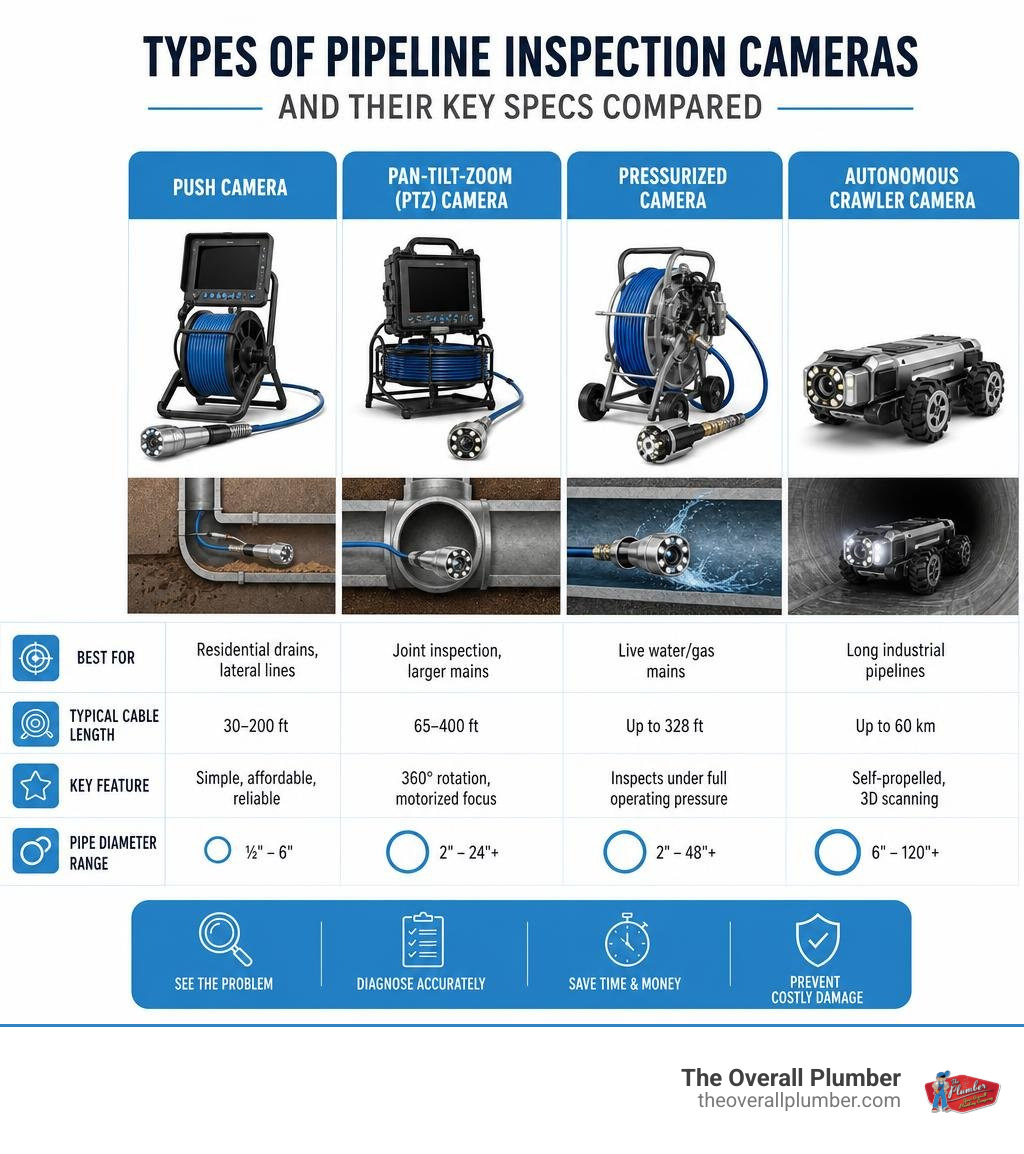
Choosing the right camera for pipeline inspection can save you thousands of dollars in unnecessary digging and guesswork. Here is a quick overview of the main camera types to help you find what you need fast:
| Camera Type | Best For | Typical Cable Length | Key Feature |
|---|---|---|---|
| Push Camera | Residential drains, lateral lines | 30–200 ft | Simple, affordable, reliable |
| Pan-Tilt-Zoom (PTZ) | Joint inspection, larger mains | 65–400 ft | 360° rotation, motorized focus |
| Pressurized Camera | Live water/gas mains | Up to 328 ft | Inspects under full operating pressure |
| Autonomous Crawler | Long industrial pipelines | Up to 60 km | Self-propelled, 3D scanning |
If your drains are backing up, you are dealing with tree root intrusion, or you suspect a broken pipe under your yard, a sewer camera inspection is the fastest way to know exactly what is wrong — without tearing anything up. Modern pipeline cameras can reach pipes as small as half an inch in diameter and run cable lengths up to 200 meters, giving plumbers a clear picture of what is happening underground before any repair work begins.
I’m Dayton Whitworth, a second-generation plumber serving the Greater Houston and Gulf Coast area, and I have used pipeline inspection cameras to diagnose everything from root-choked sewer laterals to collapsed mains hidden beneath concrete slabs. In this guide, I will walk you through every major type of camera for pipeline inspection so you can understand your options — whether you are hiring a pro or just want to know what tools are being used on your property.
Understanding the Types of Camera for Pipeline Inspection
Before you invest in or hire someone with a camera for pipeline inspection, it helps to know that not all sewer cameras are built the same. Depending on whether we are looking at a 2-inch kitchen drain in League City or a massive municipal storm main in downtown Houston, the style of camera we choose makes all the difference.
Using the wrong camera can lead to incomplete diagnostics, or worse, a very expensive piece of equipment getting permanently stuck in a twisty clay pipe. Let us break down the three primary categories of pipeline cameras you will find in the field.
Push Cameras for Standard Drain and Sewer Line Inspections
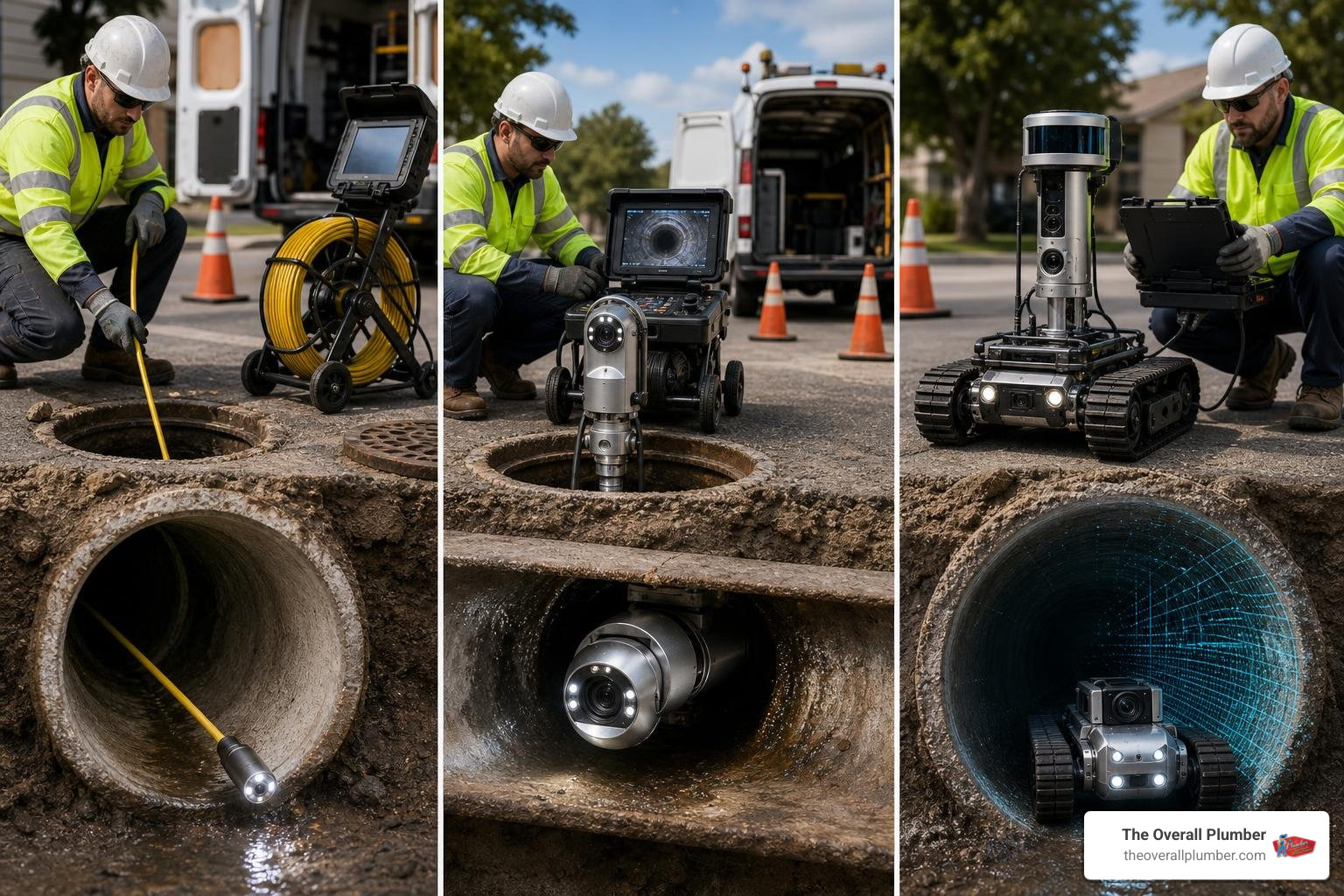
For the vast majority of residential and light commercial plumbing jobs, the standard push camera is our absolute workhorse. As the name suggests, these systems rely on a technician manually feeding a stiff, fiberglass push rod down the line.
At the end of this rod is a ruggedized, waterproof camera head surrounded by high-intensity LED lights. Because the fiberglass core is rigid yet flexible, it allows us to push the camera through multiple bends while keeping enough structural strength to avoid buckling inside the pipe.
These cameras are perfect for inspecting lateral lines that run from a home to the municipal main or septic tank. If you want to know exactly what to expect when a plumber brings one of these to your home, check out our homeowner’s guide to sewer camera inspections to demystify the process.
For smaller residential drains, compact push systems like the ROCAM MINI HD are excellent. This system uses a highly flexible 6.3 mm sliding cable and a 20 mm camera head, allowing it to navigate tight spaces and easily slide through multiple bends in small tubes.
Pan-Tilt-Zoom (PTZ) Camera for Pipeline Inspection Systems
Standard push cameras look straight ahead, which is great for seeing a blockage directly in front of you. But what happens if we need to inspect the structural integrity of a pipe joint, or find a tiny hairline crack on the top wall of a 12-inch sewer main? That is where Pan-Tilt-Zoom (PTZ) cameras shine.
A PTZ camera for pipeline inspection features a motorized head that can rotate 360 degrees horizontally and tilt 180 degrees vertically. With a PTZ system, we do not have to guess what is happening at a pipe junction; we can literally turn the camera’s “head” to look directly into lateral connections.
High-end systems like the PCE-PIC 120 feature a motorized focus and a massive 120-meter push cable, allowing us to inspect large-diameter pipes ranging from 80 mm up to 1200 mm. Similarly, industrial-grade crawler systems like the ORPHEUS 2.0 are deployed in larger municipal sewer mains, utilizing motorized wheels to travel deep into infrastructure while providing full PTZ control to capture every square inch of the pipe wall.
Autonomous Camera for Pipeline Inspection and Long-Distance Scanning
When pipelines span miles instead of feet—such as long-distance oil, gas, or municipal water transmissions—tethered push cameras and traditional wheeled crawlers simply cannot reach far enough. The physical drag of a cable eventually makes it impossible to push or pull the camera any further.
To solve this, the industry developed autonomous pipe cameras. These tetherless systems are designed to travel completely free of cords, often propelled by the natural flow of the fluid inside the pipe or by advanced internal motors.
A prime example of this cutting-edge technology is the SPC-15 Autonomous Camera. This remarkable device can travel up to 60 kilometers (over 37 miles!) on a single battery charge and withstand incredible submerged operating pressures of up to 500 PSI.
Rather than just capturing standard video, these autonomous systems use shape-shifting positioning to navigate past partial blockages and integrate with 3D scanning software. This software can unwrap the pipe’s interior into a flat 2D map or construct a 3D model, measuring structural anomalies down to a microscopic 0.01 mm.
Key Technical Specifications to Consider
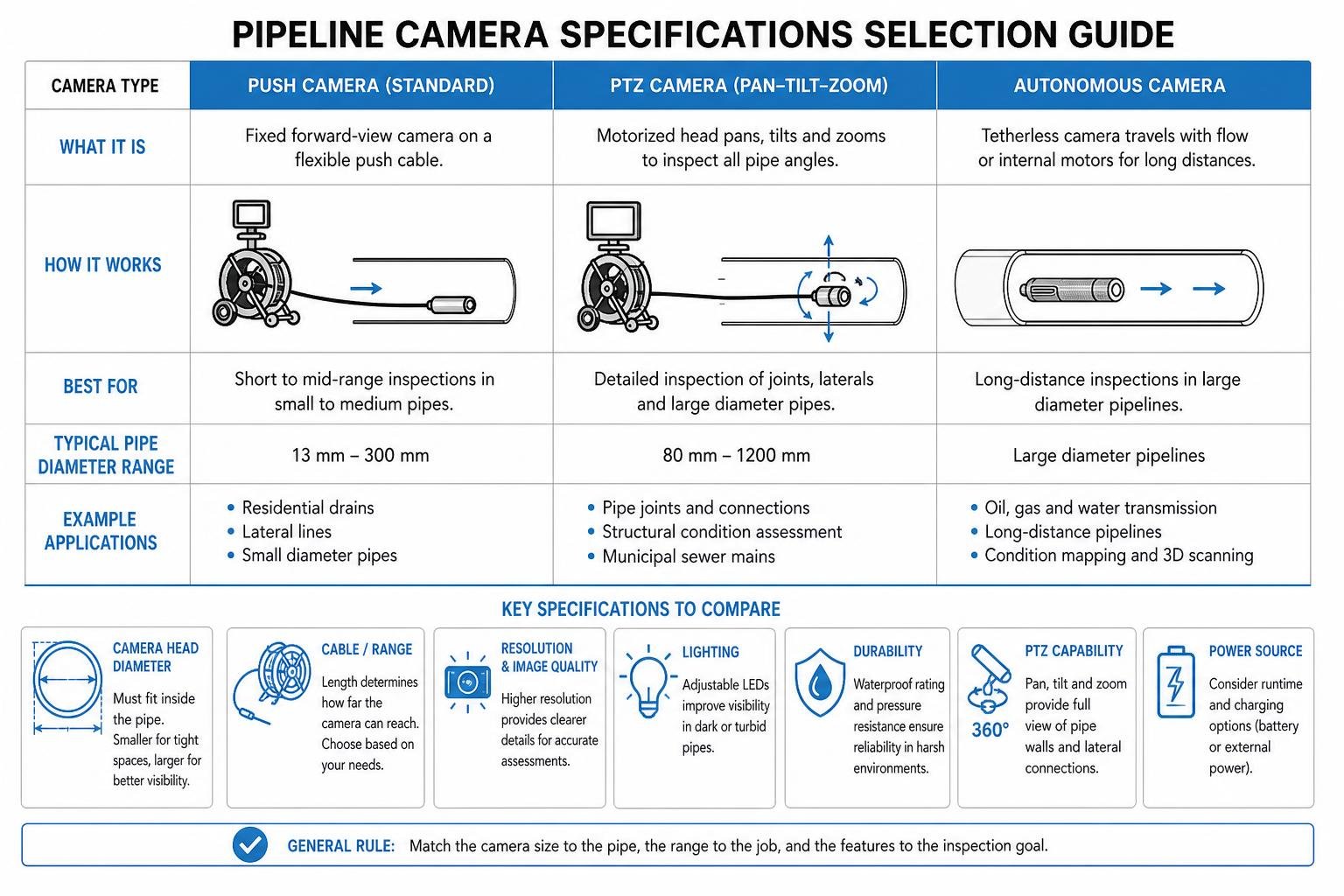
If you are looking to purchase a camera for pipeline inspection or simply want to understand the technology your plumbing technician is using, you need to know how to read the spec sheet. Choosing a camera with the wrong specifications can result in a tool that is either too big to fit in your pipes, too short to reach the problem, or too fragile to handle the environment.
A great example of a professional-grade, versatile system is the ROCAM 4 Plus, which balances a 40 mm self-leveling camera head with cable length options up to 65 meters, making it highly adaptable for pipes between 40 mm and 300 mm in diameter.
Camera Head Diameter and Pipe Size Compatibility
The first rule of pipeline inspection: the camera must actually fit inside the pipe.
- Micro/Slim Cameras (13 mm to 20 mm): These ultra-compact heads are designed for industrial heat exchangers, boilers, pool lines, and narrow residential drains. For instance, some specialized slim cameras can inspect lines as small as 13 mm (0.5 inches).
- Mid-Sized Cameras (23 mm to 40 mm): This is the sweet spot for residential mainlines and lateral sewer drains (typically 2-inch to 6-inch pipes). A 23 mm head easily navigates standard household drains without getting wedged.
- Large Mainline Cameras (50 mm and up): These are meant for municipal storm drains and large industrial pipes.
To help navigate larger pipes without the camera head flopping around on the bottom of the line, we use guide balls, skids, or roller sleeves. These attachments keep the camera centered, ensuring we get a clear, balanced view of the entire pipe diameter rather than just a close-up of the dirty bottom. If you are exploring smaller DIY options for tight spots around the house, check out our guide to waterproof borescope cameras.
Push Rod Cable Length and Flexibility
Cable length is a balancing act. If your cable is too short, you will not reach the municipal main connection. If it is too long and lacks the proper stiffness, it will bunch up and buckle inside the pipe before reaching its destination.
Standard residential push cables range from 100 to 200 feet, which is usually plenty to cover the distance from a home’s cleanout to the street. Industrial systems can extend much further. For example, the Wöhler VIS 700 HD offers a highly capable 100-foot push rod paired with a pan-and-tilt camera head, providing the perfect blend of length and maneuverability for residential and light commercial work.
When navigating multiple bends, cable flexibility is key. Professional cables utilize a specialized fiberglass core wrapped in a slick, durable PP sheath. This construction allows the cable to bend around sharp corners—like navigating up to six 90-degree bends in a 50 mm pipe—while remaining rigid enough to be pushed long distances.
Resolution, Recording, and Smart Connectivity
In the early days of sewer cameras, plumbers had to squint at blurry, black-and-white CRT monitors to guess whether they were looking at a tree root or a pile of grease. Thankfully, those days are long gone.
Modern professional cameras capture footage in crisp 1080p HD or even 4K resolutions. High-definition imaging allows us to spot hairline cracks, joint offsets, and minor scale build-up before they turn into catastrophic pipe collapses.
Furthermore, smart connectivity has revolutionized how we share this data. Modern systems feature built-in Wi-Fi transmitters that stream the live feed directly to a smartphone or tablet. This means we can stand in a dry driveway in Pearland and show a homeowner exactly what is clogging their sewer line in real-time.
If you are curious about what consumer-grade tools can do versus professional equipment, take a look at our review of the best camera to look in pipes without calling a plumber.
Advanced Features That Improve Diagnostic Accuracy
When you are deep inside an underground plumbing line, the environment is dark, wet, and highly disorienting. Advanced features on a camera for pipeline inspection are not just fancy add-ons—they are essential tools that keep the operator oriented and ensure we can pinpoint the exact location of a pipe defect above ground.
Self-Leveling Heads and PTZ Functionality
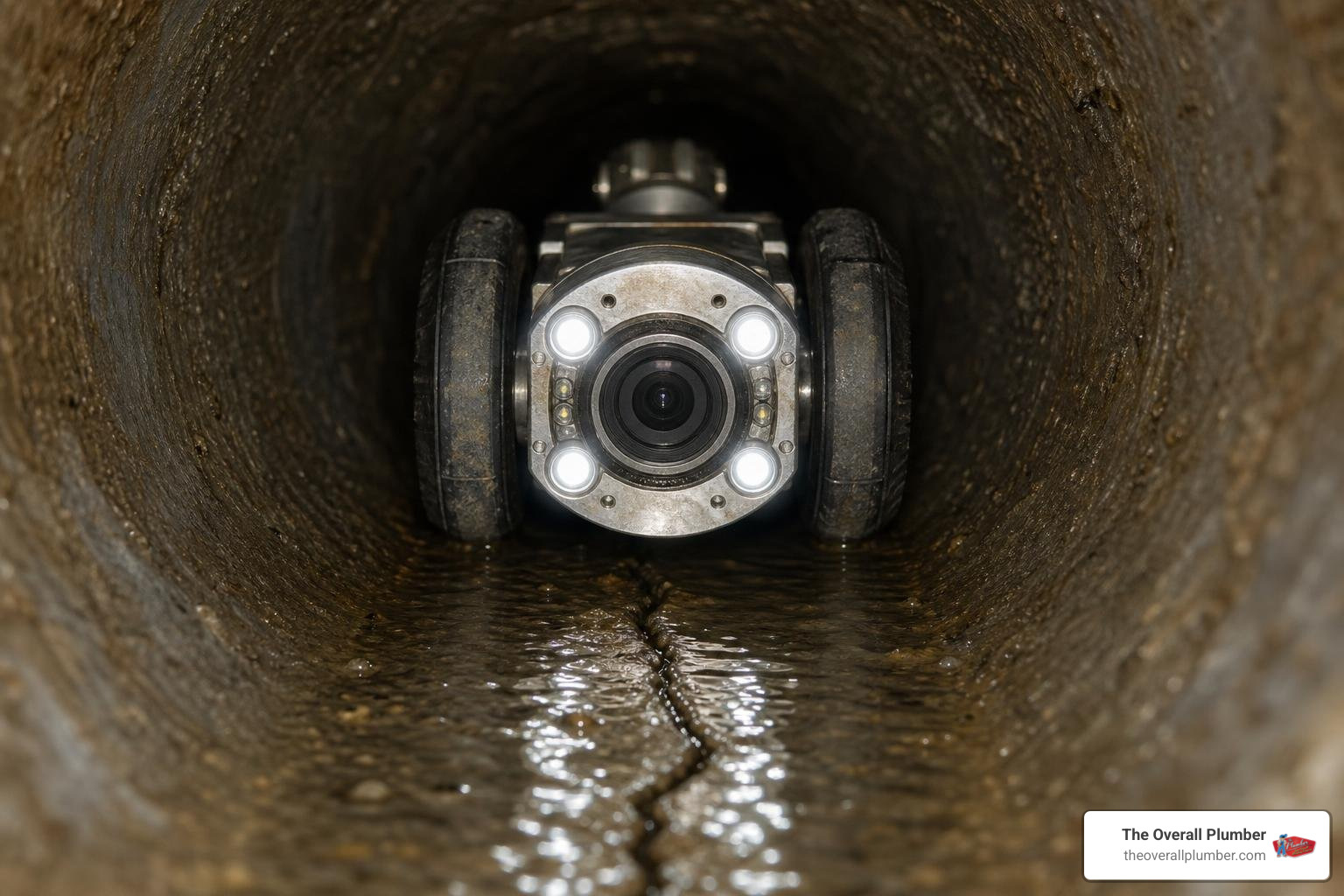
Have you ever watched raw sewer camera footage and felt a bit seasick? That happens when a standard camera head twists and turns through the pipe, leaving the video feed upside down or sideways.
- Self-Leveling Heads: These use internal mechanical counterweights or digital sensors to automatically rotate the camera lens, keeping the bottom of the pipe at the bottom of your viewing screen. This ensures the operator always knows which way is up, making it much easier to identify if a crack is on the floor or the ceiling of the pipe.
- PTZ (Pan-Tilt-Zoom) Functionality: Instead of just pushing past a lateral connection, PTZ allows us to stop, rotate the camera head, and look directly into the branch line. This is incredibly useful for verifying if a blockage is originating from a specific fixture or if a joint has begun to separate.
512Hz Sondes and Underground Locators
It is one thing to see a collapsed pipe on a monitor; it is another thing entirely to know where that collapse is located in your yard. Without locating technology, we would have to guess where to dig, potentially ruining a beautiful Texas City lawn.
This is where a 512Hz sonde comes in. A sonde is a small transmitter built directly into the camera head. As the camera travels through the pipe, the sonde constantly emits a low-frequency 512Hz electromagnetic signal.
Above ground, the technician sweeps the yard with a handheld locator receiver wand. By tracking the strength of the 512Hz signal, we can pinpoint the camera head’s exact location and even determine its depth down to the inch.
This non-destructive locating process allows us to mark the exact spot where repairs are needed. To learn more about how this technology works above ground, read our guides on finding buried lines with a pipe detector and how to locate sewer lines.
Pressurized vs. Standard Inspection Cameras
Standard sewer cameras are designed for gravity-fed, zero-pressure drain lines. But what happens when we need to inspect a live municipal water main or an industrial gas line? Shutting down water service to an entire League City neighborhood just to run a camera is highly disruptive and expensive.
Pressurized pipeline inspection cameras are engineered to be inserted directly into live, pressurized systems through standard fittings like fire hydrants, air valves, or gate valves.
- High PSI Ratings: These specialized systems can withstand incredible operating pressures. For example, the JD7 Investigator can be inserted into pipelines under normal operating pressures of up to 232 PSI.
- Multi-Sensor Heads: In addition to high-definition video, pressurized cameras often feature acoustic hydrophone sensors. This allows the technician to visually inspect the pipe while simultaneously listening for the distinct acoustic signature of a pressurized leak, tracking down tiny pinhole leaks in a single pass.
Comparing Entry-Level, Professional, and Industrial Systems
To help you understand where different pipeline inspection cameras fit into the market, we have broken them down into three distinct tiers.
| Feature / Tier | Entry-Level (DIY Borescopes) | Professional (Push Cameras) | Industrial (Crawlers & Autonomous) |
|---|---|---|---|
| Typical Cost | $50 – $300 | $1,500 – $12,000 | $15,000 – $100,000+ |
| Cable Length | 15 – 50 feet | 100 – 200 feet | 400 feet to 60 kilometers |
| Waterproof Rating | IP67 (Temporary immersion) | IP68 (Continuous submersion) | IP68 / Pressurized (up to 500 PSI) |
| Locating Sonde | No | Yes (512Hz / 33kHz) | Yes (Multi-frequency & GPS) |
| Best Used For | Clogged toilets, wall cavities | Residential sewers, commercial drains | Municipal water mains, gas pipelines |
While a cheap Amazon borescope is fun for finding a wedding ring flushed down a bathroom sink, it simply lacks the structural strength, lighting, and locating capabilities required to diagnose a buried mainline sewer issue. Professional-grade equipment is what allows us to deliver fast, accurate diagnostics without tearing up your property.
Best Practices for Maintenance and Field Use
A professional camera for pipeline inspection is a precision electronic instrument that operates in some of the most hostile environments imaginable—surrounded by abrasive grit, corrosive chemicals, and raw sewage. Proper maintenance is the only way to ensure these high-end tools remain accurate and reliable.
- Rigorous Cleaning Protocols: After every single run, the push cable and camera head must be thoroughly washed down. Debris and grit left on the cable can act like sandpaper when wound back onto the reel, scraping the protective outer sheath.
- Lens Protection: Cast iron pipes are incredibly abrasive and can easily scratch a camera’s glass lens. Utilizing replaceable plastic domes (disposable lens covers) protects the optical glass from scratching, extending the life of the camera head.
- Careful Cable Storage: When pulling a camera out of a line, it should be fed back onto the reel smoothly without forcing or twisting it. Kinking a fiberglass push rod can damage the internal copper wiring, leading to a loss of video feed.
- Battery and Environmental Care: High-capacity Li-ion batteries should be stored in temperature-controlled environments. Operating or storing equipment in extreme Texas summer heat can degrade battery life and damage sensitive touchscreen monitors.
Frequently Asked Questions About Pipeline Cameras
What is the difference between IP67 and IP68 waterproof ratings?
An IP (Ingress Protection) rating tells you how well a device can resist dust and water.
- IP67: Devices with this rating can withstand temporary immersion in water (typically up to 1 meter depth for 30 minutes). This is fine for a quick look down a dry wall cavity or a shallow drain, but not safe for active, submerged sewer lines.
- IP68: This rating indicates the equipment is designed for continuous submersion in deeper water under pressure. Professional sewer camera heads must be IP68-rated—often rated up to 10 meters of depth or higher—to handle the constant submersion of active plumbing lines.
How does a 512Hz sonde transmitter help locate pipe defects?
The sonde built into the camera head emits a continuous 512Hz electromagnetic signal. Because this low frequency can easily penetrate soil, concrete, and cast iron pipes, a technician above ground can use a locator receiver wand to trace the signal. By sweeping the wand over the ground, the receiver guides the technician directly to the camera head, showing its exact path, location, and depth.
Can pipeline inspection cameras navigate tight 90-degree bends?
Yes, but it depends entirely on the camera’s design and the pipe’s diameter. Compact systems like the ROCAM MINI HD are specifically engineered with optimized cable stiffness and shorter, spring-loaded camera heads to navigate up to six 90-degree bends in 50 mm (2-inch) lines. However, larger mainline cameras with 40 mm heads will struggle or get stuck in small pipes with tight bends, which is why matching the camera head size to the pipe diameter is so critical.
Schedule Your Professional Sewer Camera Inspection Today
At The Overall Plumber, we believe in taking the guesswork out of plumbing repairs. Whether you are dealing with slow drains in Texas City, suspect a sewer line break under your concrete slab in Houston, or want to inspect a home’s plumbing before buying a property in Galveston, we are here to help.
We utilize state-of-the-art camera for pipeline inspection technology to see exactly what is happening inside your lines, allowing us to pinpoint issues with absolute precision. Our professional services cover everything from high-definition diagnostics to trenchless repairs, ensuring your home’s plumbing is restored with minimal disruption.
Explore our specialized services and guides to learn more about how we can help protect your home:
- Get a detailed look at our video camera sewer line inspection process.
- Stop guessing and schedule a professional camera line inspection in Texas City.
- Learn about the unique plumbing challenges facing sewer lines in Houston.
- Discover how we locate problems without destroying your yard in our guide to finding your sewer line without making a mess.
- Save your lawn and driveway with modern trenchless sewer line replacement.
- Get fast, local help with local leak detection and repairs.
- Suspect a hidden leak? Learn how to spot a water leak under concrete slab.
- Find out what to look for when searching how to find a plumber to find water leak.
We proudly serve homeowners across Brazoria County, Houston, Clear Lake, Santa Fe, League City, Texas City, La Porte, Friendswood, Pearland, Pasadena, Galveston, Harris County, and Galveston County. With our satisfaction guarantees, priority scheduling, and absolutely no overtime fees or trip charges, you can rest easy knowing your home is in expert hands.
Ready to see exactly what is happening inside your pipes? Call The Overall Plumber today at (281) 668-8055 to schedule your professional sewer camera inspection.