


Finding Buried Lines with a Pipe Detector for Concrete Floor
Why a Pipe Detector for Concrete Floor Can Save You From a Costly Mistake
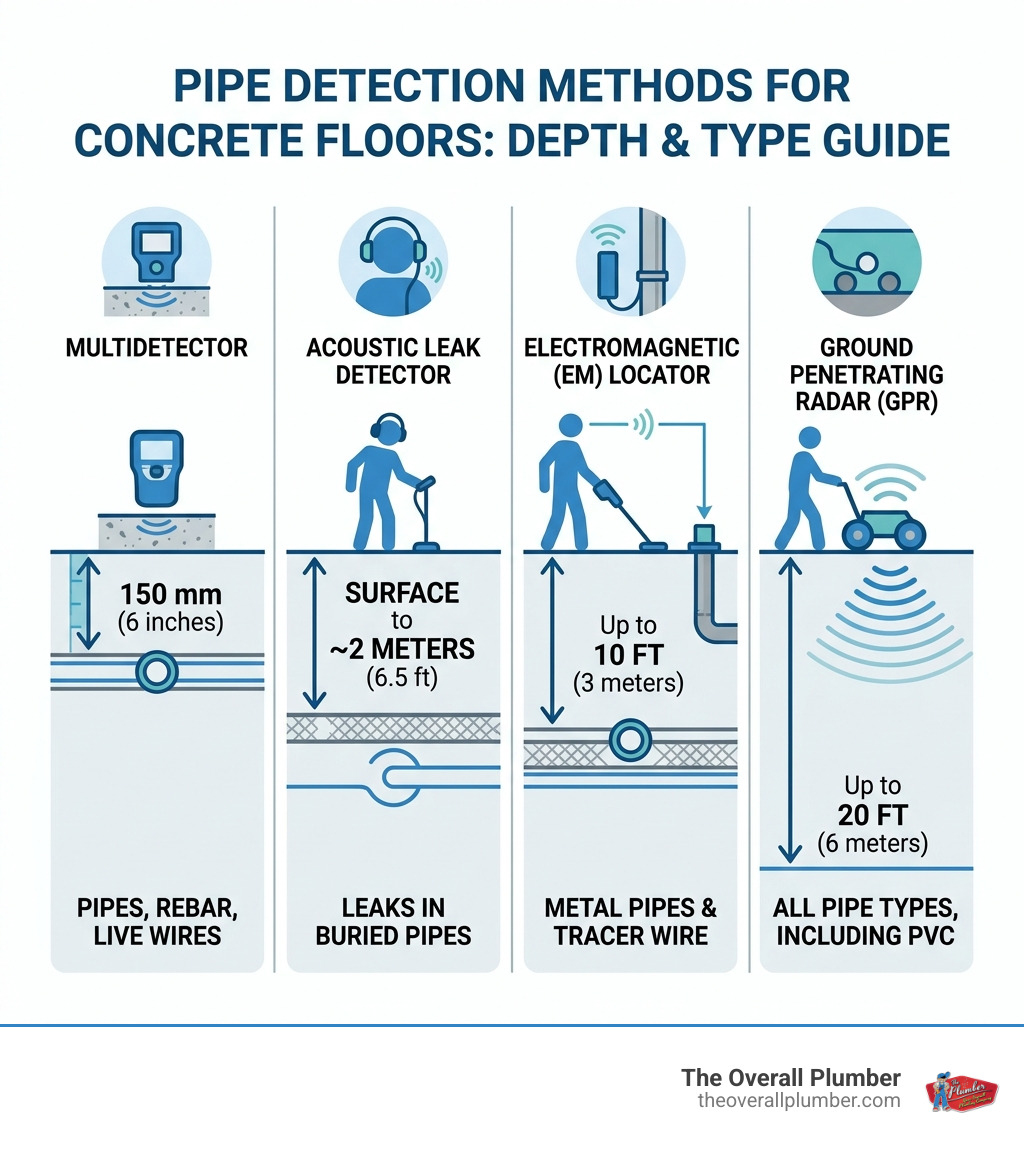
A pipe detector for concrete floor is the safest way to find buried water lines, drain pipes, and conduits before you cut, drill, or excavate a slab. Here’s a quick overview of your best options:
| Method | Best For | Depth Range | DIY Friendly? |
|---|---|---|---|
| Ground Penetrating Radar (GPR) | All pipe types, including PVC | Up to 20 ft | No |
| Electromagnetic (EM) Locator | Metal pipes and tracer wire | Up to 10 ft | Yes (rental) |
| Acoustic Leak Detector | Finding leaks in buried pipes | Surface to ~2 m | Sometimes |
| Multidetector (e.g., Hilti PS 50) | Pipes, rebar, live wires in slabs | Up to 150 mm | Yes |
| CCTV Sewer Camera | Inspecting inside drain lines | N/A (in-pipe) | Sometimes |
Concrete floors hide a lot. Water lines, drain pipes, and electrical conduits all run beneath slabs — and most homeowners have no idea exactly where. Standard metal detectors won’t cut it when rebar is present. The steel reinforcement masks the signal from copper and other pipes, making accurate detection nearly impossible without the right tool.
This matters most when you’re planning something like a sump pump installation, a bathroom addition, or any work that requires breaking up the floor. One wrong cut can mean a flooded basement and a repair bill that runs into thousands of dollars.
I’m Dayton Whitworth, a second-generation plumber serving Greater Houston and the Gulf Coast, and I’ve seen what happens when homeowners dig blind into a concrete slab without first using a proper pipe detector for concrete floor — it’s a situation we’re called in to fix more often than you’d think. In this guide, I’ll walk you through exactly how to locate buried lines safely, what tools work best, and when it makes sense to call in a professional.
Challenges of Using a Pipe Detector for Concrete Floor
Locating a pipe inside a solid block of stone and steel isn’t as straightforward as it sounds. When we talk about finding rebar, pipes and live wires in concrete and masonry, we are dealing with several physical hurdles that can trip up even experienced DIYers.
The Rebar Shield
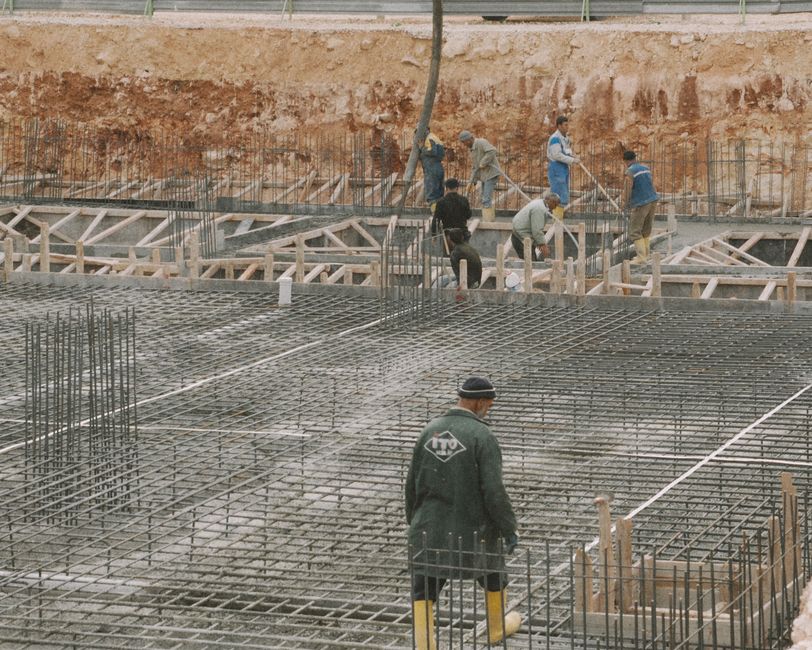
The biggest headache in Texas homes—from League City to Pasadena—is rebar. Most concrete slabs are reinforced with a mesh of steel bars. Because rebar is conductive and present in high volumes, it acts like a shield. If you use a basic consumer-grade metal detector, the machine will scream “Metal!” across the entire floor. This “masking” effect makes it nearly impossible to distinguish a 3/4-inch copper water line from the surrounding steel mesh.
Signal Masking and Distortion
Beyond just the presence of metal, the “dielectric properties” of the concrete itself matter. This is a fancy way of saying how well the material holds an electric charge. If the concrete is “green” (freshly poured) or has high moisture levels—common in our humid Gulf Coast climate—the signal from a pipe detector for concrete floor can become distorted or weakened.
Material Limitations
Different materials respond differently to detection:
- Copper Pipes: These are non-ferrous but highly conductive. In a rebar-heavy slab, they are the hardest to find with magnetic tools.
- Cast Iron: These are easier to find due to their magnetic properties but are often buried deeper (up to 10 feet), requiring more powerful industrial locators.
- PVC and PEX: These are non-metallic and essentially invisible to standard electromagnetic locators unless they have a tracer wire attached.
Essential Tools for Locating Pipes in Concrete
To get the job done right, we use a variety of specialized technologies. No single tool is perfect for every scenario, which is why a “toolbox” approach is best.
Technology Comparison Table
| Technology | How it Works | Pros | Cons |
|---|---|---|---|
| GPR | Radio wave pulses | Finds metal & plastic; non-invasive | Expensive; requires expert training |
| EM Locators | Electromagnetic fields | Great for metallic lines & tracer wires | Blocked by non-metallic materials |
| Acoustic | Sound vibration | Pinpoints high-pressure leaks | Requires a leak to be present |
| CCTV | Visual camera | Shows internal pipe condition | Can’t “see” through the pipe wall |
Ground Penetrating Radar (GPR)
GPR is the gold standard for concrete scanning. It sends high-frequency radio waves into the slab and listens for the reflection. When those waves hit an object—whether it’s a copper pipe, a PVC drain, or a void in the soil—they bounce back differently. This allows for a 2D or 3D map of what’s underneath without ever breaking the surface.
Electromagnetic (EM) Locators
These tools, like the PCE-CL 20, use a transmitter and a receiver. We often hook the transmitter to a known point (like a shut-off valve) to “energize” the pipe with a specific frequency, such as 33 kHz. The receiver then tracks that specific signal through the concrete. For non-metallic pipes, we can “fish” a small transmitter called a sonde into the line using a CCTV pipe inspection camera to track its path from above.
Acoustic and Ultrasonic Sensors
If you suspect a leak but can’t find the pipe, acoustic leak detectors are lifesavers. They use high-sensitivity microphones and headphones to listen for the “hiss” of water escaping a pipe under pressure. This is particularly useful in areas like League City Texas where slab leaks are a common regional issue.
How to Use a Pipe Detector for Concrete Floor Effectively
Using a pipe detector for concrete floor effectively requires a systematic approach. You can’t just wave it around like a magic wand; you need a plan.
Step 1: Entry Point Tracing
Before turning on the machine, use your eyes. Look for where utilities enter the foundation. Trace the path from the water meter or the main sewer cleanout toward the house. Pipes generally run in straight lines or 45/90-degree angles. Predicting the “likely path” helps you narrow down your scan area.
Step 2: Calibration and Grid Scanning
Whether you are using a PS 50 Multidetector or a professional GPR unit, you must calibrate the device for the specific type of concrete you are scanning (e.g., “wet concrete” vs. “dry concrete” modes).
- The Grid Method: Move the detector in a grid pattern—first north-to-south, then east-to-west.
- Marking: Use a wax pencil or painter’s tape to mark every “hit.”
Step 3: Interpreting the Data
Professional GPR pipe locating in concrete displays results as “hyperbolas” (upside-down U shapes). The peak of the U is the center of your pipe. By comparing the depth of these hits, you can tell the difference between shallow rebar (usually at a consistent depth) and a sloping drain pipe.
If you’re in League City, you might find that the soil shifting has caused pipes to settle deeper than originally installed, so always account for a few inches of “buffer” depth.
DIY vs. Professional Pipe Detection Services
Is this a project you can handle yourself, or is it time to call in the pros?
The DIY Route
You can rent a “Hot Spot” pipe locator or a Hilti multidetector from places like United Rentals or Home Depot. These are great for finding shallow utilities or confirming a pipe’s location before a small DIY project.
- Cost: Rental fees usually range from $75 to $200 per day.
- Risk: High. If you misinterpret a signal and hit a post-tension cable or a main water line, the repair cost will dwarf the savings.
The Professional Advantage
Professional services, such as those we provide at The Overall Plumber, offer a 99.8% accuracy rate. We use NASSCO-certified technicians and industrial-grade GPR equipment that provides a much clearer picture than consumer tools.
- Accuracy: We can distinguish between a live electrical conduit and a cold water line.
- Certification: For commercial projects in Pasadena, having a professional scan is often a safety requirement to maintain structural integrity.
- Comprehensive Mapping: We don’t just find the pipe; we provide a map of the entire subsurface environment, including rebar spacing and concrete thickness.
For homeowners in Pasadena Texas, the peace of mind that comes with a professional scan is usually worth the investment, especially before major renovations.
Safety Precautions During Slab Excavation
Once you’ve used your pipe detector for concrete floor and marked your lines, the real work begins. Excavating a slab is high-stakes business.
- Shut Off the Main Water: Before the first jackhammer hit, locate and test your main water shut-off valve. If you do hit a line, you need to be able to stop the flow instantly. At 70 PSI, a punctured copper line can flood a room in minutes.
- Mark “No-Drill” Zones: Use red spray paint to mark areas where pipes are detected. Give yourself a 6-inch “safety buffer” on either side of the marks.
- Sump Pump Precautions: When excavating for a sump pump in areas like Sugar Land, main supply lines often enter near the perimeter. Always dig slowly and switch to hand tools (like a small shovel or trowel) once you get through the concrete layer.
- PPE Requirements: Concrete dust contains silica. Always wear a respirator, eye protection, and heavy-duty gloves.
- Trenchless Options: If you find a leak in Pearland, ask us about trenchless repair. Sometimes we can fix a pipe from the inside without having to break the concrete at all!
For residents in Sugar Land Texas or Pearland Texas, following these steps ensures that a simple home improvement project doesn’t turn into a structural nightmare.
Frequently Asked Questions about Pipe Detectors
Can a pipe detector for concrete floor find PVC pipes?
Yes, but it depends on the technology. Standard metal detectors cannot find PVC. However, Ground Penetrating Radar (GPR) is excellent at finding non-metallic objects because it looks for changes in material density. Another trick we use is running a “tracer wire” or a detectable “snake” through the PVC pipe, which can then be picked up by an electromagnetic locator.
How deep can a pipe locator detect copper lines?
Most professional-grade locators can find copper pipes up to 7 or 10 feet deep. However, accuracy decreases as depth increases. In the dense, clay-heavy soils of the Texas Gulf Coast, signal strength can be dampened by soil saturation. If the pipe is deeper than 10 feet, we typically rely on GPR or high-powered industrial locators.
Does rebar affect the accuracy of a pipe detector?
Absolutely. Rebar causes magnetic interference and signal dispersion. To combat this, modern tools like the PS 50 Multidetector use “Pulse Power” technology, sending out up to 1 million impulses per second to “see through” the rebar mesh and classify the materials underneath.
Conclusion
Finding buried lines doesn’t have to be a guessing game. By using a pipe detector for concrete floor, you protect your home’s structural integrity and your wallet from accidental utility strikes. Whether you choose to rent a tool for a small weekend project or hire a professional team for a major renovation, the key is to never dig blind.
At The Overall Plumber, we take the guesswork out of the equation. We serve Brazoria, Harris, and Galveston Counties with expert local leak detection and repairs. We offer a 100% satisfaction guarantee, priority scheduling for our neighbors, and we never charge overtime fees.
If you’re planning to cut into your concrete floor and want to be absolutely sure what’s underneath, give us a call. We’ll help you map it out safely so you can build with confidence.