


The Best Camera to Look in Pipes Without Calling a Plumber
The Best Camera to Look in Pipes (Top Picks at a Glance)
A camera to look in pipes is the fastest way to find out what’s causing a clog, crack, or backup — without tearing up your walls or yard.
Here are the top options covered in this guide:
| Camera | Best For | Cable Length | Price Range |
|---|---|---|---|
| DEPSTECH Dual Lens | Best overall / most reviews | Short reach | Budget–Mid |
| Sanyipace 100FT | Best rated for DIY | 100 ft | Budget |
| Anysun Self-Leveling | Best with locator | Up to 300 ft | Mid-range |
| VEVOR Industrial | Best for pros | Long reach | Mid–Pro |
| Professional-grade systems | Contractors / full sewer lines | 150–400 ft | $1,500+ |
So you’ve got a slow drain, a mystery backup, or a soggy patch in the yard. You know something is wrong inside those pipes — you just can’t see it. That’s exactly the problem a pipe inspection camera solves.
These tools push a small waterproof camera on a flexible cable into your drain or sewer line. You watch a live video feed on a screen. You see the clog, the crack, the tree root — right there. No guessing. No digging. No surprise bills for problems you didn’t know existed.
The market has exploded. There are now over 788 pipe camera listings on Amazon alone, ranging from $35 to nearly $900 for consumer models — and up to $15,000+ for professional-grade systems. That’s a lot to sort through.
This guide cuts through the noise. It covers how these cameras work, what features actually matter, and which models are worth your money — whether you’re a homeowner dealing with recurring clogs or a DIYer who wants to skip the service call.
I’m Dayton Whitworth, a second-generation plumber serving Greater Houston and the Gulf Coast, and I’ve used cameras to look in pipes on hundreds of residential inspections — from simple kitchen drain blockages to full sewer line diagnoses. I’ll help you find the right tool for the job before you spend a dime in the wrong direction.
Understanding the Technology: How a Camera to Look in Pipes Works
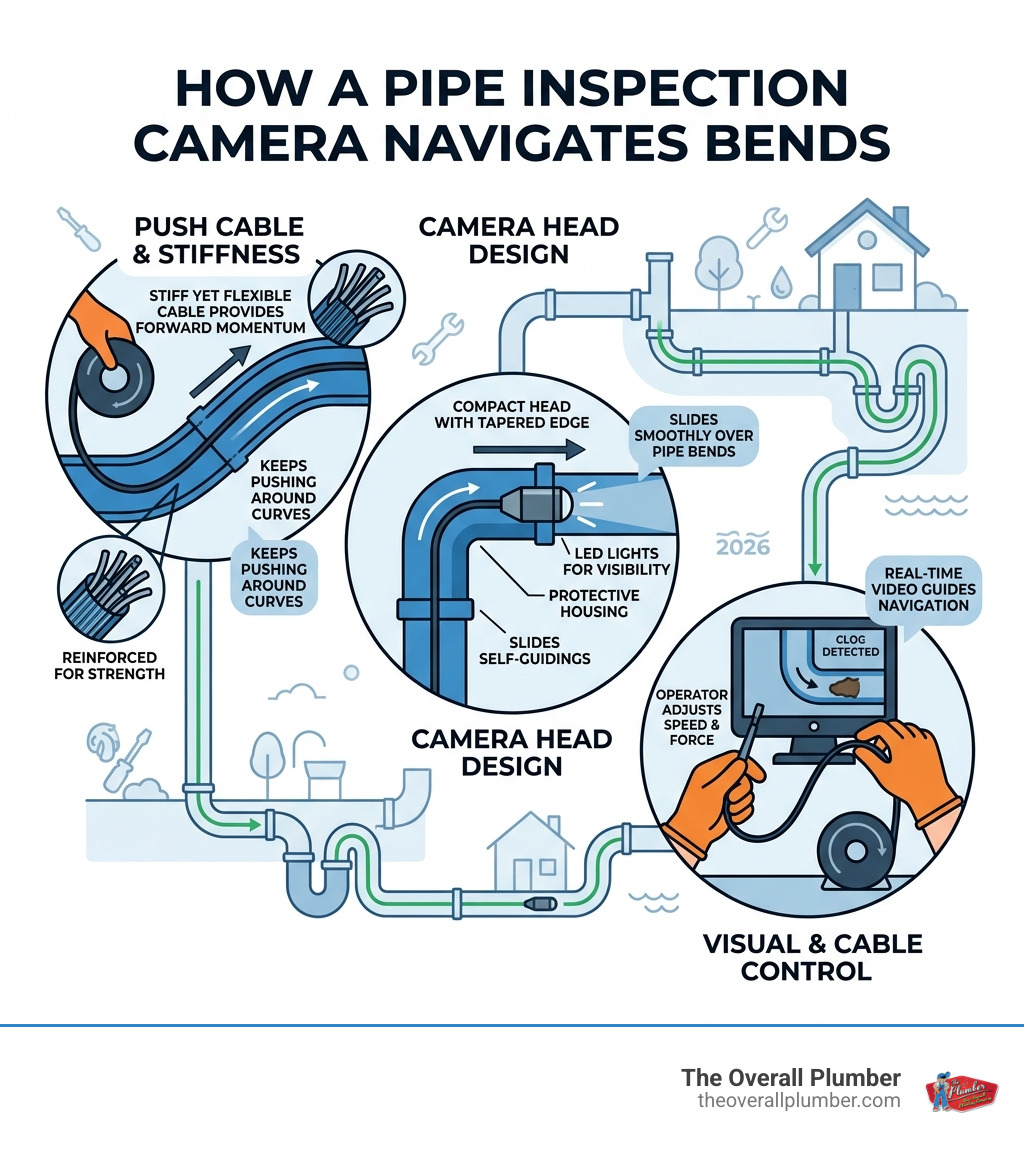
At its simplest, a camera to look in pipes is a high-tech version of a doctor’s endoscope, but built for the rough-and-tumble world of Houston’s plumbing. These devices consist of a camera head, a flexible cable, and a monitor.
The camera head is usually made of stainless steel to resist corrosion and is protected by a sapphire lens mirror to prevent scratches from sand and debris. Surrounding the lens are adjustable LED lights. These are crucial because, as you can imagine, it’s pitch black inside a sewer line under a house in League City.
The magic happens in the cable. For professional Video Camera Sewer Line Inspection services, we use a fiberglass “push-rod.” This material is stiff enough to be pushed hundreds of feet into a pipe but flexible enough to negotiate the 45-degree and 90-degree bends common in residential drains.
Once the camera is inside, the signal travels back through the cable to a monitor. Most modern systems, like the Draining plumbing, Wall, Wire inspection camera system, include DVR (Digital Video Recording) capabilities. This allows you to record the footage onto an SD card or USB drive, which is vital if you need to show the evidence to an insurance company or a repair crew.
Choosing the Right Camera to Look in Pipes Based on Diameter
One size does not fit all in pipe cameras. If you buy a camera that is too large, it won’t fit through the P-trap under your sink. If it’s too small, the image will be “lost” in the cavernous space of a main sewer line.
- Small Drains (1.5″ to 2″): For kitchen sinks and bathroom drains, you want a camera head diameter of about 7mm to 8mm (roughly 0.3 inches). These are often called “borescopes” or “endoscopes.”
- Main Sewer Lines (3″ to 6″): For the Sewer Lines in Houston that run from your house to the city tap, you need a larger, more rugged camera head, typically around 23mm (0.9 inches). These larger heads often come with “skids” — plastic cages that center the camera in the pipe so you aren’t just looking at the bottom of the sludge.
The Difference Between Push-Rods and Semi-Rigid Cables
When you’re shopping for a camera to look in pipes, you’ll see two main cable types: semi-rigid and fiberglass push-rods.
- Semi-Rigid Cables: These are usually found on cheaper, handheld units. They are like a stiff wire that holds its shape. They are great for looking 10 feet into a wall or a short drain, but they lack the “oomph” to be pushed 50 feet down a sewer line.
- Fiberglass Push-Rods: These are the gold standard. They are wound on a reel and can be pushed long distances. High-end models even include “meter counters” on the screen, telling you exactly how many feet of cable you’ve deployed. If you see a blockage at 42 feet, you know exactly where to mark the ground in your yard.
Key Features to Look for in a Pipe Inspection Camera
If you are going to invest in your own equipment, don’t get distracted by flashy screens. Focus on the specs that determine if the tool will actually survive the job.
- IP68 Waterproof Rating: This is non-negotiable. An IP67 rating means it can handle a splash; IP68 means it can be fully submerged for extended periods. Since many pipes in Pearland or Friendswood are constantly holding water due to shifting foundations, you need full submersion protection.
- Adjustable LED Lights: You want at least 6 to 12 LEDs. Being able to dim them is actually helpful; sometimes, high-intensity light reflects off white PVC pipes and “blinds” the camera.
- Self-Leveling Heads: This is a premium feature found in systems like the SeeSnake® Mini Camera with TruSense®. As the cable twists through the pipe, a self-leveling camera uses a weighted mechanism to keep the image upright. Without it, you might find yourself tilting your head sideways trying to figure out if you’re looking at the top or the bottom of the pipe.
- Battery Life: Look for a lithium-ion battery that offers at least 6 to 8 hours of continuous use. There’s nothing worse than getting 80 feet into a 100-foot run only for the monitor to go black.
Benefits of Using a High-Resolution Camera to Look in Pipes
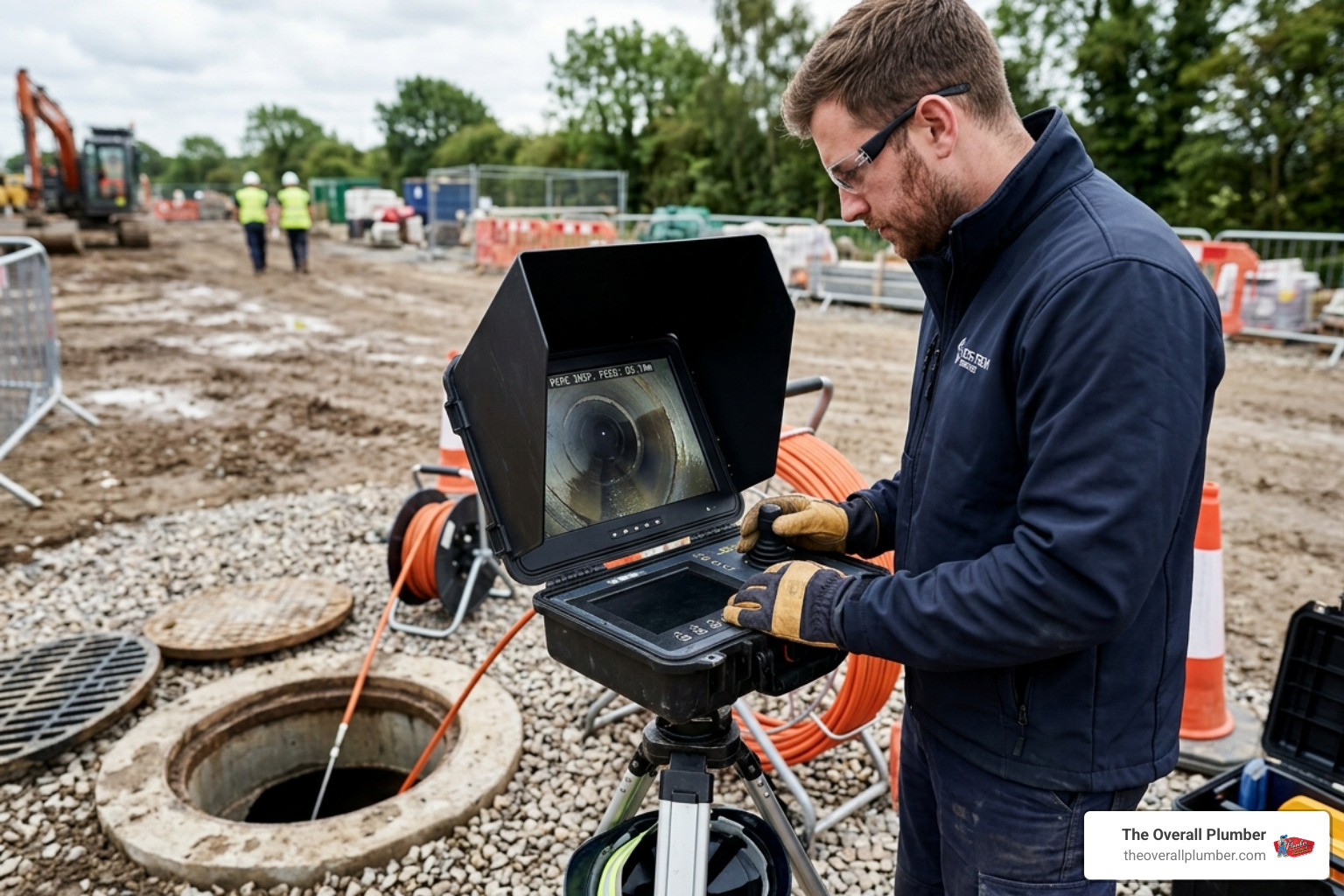
In the past, pipe cameras used “TVL” (Television Lines) for resolution, with 1000TVL being the standard. Today, we recommend looking for 1080P HD resolution.
Why does resolution matter? Because a Broken Pipe Repair is expensive, and you want to be 100% sure of what you’re seeing. High resolution allows you to distinguish between a harmless spider web and a hairline crack that is leaking raw sewage under your slab. It also helps identify “root hair” intrusion — the tiny beginnings of tree roots that will eventually destroy your plumbing if left unchecked.
Why You Need a 512Hz Sonde and Locator
This is the most “pro” feature you can get. A sonde is a tiny radio transmitter located inside the camera head. It emits a 512Hz signal.
When the camera finds a disaster area inside the pipe, you use a handheld “locator” wand above ground. The wand picks up the signal from the sonde through the dirt and concrete. This allows you to pinpoint the exact spot for a Repair Broken Sewer Line Houston.
Without a sonde, you might know you have a break, but you won’t know if it’s under your living room rug or the oak tree in the front yard. Using a locator can save thousands of dollars in unnecessary excavation.
Top-Rated Models: Finding the Best Camera to Look in Pipes for Your Needs
Based on our experience and current market data, here is how the top consumer and prosumer models stack up. If you’re looking for Local Leak Detection and Repairs Houston Plumber services, we often use similar (though more industrial) versions of these.
| Model | Features | Pros | Cons |
|---|---|---|---|
| Anysun Self-Leveling | 512Hz Sonde, 7″ Screen | Very reliable image | More expensive |
| DEPSTECH Triple Lens | 1080P, Side Cameras | Great for tight spots | Short cable reach |
| Sanyipace 100FT | DVR, 16GB SD Card | High value for price | No self-leveling |
| VEVOR Industrial | 300FT Cable, 9″ IPS | Huge reach for sewers | Heavy and bulky |
Best Budget Borescopes for Small Drains
If you’re just trying to see why the shower is draining slowly in your Pasadena home, you don’t need a $1,000 rig. The DEPSTECH Dual or Triple Lens series is a fan favorite. These often feature 1080P resolution and connect directly to your smartphone or come with a small handheld screen.
The “Triple Lens” tech is particularly cool because it has cameras on the side of the probe, allowing you to look at the pipe walls without having to navigate the head around. These are perfect for “wall fishing” or checking for clogs within the first 15–20 feet of a drain.
Professional-Grade Sewer Cameras for Long Distances
For those in Galveston or Texas City dealing with long runs to the street, you need a fiberglass rod system.
- Sanyipace and Anysun dominate the “prosumer” market. For $400–$800, you get a 100-foot to 200-foot reel, a waterproof camera, and a monitor with recording features.
- Industrial Systems: Brands like RIDGID or Insight Vision offer systems like the Opticam. These are the “tanks” of the industry. They feature 10.4-inch screens, always-on sondes, and can inspect pipes up to 12 inches in diameter. These are what we use when the job is high-stakes and the conditions are brutal.
Safety Tips and Common Pitfalls During Pipe Inspection
Using a camera to look in pipes looks easy on YouTube, but things can go south quickly if you aren’t careful. Here’s how to avoid a plumbing nightmare:
- Don’t Force It: If you feel the cable hit a hard stop, don’t just keep pushing. You could kink the fiberglass rod (which is expensive to repair) or, worse, get the camera head wedged in a collapsed section of pipe. If it’s stuck, you’ll be calling us to dig it out.
- Avoid Caustic Chemicals: If you just poured a gallon of “liquid fire” drain cleaner down the pipe, do not send your camera in. Those chemicals can eat through the seals of even an IP68 camera and destroy the electronics. Flush the line with plenty of water first.
- Clean as You Go: When you pull the cable out of a sewer line, it will be covered in… well, you know. Use a rag and a disinfectant solution to wipe the cable down as it comes out of the pipe and back onto the reel. This keeps your equipment (and your garage) from smelling like a Houston swamp.
- Watch for “The Loop”: In larger pipes, if you push too much cable too fast, the cable can actually loop back on itself inside the pipe. If this happens, you might get the camera stuck in a knot. Always push slowly and watch the screen for signs of the cable doubling back.
- Storage Matters: Never store your camera in direct Texas sunlight or high humidity for long periods. Condensation can build up inside the monitor screen, making it unreadable.
Frequently Asked Questions about Pipe Cameras
How deep can a pipe camera go?
Most consumer models have cables ranging from 50 to 100 feet. Professional reels can go up to 400 feet. In terms of vertical depth, a 512Hz sonde can typically be detected through up to 15 feet of soil or 10 feet of concrete.
Can I use a pipe camera to find a leak?
Yes and no. A camera is great for finding structural leaks — like a crack, a separated joint, or a hole eaten away by corrosion. However, it won’t necessarily find a “pinhole” leak in a pressurized water line. For that, we usually use acoustic leak detection or pressure testing.
Do I need a self-leveling camera head?
If you are doing a quick check of a 10-foot pipe, no. But if you are navigating a 100-foot sewer line with multiple turns, a self-leveling head is a lifesaver. Without it, you’ll lose your sense of orientation, making it hard to tell if a crack is on the “top” of the pipe (where it might only leak during heavy rain) or the “bottom” (where it leaks constantly).
Conclusion
Owning a camera to look in pipes can be a game-changer for homeowners in Harris and Galveston Counties. It turns a “mystery problem” into a “known problem,” allowing you to make smarter decisions about your home’s maintenance. Whether you choose a budget-friendly DEPSTECH for your bathroom sinks or a rugged VEVOR for your main line, you’re taking a big step toward plumbing independence.
However, sometimes the view on the screen is more than a DIY project can handle. If your camera reveals a major collapse, a heavy root intrusion, or a pipe that has “bellied” under your foundation, you need professional help.
At The Overall Plumber, we’ve seen it all. From the sandy soils of Galveston to the shifting clays of Santa Fe and La Porte, we know exactly what Texas pipes have to deal with. We offer expert camera inspections with high-end industrial equipment that leaves no room for doubt. Plus, with our satisfaction guarantee, priority scheduling, and no overtime fees, we make the repair process as painless as possible.
If you’ve seen enough on your DIY camera and you’re ready for a permanent solution, we’re here to help. We serve Brazoria County, Houston, Clear Lake, League City, Friendswood, Pearland, and beyond.
Schedule a Professional Video Camera Sewer Line Inspection with us today and let’s get your plumbing back on track!