

A Kitchen Main Drain Clogged Can Signal a Deeper Problem
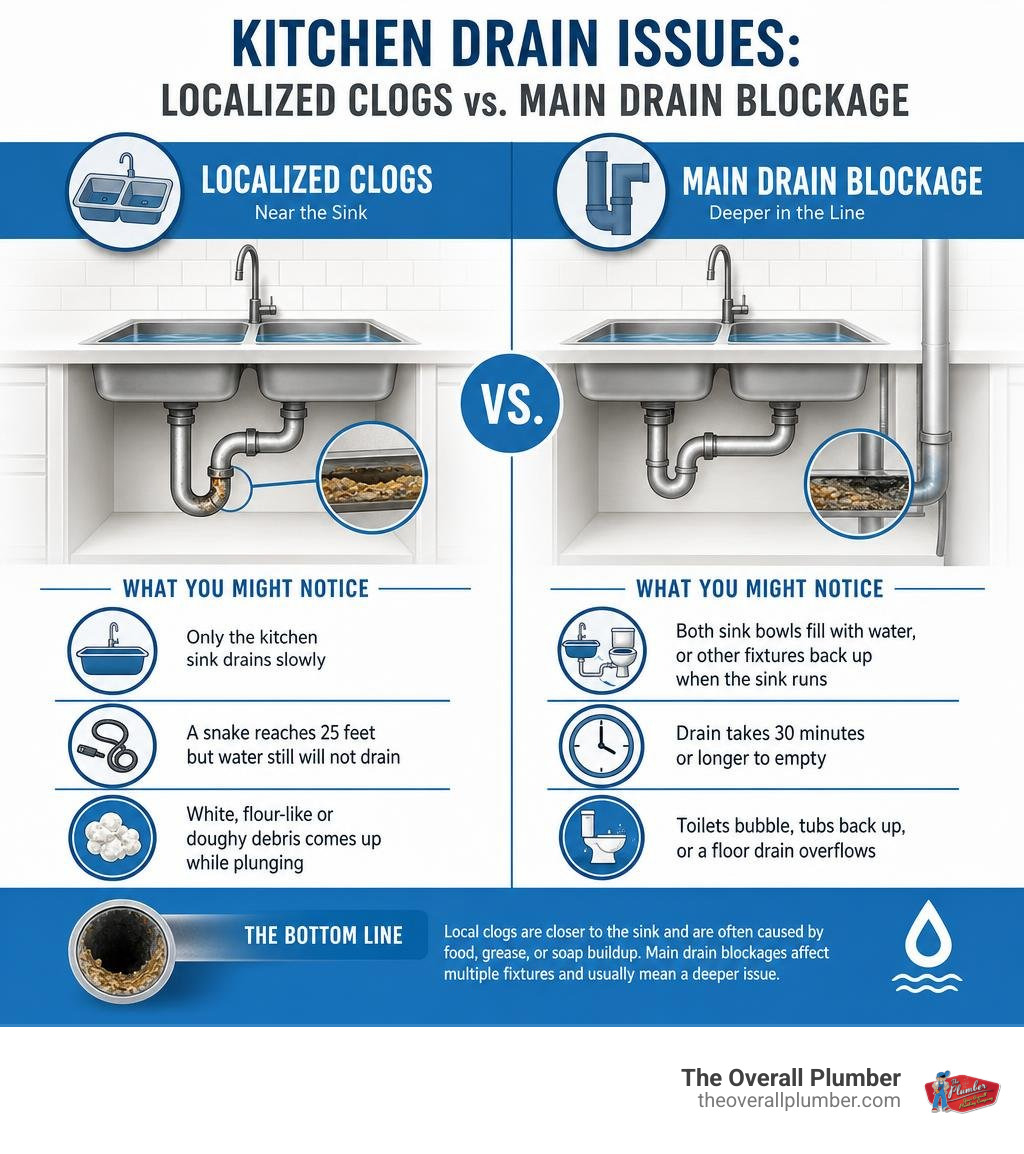
A kitchen main drain clogged problem may be more than a blocked sink trap. If both sink bowls fill with water, the drain takes 30 minutes or longer to empty, or running the kitchen sink causes gurgling or backup in another fixture, the restriction may be deep in the kitchen branch line or main sewer line.
| What you notice | What it often means |
|---|---|
| Only the kitchen sink drains slowly | A localized clog in the disposal, P-trap, or nearby wall pipe |
| A snake reaches 25 feet but water still will not drain | The clog may be farther down, or grease may have closed around the snake cable |
| White, flour-like or doughy debris comes up while plunging | Often congealed cooking grease mixed with soap scum and fine food waste |
| Toilets bubble, tubs back up, or a low floor drain overflows | A deeper shared drain or main sewer line blockage is possible |
Grease is a common cause. Hot oil may travel down the pipe as a liquid, then cool and stick to the walls. Over time, it catches soap residue, starches, and food particles until the pipe opening becomes too small for normal flow.
I am Dayton Whitworth, a second-generation plumbing professional serving Greater Brazoria County, Galveston County, Houston, and nearby Gulf Coast communities. I have seen a kitchen main drain clogged situation range from a simple grease-packed branch line to a deeper sewer issue that needs camera inspection and professional cleaning.
Discover more about kitchen main drain clogged:
How to Diagnose a Kitchen Main Drain Clogged Deep Beyond the P-Trap
When your kitchen sink refuses to drain, the first crucial step is pinpointing the exact location of the obstruction. A minor clog right in the sink elbow requires a very different approach than a kitchen main drain clogged 30 feet inside your home’s drainage network. In our plumbing experience throughout Houston and surrounding communities like Pearland and Sugar Land, mistaking a main lateral issue for a simple fixture clog leads to wasted effort, messy kitchen overflows, and unnecessary stress.
To perform basic symptom mapping, start by analyzing how wastewater behaves when released. A localized obstruction right at the sink strainer or garbage disposal usually shows immediate standing water in a single basin. However, if water drains very slowly—taking 30 to 40 minutes for a half-filled sink to drop—the restriction is located deeper down the branch line.

When wastewater flows through a pipe with a deep restriction, it encounters hydrostatic backpressure. The water fills the empty pipe volume behind the blockage until gravity can no longer push it forward. To verify system performance, we test the Gallons Per Minute (GPM) flow rate. Standard residential kitchen branch lines handle around 4 to 6 GPM under optimal gravity drainage mechanics. If your sink backs up almost immediately after running high tap volume, the available pipe capacity behind the trap has shrunk dramatically. For more context on system diagnostics, review How to Diagnose Main Line Blockage from Kitchen Sink Issues.
Is Your Kitchen Main Drain Clogged or Is It Just a Local P-Trap Blockage?
Before hauling out heavy mechanical tools, determine whether the issue stays within the cabinet under your sink or extends into the wall.
Here is our step-by-step diagnostic verification process:
- Place a catch bucket beneath the P-trap: Unscrew the slip nuts on the curved plastic or brass P-trap by hand or with channel-lock pliers.
- Inspect the waste arm: Clean out any visible debris, food scraps, or hair lodged inside the trap bend.
- Observe the wall stub-out: If the P-trap is entirely clear yet standing water remains trapped behind the wall, your clog sits deeper in the 1.5-inch or 2-inch kitchen branch pipe.
- Perform a multi-fixture isolation test: Run water in adjacent fixtures. Turn on the kitchen faucet at full force, then head to the nearest bathroom or utility area.
If running the kitchen sink causes gurgling in a hall bathtub, raises the water level in a low basement or garage floor drain, or causes the toilet bowl water to bubble, you are dealing with a broad main sewer line blockage. Because the main sewer lateral is the shared highway for all household waste, wastewater always seeks the path of least resistance. When the main line clogs, greywater backs up out of the lowest elevation fixtures first.
White Powder Debris: Understanding Congealed Saponified Grease
Have you ever plunged a stubborn kitchen sink for an hour, only to see a large cupful of a white, chalky, or doughy substance surge back up into the basin? Many homeowners assume this white material is broken-down drywall, mineral scale, or old chemical drain opener paste. In reality, it is a hallmark indicator of heavy, congealed grease buildup.
When hot liquid fats, oils, and grease (FOG)—such as bacon fat, butter, pan drippings, and coconut oil—are poured down the sink, they wash into the cool underground pipes. As the grease cools below its melting threshold, it solidifies along the interior walls of the pipe.
Over months and years, this fat matrix undergoes a natural chemical process known as saponification. The fats react with alkaline dish soaps, sodium compounds, and hard water minerals present in municipal water across Harris and Galveston counties. This reaction creates a hard, dense, white-to-pale-yellow substance chemically similar to crude soap paste. Plunging creates intense hydraulic force that shears off chunks of this soft, doughy grease wall, sending white flakes floating up into your sink basin.
When you dislodge this white paste, it confirms that your drain pipe interior has narrowed severely due to fat accumulation, creating a structural bottleneck deep inside the branch line.
Why Standard Snaking Fails on Deep Kitchen Drain Lines
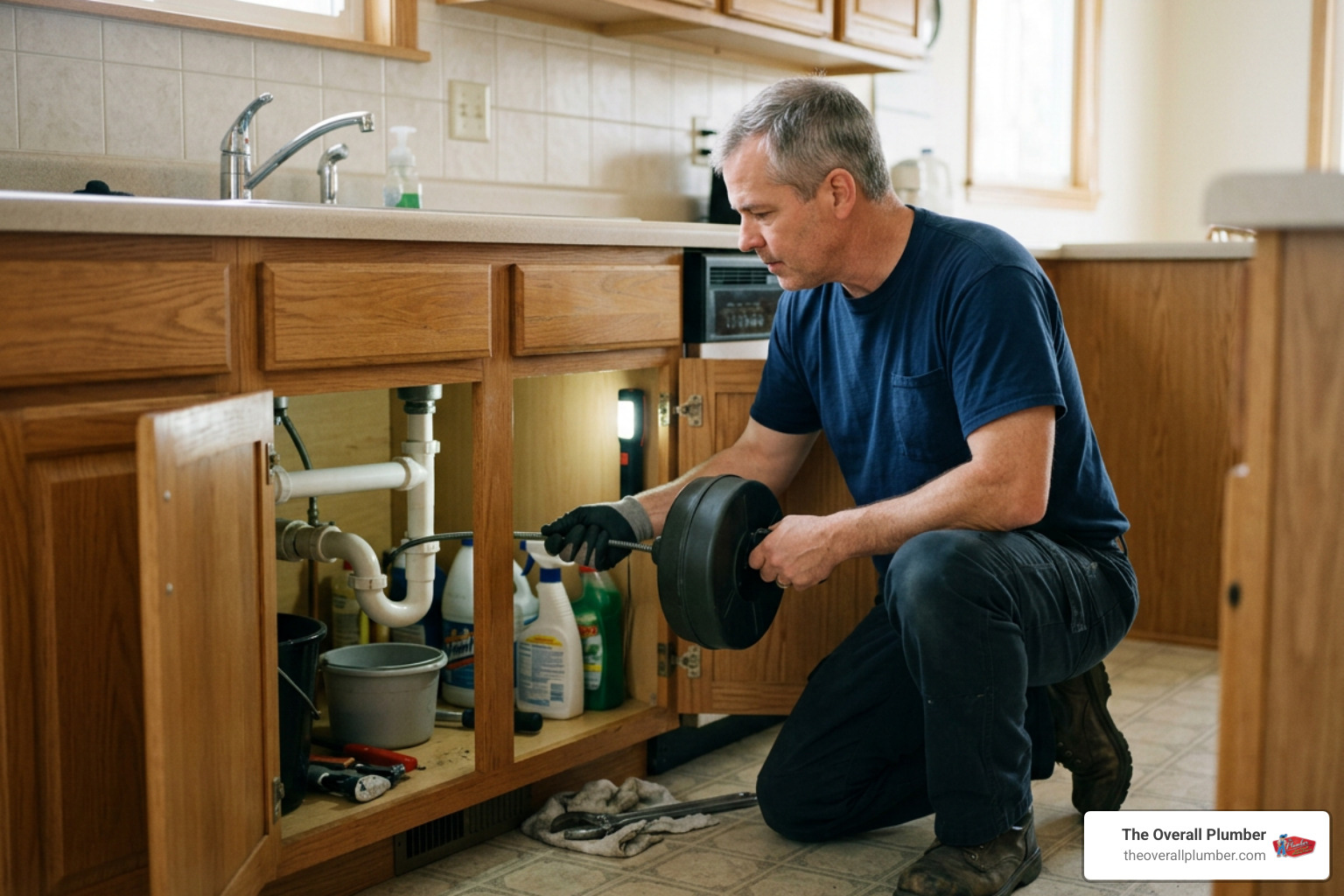
A common point of frustration for homeowners occurs when they purchase or rent a standard 25-foot manual drain snake, run the entire cable into the wall, pull it back out, and find the sink remains completely backed up. Understanding why a 25-foot snake fails requires a closer look at residential plumbing architecture.
Kitchen drain branch lines rarely run in a straight line to the main sewer stack. Depending on your home’s layout, a kitchen branch line can extend anywhere from 15 to over 40 feet across walls, floor joists, or concrete foundation slabs before tying into the 4-inch main building sewer stack. If your clog sits 30 feet from the sink opening, a 25-foot cable will stop short of reaching the obstruction.
Furthermore, kitchen drain lines utilize 1.5-inch to 2-inch PVC, ABS, or legacy cast iron pipes connected by tight 90-degree sanitizing tees and long-sweep elbows. A thin, flexible 1/4-inch cable can easily twist, loop back on itself inside a wider section of pipe, or kink at sharp directional turns, giving the user a false impression that it has struck a solid blockage when it is merely jammed against a pipe fitting. Learn more about proper cable routing in this step-by-step guide to snaking a kitchen sink.
Why Snaking Fails When a Kitchen Main Drain Clogged with Heavy Grease
Even when a 35-foot or 50-foot auger cable successfully reaches a grease clog, standard flexible steel snakes often fail to restore full flow. Soft obstructions like grease behave very differently than hard obstructions like tree roots or small toys.
When a spinning snake head strikes a dense wall of congealed fat and saponified grease, the narrow spiral auger tip simply pierces a small hole straight through the center of the soft blockage.
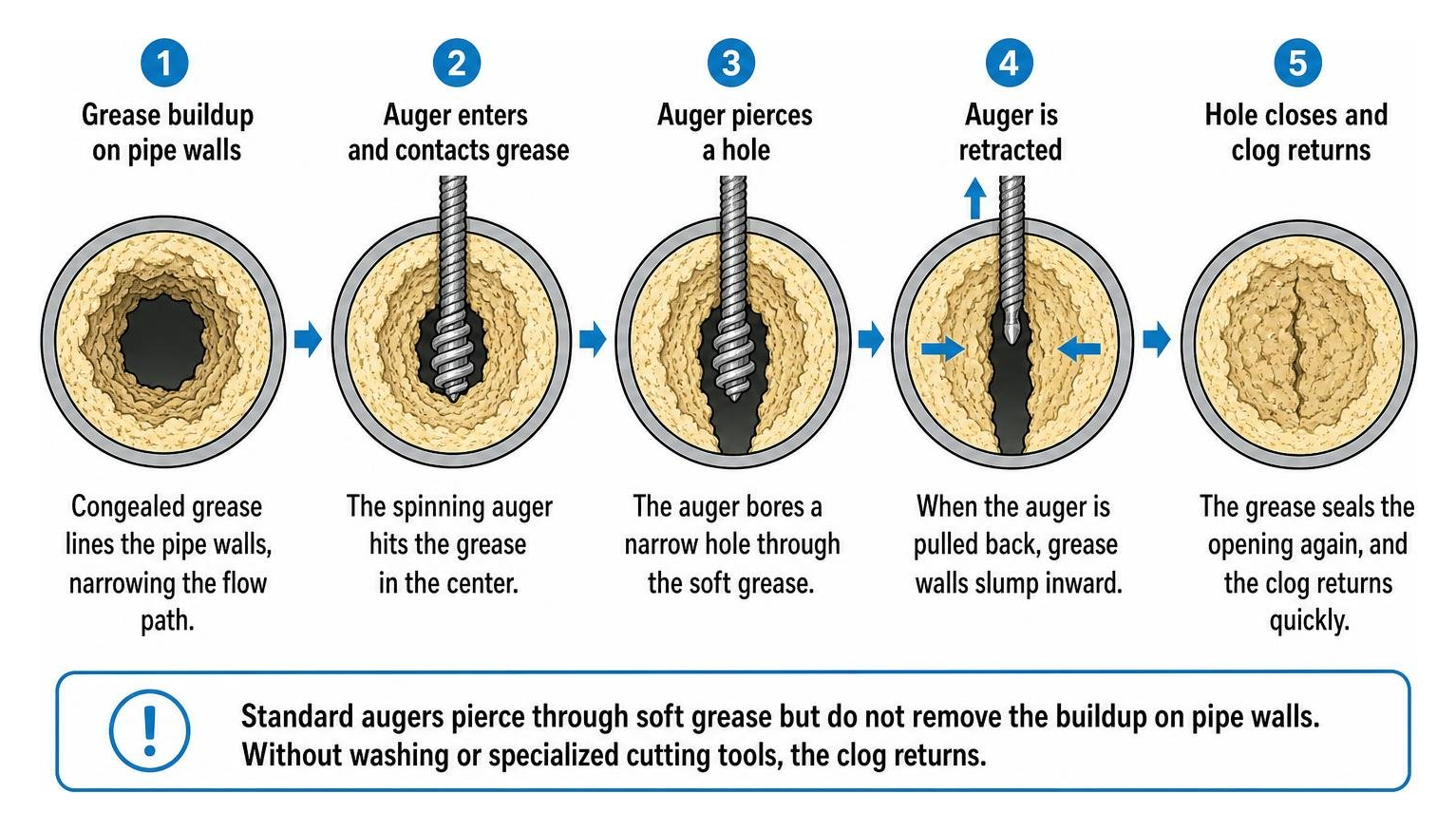
As soon as the plumber or homeowner retracts the cable, the semi-solid grease walls slump back together, sealing the opening instantly. Water may trickle through for a few minutes before the sticky fat reseals the pipe entirely. For a deeper understanding of why soft clogs demand specialized mechanical removal, read about why waiting for a clog to clear itself is a recipe for disaster.
Without high-velocity washing or specialized expanding cutter heads, standard snaking leaves the thick grease coats intact on the pipe walls, leading to rapid re-clogging within 12 to 24 months.
The Role of Dishwasher Connections in Main Line Buildup
Modern kitchen conveniences frequently compound deep main line grease blockages. The automatic dishwasher is one of the primary contributors to deep kitchen branch line restrictions.
Dishwashers discharge high volumes of greywater laden with food starches, un-shredded waste particles, and heavy animal fats emulsified by high-temperature washing cycles. This hot, soapy liquid travels down the dishwasher discharge hose, enters the garbage disposal or waste tee connection under the sink, and enters the branch line.
- High-Temperature Emulsification: Hot dishwasher water keeps grease liquefied longer, allowing it to travel 20 to 30 feet deep into the branch line before cooling and settling on pipe walls.
- Starch Binding: Un-shredded food scraps (such as rice, pasta, and potato peels) combine with emulsified fats, creating a sticky paste that adheres tightly to PVC wall joints.
- Waste Tee Accumulation: If the under-sink dishwasher branch connection lacks a proper high loop or air gap, food debris can collect at the junction, restricting flow into the wall.
Always inspect your dishwasher hose connection and verify that the branch tailpiece remains clear of sticky residue when troubleshooting slow kitchen drainage.
Advanced DIY Unclogging Methods for Deep Kitchen Line Blockages
If standard plunging and 25-foot snakes have failed to resolve your kitchen main drain clogged situation, basic store-bought fixes are no longer sufficient. However, before calling for emergency professional assistance, several advanced DIY techniques can clear severe grease obstructions deep inside the pipe.
First, avoid pouring caustic chemical drain openers down a completely blocked main line. Chemical drain cleaners rely on chemical reactions that generate intense heat. When poured into a pipe filled with cold standing water, the chemical dilutes before reaching a deep clog 30 feet down the line. Worse, sitting chemical pools can warp thin PVC pipes, melt plastic joints, corrode vintage cast iron, and create serious chemical burn hazards for anyone disassembling the pipe later. Check our practical emergency steps in The Oh Shit Guide to Dealing With a Backed Up Drain.
Instead, focus on thermal, chemical saponification, and mechanical water pressure techniques.
Using a Water Pressure Blow Bag (Drain King)
One of the most effective DIY tools for clearing stubborn grease blockages deep beyond the P-trap is an expanding water pressure blow bag (commonly sold under brand names like Drain King).
A blow bag consists of an expanding rubber bladder that attaches directly to a standard garden hose. When inserted into a drain line and pressurized with tap water, the bag expands radially to grip the inner walls of the pipe, creating an airtight, watertight seal. Once fully expanded, high-pressure water surges through the tip of the bag, blasting pulsating streams of water directly against the obstruction.
Here is how to safely operate a blow bag:
- Locate the Cleanout Access: Access the kitchen branch line via an exterior wall cleanout plug or by removing the under-sink P-trap to expose the wall stub-out.
- Insert the Bladder: Push the 1.5-inch or 2-inch blow bag at least 2 to 3 feet past the cleanout fitting into the wall pipe. Never engage a blow bag inside a loose P-trap or right at the pipe entrance.
- Seal Alternate Pressure Routes: Block all alternate pressure release points. Cap or plug adjacent sink basins, clamp dishwasher lines, and make sure secondary vents are clear so water force pushes strictly against the downstream clog.
- Turn On Water Pressure: Slowly open the garden hose valve. Allow the bladder to expand completely against the pipe walls before increasing water volume to full pressure.
- Monitor Flow: Maintain pressure for 3 to 5 minutes while high-velocity hydraulic force breaks apart the congealed grease block. Turn off the hose tap slowly before removing the bag.
Mechanical Augering Beyond 25 Feet
If a water pressure blow bag cannot break through dense saponified grease, upgrading to a heavier mechanical cable auger is the next logical step. You can rent professional-grade motorized drum augers equipped with 50-foot to 75-foot steel cables from local tool rental outlets across the Houston metro region.
Follow these best practices when augering deep kitchen lines:
- Cable Diameter: Select a 3/8-inch inner-core steel cable for standard 1.5-inch to 2-inch kitchen lines. Avoid using heavy 3/4-inch main sewer cables in smaller kitchen branch pipes, as they can break plastic fittings.
- Attachment Head Selection: Swap out standard straight wire heads for a slotted bulb head or a small grease cutter tool. A bulb head grabs soft fibrous fat masses so you can extract them, while grease blades scrape fat off pipe interiors.
- Bypass Under-Sink Traps: Never feed a motorized cable down through a kitchen sink strainer or garbage disposal. Always disassemble the P-trap and feed the cable directly into the exposed wall cleanout fitting.
- Maintain Cable Control: Position the motorized drum within 2 feet of the pipe opening to prevent cable whipping or dangerous loop-backs. Feed the cable slowly by hand while applying steady pressure, allowing the rotating cutting head to chew through soft grease walls gradually.
For detailed DIY main line clearing techniques, review the detailed steps in this expert rescue guide for fixing a clogged plumbing main line.
When DIY Fails: Professional Drain Cleaning Tools and Solutions
When mechanical augering and pressure blasters fall short, the restriction inside your kitchen main drain likely involves structural pipe defects, severe tree root intrusion, or petrified grease walls that require commercial equipment. Attempting to force rentals through damaged lines can crack underground pipes or break cables inside the foundation.
Professional plumbers employ advanced equipment designed specifically for stubborn grease blockages and deep sewer main failures. Explore our full range of advanced solutions on our Clogged Drain Service page.
High-Pressure Hydro-Jetting vs. Cable Augering
For severe kitchen main line grease blockages, traditional snaking is often a temporary solution. The industry standard for restoring grease-choked drain lines to near-original capacity is high-pressure hydro-jetting.
A hydro-jetter uses a specialized multi-directional nozzle attached to a high-pressure hose, delivering water at pressures ranging from 3,000 to 4,000 PSI at up to 12 GPM. The forward-facing jet pulverizes hard blockages, while rear-facing jets blast water backward against pipe walls, scouring away grease layers, soap film, and scale, flushing the entire pipe clean.
| Feature / Metric | Mechanical Cable Augering | High-Pressure Hydro-Jetting |
|---|---|---|
| Primary Action | Mechanical cutting and punching holes | 360-degree high-pressure hydraulic scouring |
| Best Used For | Tree root intrusion, solid objects, localized clogs | Heavy grease (FOG), soap scum, sand, sludge |
| Pipe Wall Cleaning | Clears center channel; leaves wall residue | Restores full pipe diameter to near-new condition |
| Safety on Aging Pipe | High cable torque can damage thin cast iron | Pressure adjustable for fragile or aged materials |
| Long-Term Protection | Clogs often recur within 12 to 24 months | Long-lasting clearance when paired with proper maintenance |
High-Definition CCTV Sewer Camera Inspections
Before undertaking heavy cleaning or pipe repairs, professional plumbers perform a high-definition video camera inspection. A waterproof camera mounted on a flexible push-cable is navigated down the cleanout into the main sewer lateral.
Camera inspections allow us to:
- Pinpoint the exact depth and distance of line obstructions.
- Differentiate soft grease buildup from structural pipe bellies (sagging lines where grease collects), offset joints, or crushed pipes under slab foundations.
- Inspect cast iron pipe bottoms for severe corrosion or bottom rot.
- Verify 100% waste removal following hydro-jetting or heavy augering.
When dealing with deep sewer complications, fast professional response is essential. Learn why homeowners trust our specialized Houston auger service and how our dedicated main drain clogs priority auger service resolves severe household backups fast.
Frequently Asked Questions About Kitchen Main Drain Clogs
How do I know if my main sewer line is clogged or just the kitchen sink?
You can differentiate a localized kitchen drain clog from a main sewer line blockage by observing how other home plumbing fixtures react. If only your kitchen sink drains slowly or backs up, the obstruction is isolated to the kitchen branch line or P-trap.
However, if using your kitchen sink causes water to back up into a lower-level shower basin, causes gurgling noises in bathroom sinks, or causes the main house toilet to bubble, you have a main sewer line clog. When the main line is obstructed, wastewater backs up through the lowest plumbing openings across the entire house. For additional insights on identifying main drain signs, read Main Sewer Drain Clogged: Signs and Causes Guide.
Why did white chalky paste come out of my drain while plunging?
The white, flour-like or doughy paste dislodged by plunging is congealed grease that has undergone saponification. When cooking fats, oils, and grease are washed down the sink, they combine with alkaline soap residues and mineral salts in your home’s water supply. Over time, this mixture hardens along the inner pipe walls into a dense, white grease paste. Plunging creates intense pressure changes that shear off chunks of this congealed fat layer, bringing it up into the sink basin.
Can chemical drain openers dissolve a deep main line grease blockage?
No. Liquid chemical drain cleaners are generally ineffective against deep main line grease blockages. Because the chemical must travel through feet of standing water behind the clog, it dilutes significantly before reaching the obstruction, losing its reactivity.
Furthermore, caustic chemicals sitting trapped inside plastic PVC pipes can generate excessive thermal heat, which warps pipe joints, damages garbage disposal seals, and creates hazardous conditions for plumbers who must service the line later. Mechanical clearing via water blow bags, augers, or professional hydro-jetting is far safer and more reliable. For alternative home troubleshooting, check Kitchen Drain Clogged? Causes and Fixes.
Restoring Flow and Preventing Future Main Line Blockages
Resolving a kitchen main drain clogged emergency brings immediate relief, but long-term peace of mind requires establishing preventative kitchen waste habits. Because fat, oil, and grease accumulation remains the leading cause of deep kitchen branch line failures, adopting proper kitchen routines prevents recurring plumbing emergencies.
Follow these plumber-approved tips to keep your kitchen drain lines clear:
- Wipe Pans Before Washing: Always wipe greasy skillets, roasting pans, and baking sheets with dry paper towels and throw them in the trash before rinsing them in the sink.
- Collect Cooking Oils: Pour hot frying oils and bacon drippings into heat-resistant containers or empty tin cans, allow them to solidify, and discard them in your household garbage.
- Run Hot Water Weekly: Once a week, fill your kitchen sink basin completely with hot tap water, then release the stopper. The volume and heat create a natural scouring effect that sweeps minor grease films down the branch line.
- Install Fine Mesh Strainers: Place removable stainless steel mesh basket strainers over both sink drains to intercept food particles, coffee grounds, rice grains, and pasta shreds before they enter your plumbing.
- Maintain Garbage Disposals Wisely: Avoid grinding fibrous, starchy, or expandable foods (such as celery, corn husks, potato peelings, or rice) down your disposal. Always run cold water for 15 seconds before, during, and after operating the disposal unit.
Preventative maintenance protects your home against unexpected water damage and sewage backups. Read our guide on how to stop the clogging of drainage before your house becomes a pool to safeguard your residential plumbing system.
At The Overall Plumber, we serve homeowners across Brazoria County, Harris County, Galveston County, Houston, Clear Lake, League City, Friendswood, Pearland, Pasadena, La Porte, Texas City, Santa Fe, and Galveston. We provide drain cleaning with augers and camera inspections, plumbing protection plans, and repair services with no trip charges, satisfaction guarantees, transparent upfront flat-rate pricing, and no overtime fees.
For comprehensive sewer repairs and line restorations, explore our complete sewer line services and main drain repair solutions. If your kitchen drain line is completely backed up or showing early signs of main sewer line trouble, don’t wait for sewage to back up into your living spaces. Get in touch with our emergency team at 24-Hour Emergency Plumbers.