

Why Waiting for a Clog to Clear Itself Is a Recipe for Disaster
Will a toilet unclog itself overnight — here’s the short answer:
- Yes, sometimes — if the clog is made of water-soluble materials like toilet paper or human waste, it may dissolve within 1 to 5 hours on its own.
- No, often not — clogs caused by wipes, sanitary products, grease, or foreign objects will not clear themselves, no matter how long you wait.
- It depends on these key factors:
- What caused the clog (soluble vs. insoluble material)
- How severe the blockage is
- How long it has already been sitting
The stakes are real. A clog that seems harmless at bedtime can silently build pressure, grow bacteria, or overflow onto your bathroom floor while you sleep. That “wait and see” approach works occasionally — but when it fails, the damage it leaves behind is far worse than the original clog.
I’m Dayton Whitworth, a second-generation plumber serving Greater Houston and the Gulf Coast, and I’ve responded to countless emergency calls that started with someone wondering will a toilet unclog itself overnight before deciding to leave it until morning. In this guide, I’ll show you exactly when waiting is safe, when it isn’t, and what to do instead.
Will a Toilet Unclog Itself Overnight?
In the plumbing world, we often deal with the “hope and pray” method of home repair. When you stare down a bowl filled to the brim, it’s tempting to close the door, go to sleep, and hope the problem vanishes by April 2026.
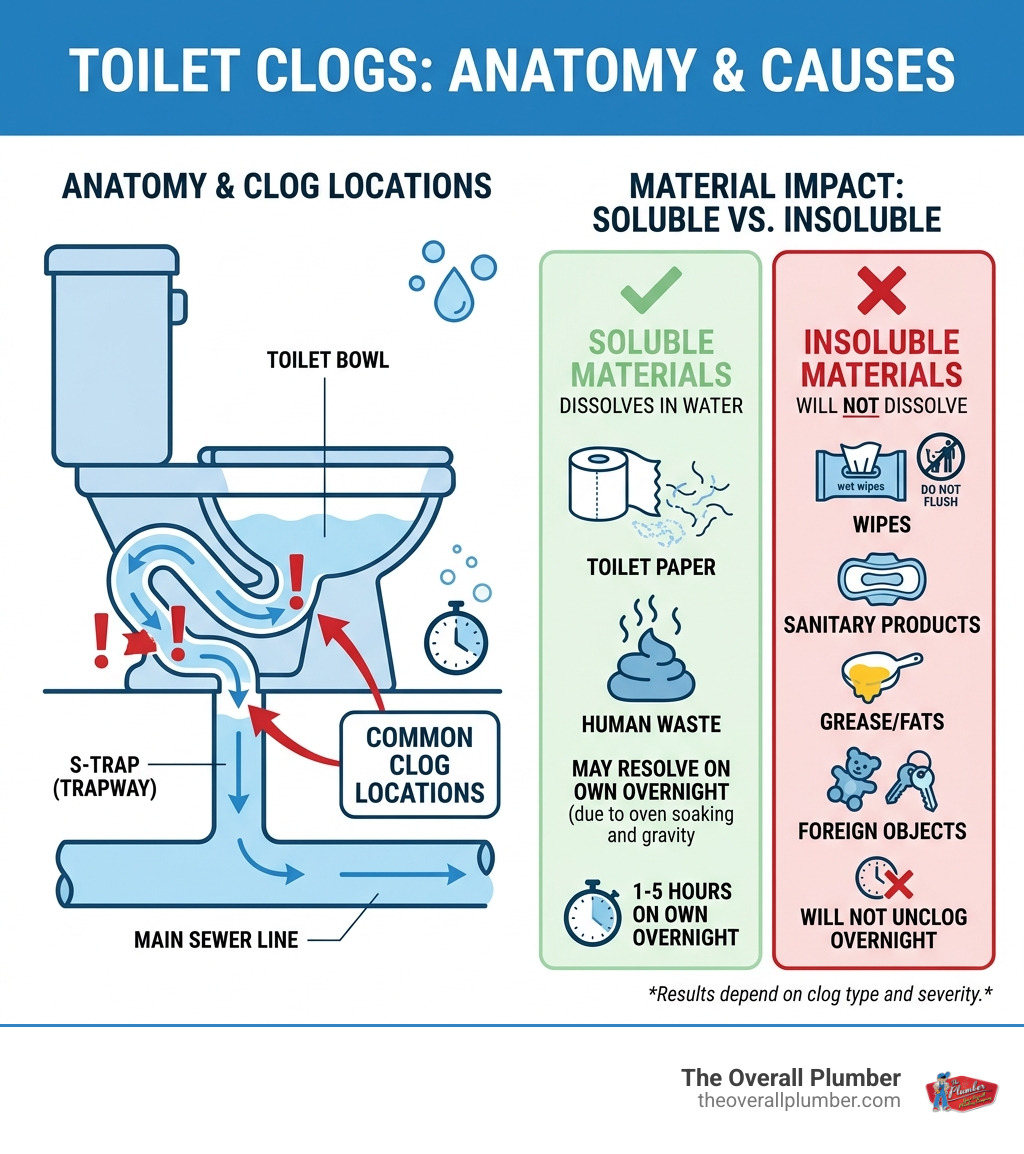
The truth is that will a toilet unblock itself overnight? depends entirely on the “ingredients” of the blockage. If the clog consists purely of organic human waste and standard toilet paper, there is a legitimate chance it will resolve. These materials are water-soluble. Over a period of 3 to 5 hours, the standing water in the bowl exerts consistent pressure on the blockage while simultaneously softening the fibers of the paper and the organic matter.
Gravity is your only friend in this scenario. The weight of the water in the bowl pushes against the obstruction. If the material softens enough, that pressure eventually forces the mass through the S-trap and down into the drain line. However, research suggests that if a clog hasn’t cleared itself within that 5-hour window, it is highly unlikely to do so without intervention.
| Material Type | Soluble? | Will it Clear Overnight? |
|---|---|---|
| Standard Toilet Paper | Yes | Likely (1–3 hours) |
| Human Waste (Organic) | Yes | Possible (1–5 hours) |
| “Flushable” Wipes | No | Highly Unlikely |
| Paper Towels/Tissues | No | No |
| Feminine Products | No | Never |
| Toys/Foreign Objects | No | Never |
How to tell if your toilet will unclog itself overnight
Not every clog is a candidate for the waiting game. To determine if you can safely walk away, look for these signs:
- The Slow Recede: If you notice the water level in the bowl is slowly dropping over 15 to 30 minutes, you have a partial clog. This is the best candidate for self-unclogging because water is still finding a path through.
- Gurgling Sounds: If you hear a “glug-glug” sound coming from the pipes, it often means air is trying to move past the blockage. While annoying, it suggests the clog isn’t a solid, airtight seal.
- The Static Bowl: If the water level remains exactly where it was an hour ago, you have a “hard” clog. This is a recipe for disaster. A static bowl usually means the blockage is non-soluble or so tightly packed that water cannot penetrate it.
If your toilet isn’t flushing and you also notice the toilet handle is loose, you might be dealing with a mechanical issue on top of the blockage, which will definitely require manual repair.
The Science of Solubility: What Can and Cannot Clear on Its Own
To understand why will a toilet unclog itself overnight is such a gamble, we have to look at the science of what we flush.
Standard toilet paper is designed to disintegrate. It is made of short cellulose fibers that lose their structural integrity almost immediately upon contact with water. In many cases, toilet paper alone will dissolve in about 10 to 20 minutes.
Human waste is a bit more complicated. On average, feces are approximately 75% water and 25% solid matter. However, that solid portion is composed of roughly 30% cellulose (dietary fiber), 10-20% fats and cholesterol, and various proteins. While the water-soluble parts may break down in an hour, the fats and cellulose can act like a “glue,” holding the mass together.
According to Will a Toilet Unclog Itself Overnight? (2026), fats can comprise up to 8% of wet feces. In homes with hard water—common in areas like Pearland and Friendswood—these fats can react with minerals in the water to create a stubborn, soap-like solid that won’t just “melt” away overnight.
If your toilet frequently clogs despite only flushing soluble materials, it may be a sign of an aging fixture with a narrow trapway. In these cases, you might want to look into toilet replacement services to upgrade to a high-performance, clog-resistant model.
The Hidden Dangers of Delayed Action
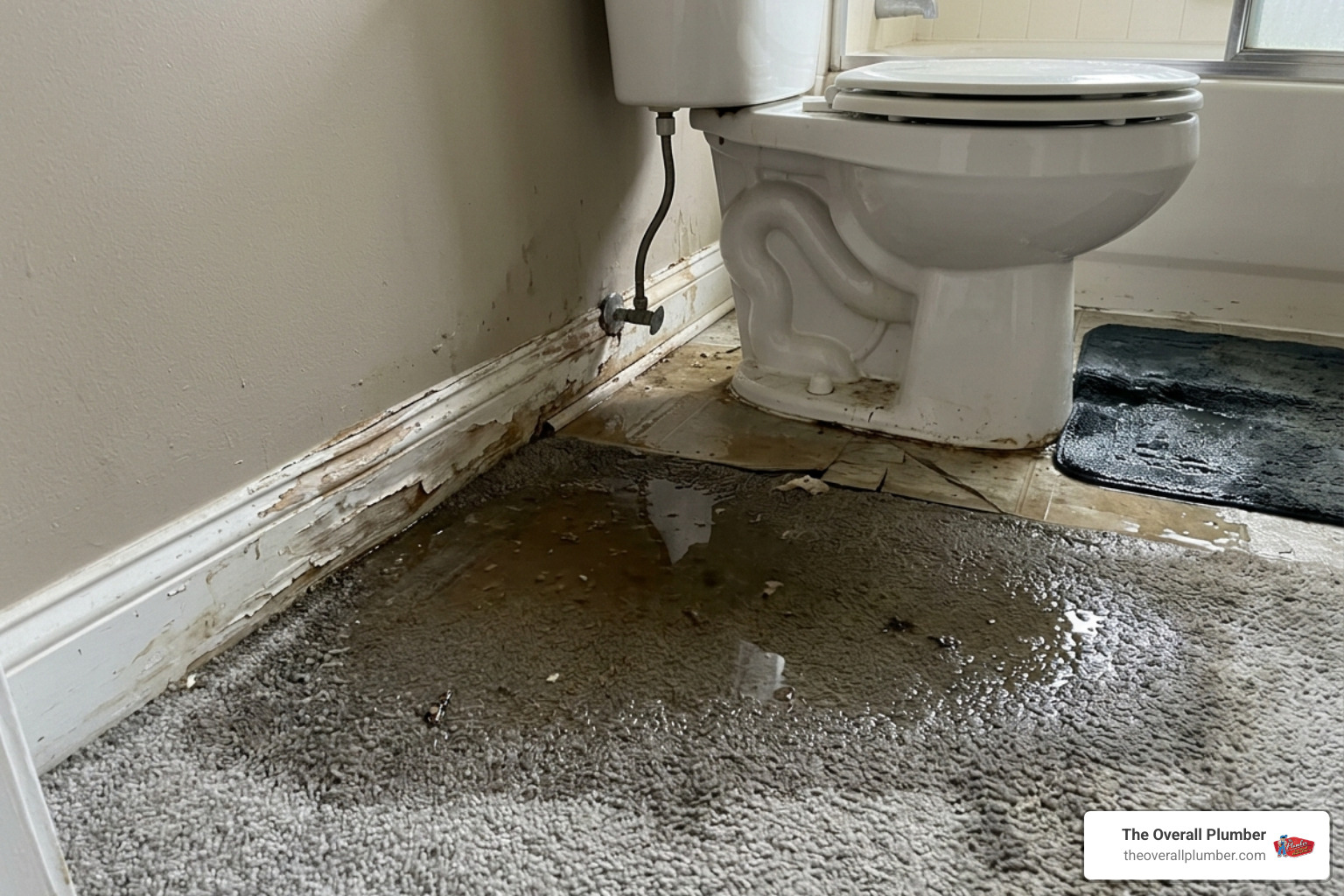
Leaving a clogged toilet unattended isn’t just an inconvenience; it’s a risk to your home’s hygiene and structural integrity. In our years serving Houston and Brazoria County, we’ve seen “overnight waits” turn into thousands of dollars in restoration costs.
When a toilet is clogged, the water sitting in the bowl is classified as “black water.” This isn’t just dirty water; it is a biohazard teeming with bacteria, viruses, and parasites. As it sits, these pathogens multiply. If the toilet overflows while you are sleeping, this contaminated water soaks into your floorboards, baseboards, and even the drywall.
Why you shouldn’t wait for a toilet to unclog itself overnight
- The Midnight Flush: The biggest risk is human error. A family member or guest might walk into the bathroom in the middle of the night, forget the toilet is clogged, and flush. This almost guarantees an overflow.
- Wax Ring Failure: Your toilet is sealed to the floor by a wax ring. Toilets are designed to handle water flowing down, not the constant upward pressure of a heavy column of standing water. Leaving a clog overnight can put enough pressure on that seal to cause a slow, hidden leak into your subfloor.
- Clog Compaction: Sometimes, waiting actually makes the clog worse. As the water-soluble parts of the blockage dissolve, the remaining insoluble parts (like hair or lint) can settle and compact into a denser, harder mass that is much more difficult for a plunger to move.
- Health Hazards: Stagnant waste produces sewer gases and foul odors that can permeate your home. For those with respiratory issues or young children, these fumes are more than just a nuisance.
If you are facing a stubborn blockage that won’t budge, don’t wait for the damage to spread. A local plumber clogged drain service can clear the line safely before a minor issue becomes a major flood.
Effective DIY Methods to Clear a Clog Without a Plunger
If you’ve decided that waiting for the toilet to unclog itself isn’t worth the risk, but you don’t have a plunger handy, there are a few “kitchen chemistry” tricks that actually work.
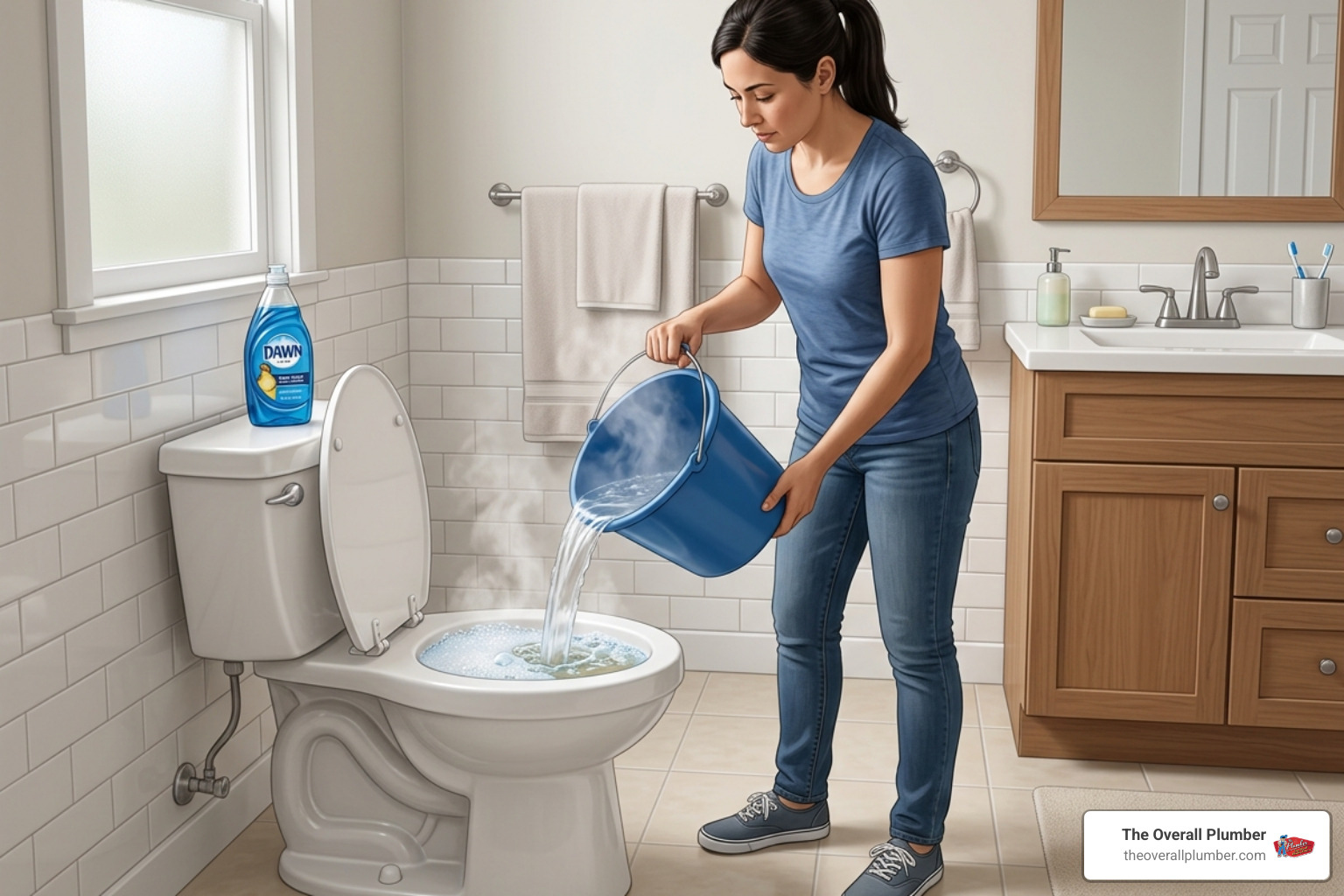
The Dish Soap and Hot Water Method This is the most effective DIY strategy for organic clogs.
- Step 1: Squirt about half a cup of liquid dish soap into the bowl. The soap acts as a lubricant, adding “slip” to the trapway and the blockage.
- Step 2: Let the soap sit for 10 minutes to sink down to the clog.
- Step 3: Pour a gallon of very hot (but NOT boiling) water into the bowl from about waist height. The force of the pour adds pressure, while the heat helps break down fats and waste.
- Step 4: Wait 15–30 minutes. If the water level drops, the clog is clearing.
The Baking Soda and Vinegar Fizz If the soap method fails, you can try the classic volcano reaction. Pour one cup of baking soda into the bowl, followed by two cups of white vinegar. Let it fizz for 20 minutes. The chemical reaction can sometimes break the surface tension of the clog.
The Wire Hanger (Last Resort) If you suspect a physical object is stuck near the entrance of the trap, you can straighten a wire hanger and use it as a makeshift snake. Be extremely careful, as metal hangers can easily scratch the porcelain of your bowl.
For residents in the Houston area, if these home remedies don’t do the trick, you likely need professional equipment. Our Houston auger service and Brazoria County auger service use specialized tools that can reach deep into the plumbing to remove blockages without damaging your fixtures.
Frequently Asked Questions about Toilet Clogs
How long should you wait before taking action on a clogged toilet?
We recommend waiting no longer than one to two hours. If the water level hasn’t dropped significantly by then, the clog is likely too dense or made of the wrong materials to clear on its own. Waiting overnight increases the risk of the clog hardening or an accidental overflow.
Can a clogged toilet overflow while you sleep?
Yes. While it won’t spontaneously overflow if no one touches it, a leaking fill valve or a “phantom flush” caused by a faulty flapper can slowly add water to the bowl. If the bowl is already full because of a clog, that extra water has nowhere to go but onto your floor.
Does boiling water work to clear a toilet clog?
Never use boiling water. While hot tap water is helpful, boiling water can crack the porcelain of your toilet bowl or melt the plastic PVC pipes and wax ring beneath the toilet. Always use water that is hot to the touch but not boiling.
Contact Us for Fast Help with a Clogged Toilet
We provide comprehensive drain cleaning using professional-grade augers and camera inspections to see exactly what’s causing your backup. If your toilet is old and prone to frequent clogs, we also offer toilet replacement services to give you peace of mind.
Our team offers:
- Priority Scheduling: Because a clog won’t wait, and neither should you.
- No Trip Charges: We believe in fair, transparent pricing.
- No Overtime Fees: Plumbing disasters don’t stick to a 9-to-5 schedule.
- Satisfaction Guarantees: We don’t consider the job done until your drains are flowing perfectly.
Need help now? Contact us today or call us at 281-668-8055 to schedule your service.