

When Your Sewer Line Keeps Backing Up, the Problem Is Bigger Than a Clog
If your sewer line keeps backing up even after it’s been cleaned, you are not dealing with a simple blockage. Something deeper is going on — and snaking it again probably will not fix it.
Why does a sewer line keep backing up after cleaning?
The most common reasons include:
- Tree root intrusion — Roots grow back fast after snaking and block the pipe again within days or weeks.
- Structural pipe damage — Cracks, bellies, or collapsed sections trap waste and can’t be fixed by cleaning alone.
- Grease and debris buildup — Layers of grease, wipes, and debris coat pipe walls and reform clogs quickly.
- Municipal main line issues — Sometimes the problem is in the city’s sewer main, not your private line at all.
- Wrong cleaning method — A basic snake punches a hole through a clog but doesn’t clear the pipe walls or address root masses.
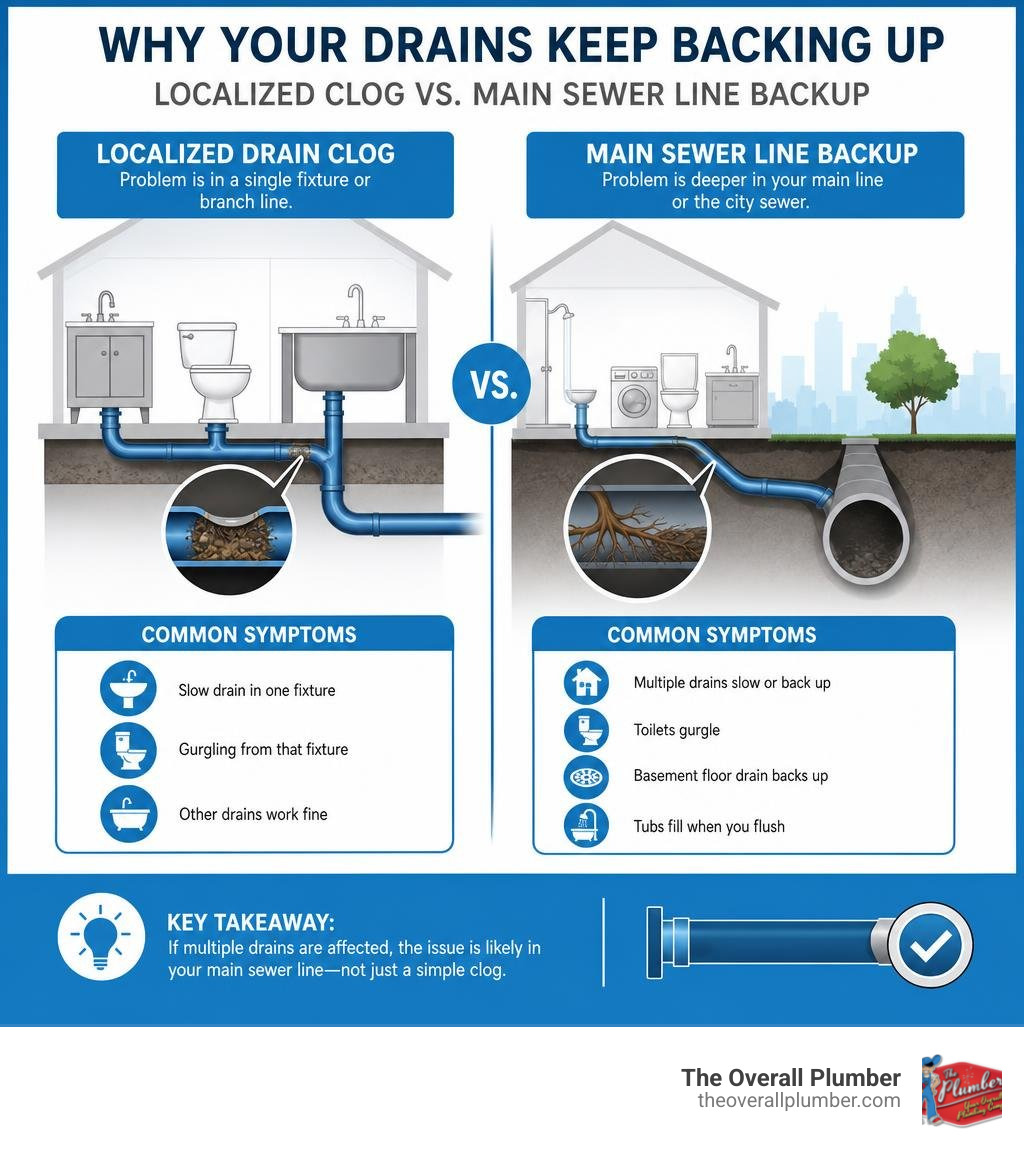
The pattern is always the same: drains run fine for a few days, then slow down again. Toilets gurgle. A tub fills up when you flush. The basement floor drain backs up during laundry. These are not random events — they are symptoms of one underlying problem that keeps getting masked instead of fixed.
I’m Dayton Whitworth, a second-generation plumber with hands-on experience diagnosing and resolving cases where a sewer line keeps backing up across Houston and the Gulf Coast. In this guide, I’ll walk you through exactly what’s causing your recurring backups and what it actually takes to stop them for good.
Sewer line keeps backing up terminology:
Why Your Sewer Line Keeps Backing Up After Cleaning
It is incredibly frustrating to pay a plumbing company to clear your drains, only to watch dirty water bubble back up into your tub or shower just a few days later. You might think the technician didn’t do their job, but the truth is often more complex. A “cleaned” sewer line can still have massive structural or environmental issues hiding beneath the surface.
In our service areas across Galveston County, Harris County, and Brazoria County, we deal with unique geological and infrastructural challenges. The highly expansive clay soil in Texas behaves like a sponge—expanding rapidly when wet and shrinking during dry spells. This constant ground shifting puts immense physical stress on buried pipes, leading to joint separation, cracks, and complete collapses.
When older homes in Pasadena, Pearland, or La Porte rely on outdated pipe materials like porous clay or brittle cast iron, the risk of recurring blockages skyrockets. Cast iron pipes naturally corrode and develop a rough, scaled interior over the years. This scale catches toilet paper, hair, and waste, forming a new clog almost immediately after a drain snake passes through. To protect your home and health, recognizing the signs of a home sewer backup early is essential before a minor slow drain becomes a major indoor flood.
Tree Root Intrusion: The Reason Your Sewer Line Keeps Backing Up
If you have beautiful, mature oak trees in your yard in League City or Friendswood, your plumbing might be paying the price. Tree roots are the single most common cause of recurring sewer line blockages. Roots are naturally drawn to the warmth, moisture, and nutrient-rich oxygen flowing inside your sewer lateral.
When a pipe has even a hairline crack or a slightly loose joint, tree roots will find it. They slip inside as tiny, hair-like fibers. Once inside, they feast on the wastewater and grow into massive, woody root balls that completely fill the diameter of the pipe.
While a mechanical drain snake can punch a temporary hole through these roots to get your water flowing again, it acts like a weed whacker. It trims the roots but leaves the main root structure completely intact. Within days or weeks, those trimmed roots grow back stronger, trapping new debris and causing another backup. True long-term solutions require specialized root-cutting blades, chemical foaming treatments like Vaporooter or copper sulfate to inhibit regrowth, or physically repairing the entry points.
Structural Damage: Why Your Sewer Line Keeps Backing Up
When a sewer line keeps backing up, structural damage is often the silent culprit. Over time, pipes can crack, break, or collapse entirely due to shifting soil, heavy vehicle traffic overhead, or simple age. When a section of pipe collapses, no amount of snaking or clearing will restore proper flow because the physical pathway for wastewater is gone.
Another common structural issue is a “pipe belly.” This occurs when a section of the sewer line sags or sinks lower than the rest of the pipe, usually due to poor soil compaction during installation or ground shifting. Gravity is supposed to pull waste downward toward the city main, but a pipe belly creates a stagnant pool where solids, grease, and toilet paper settle. A drain snake will pass right through the standing water in a belly without fixing the sag, meaning waste will immediately begin accumulating again the moment the plumber leaves. If you suspect structural failure, scheduling a professional broken sewer line repair is the only way to permanently restore your system’s integrity.
Grease, Wipes, and Debris Accumulation
Sometimes, the culprit behind a recurring backup is what we put down our drains. “Flushable” wipes are perhaps the greatest marketing trick of the 21st century. Despite what the packaging claims, these wipes do not disintegrate in water like standard toilet paper. Instead, they catch on rough pipe interiors, tree roots, or pipe joints, acting as a net that catches every other piece of waste flowing down the line.
When you mix flushable wipes with kitchen grease poured down the sink, you get a recipe for “fatbergs”—rock-hard masses of congealed fat and synthetic fibers that cling to pipe walls. Grease cools and solidifies as it travels through your cold underground pipes, slowly narrowing the passage like plaque in an artery. A standard snake might poke a small hole through a grease clog, but the sticky residue remains on the pipe walls, ready to trap the very next thing you flush. To prevent these stubborn blockages, we must actively practice protecting municipal pipes by disposing of grease in the trash and installing fine mesh drain strainers in our sinks and showers.
Municipal Main vs. Private Lateral Line Issues
As a homeowner, it is crucial to understand where your plumbing responsibility ends and the city’s begins. Your home is connected to the municipal sewer system via a private sewer lateral line. You are fully responsible for maintaining and repairing this lateral line from your house all the way to the connection point at the city main (which often sits under the street or easement).
If the blockage is located within your private lateral, the repair is your responsibility. However, if the city’s main sewer line becomes clogged or overwhelmed—which frequently happens in coastal Texas during heavy rain and flash flooding—wastewater has nowhere to go. It will back up into the lowest residential lateral lines, overflowing through basement drains or ground-floor toilets.
If you have a double cleanout installed near your property line, a plumber can easily open it to see if the standing water is coming from the city side or your home’s side, helping you quickly identify who is responsible for the cleanup and repair.
Diagnostic Power: How a Video Camera Inspection Solves the Mystery
If you are tired of paying for temporary fixes, you need to stop guessing and start looking. A professional video camera inspection is the ultimate diagnostic tool for recurring sewer issues.

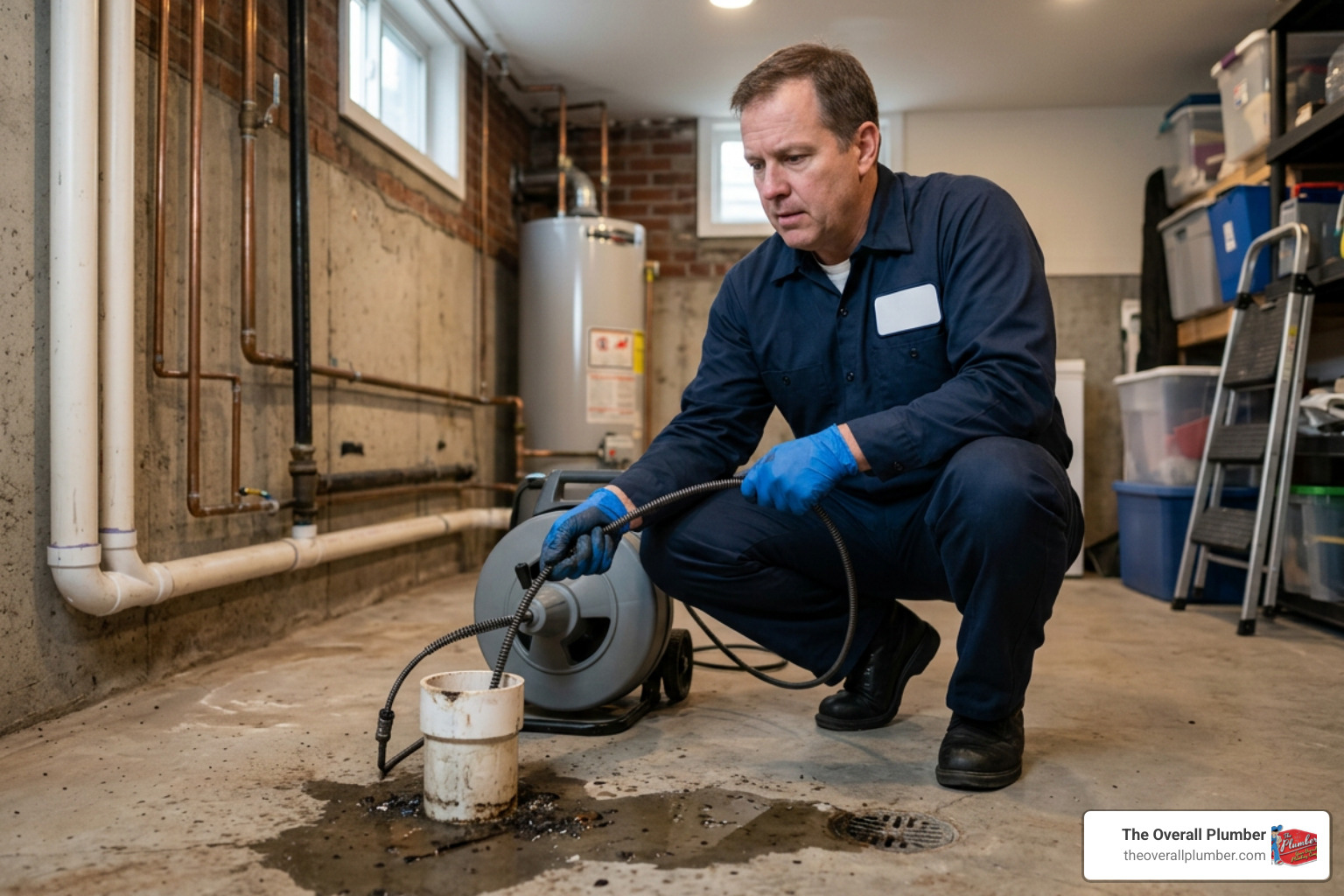
During this process, we insert a high-resolution, waterproof camera attached to a flexible fiber-optic cable directly into your sewer cleanout. As we push the camera through your lateral line, it transmits a real-time, high-definition video feed to a monitor above ground. This allows us to see exactly what is happening inside your pipes without digging up your yard.
A camera inspection can pinpoint the exact location and cause of your recurring backups, whether it is a thick mass of tree roots, a sagging pipe belly, a misaligned joint, or a collapsed section of cast iron. By knowing the exact state of your pipes, we can recommend the precise repair method needed rather than relying on trial-and-error snaking. If you want to eliminate the guesswork, check out our comprehensive sewer camera inspections guide or schedule a targeted camera line inspection in Texas City to see the truth for yourself.
Snaking vs. Hydro Jetting vs. Trenchless Repair
When addressing a persistent sewer backup, you have several options ranging from quick maintenance fixes to permanent structural rehabilitations. Understanding the differences in cost, longevity, and effectiveness will help you make the smartest choice for your home.
| Feature | Drain Snaking (Augering) | Hydro Jetting | Trenchless Sewer Repair (CIPP) |
|---|---|---|---|
| Primary Function | Punches a hole through localized blockages | Blasts away grease, scale, and roots | Rebuilds or replaces damaged pipes |
| Effectiveness | Low (Temporary relief only) | High (Clears full pipe diameter) | Permanent (Restores structural integrity) |
| Longevity | Days to months | 1 to 3 years (with proper habits) | 50+ years (engineered life) |
| Yard Impact | None | None | Minimal (Small access points) |
| Average Cost | $150 – $500 | $350 – $800 | $3,000 – $7,000 |
Drain Snaking (Augering)
Mechanical drain snaking, or augering, involves feeding a steel cable with a rotating cutting head down into the sewer line. It is highly effective for clearing sudden, localized blockages like a clump of hair or an accidental toy flushed down the toilet.
However, snaking is only a temporary band-aid for systemic issues. The snake simply punches a narrow hole through grease, sludge, or root masses to restore basic drainage. It does not clean the pipe walls, meaning the remaining debris and grease will quickly catch new waste and reform the clog.
Hydro Jetting
Hydro jetting is a heavy-duty cleaning method that uses specialized machines to pump water through a hose at ultra-high pressures (typically 3,500 to 4,000 PSI). The nozzle at the end of the hose shoots powerful jets of water both forward to break up blockages and backward to scrub the internal pipe walls.
Unlike a snake, hydro jetting completely clears the entire pipe diameter, blasting away accumulated grease, scale, hair, and even thick tree roots. It restores your pipes to a “like-new” internal condition. For a deeper dive into how this process works, read our drain line jetting guide.
Trenchless Sewer Repair
When your sewer line has structural damage like cracks, separated joints, or minor collapses, cleaning is no longer enough. In the past, repairing these issues meant digging a massive, destructive trench through your beautifully manicured yard, driveway, or patio.
Today, we utilize advanced trenchless sewer repair methods like Cured-In-Place Pipe (CIPP) lining. We insert an epoxy-saturated felt tube into the existing damaged pipe, inflate it, and let it cure. This creates a seamless, durable “pipe-within-a-pipe” that seals all cracks and joints, completely blocking out tree roots.
Trenchless repairs typically cost 30% to 50% less than traditional excavation when you factor in the thousands of dollars saved on restoring landscaping, concrete, and flooring. Best of all, these high-quality epoxy linings are engineered for a service life of 50+ years. Learn more about this modern solution in our guide on trenchless sewer line replacement.
Frequently Asked Questions About Recurring Sewer Backups
How can I tell if a backup is in my private line or the city main?
If only one sink or shower is draining slowly, you likely have a localized clog in a secondary branch line. However, if multiple fixtures are backing up simultaneously—such as your bathtub filling with dirty water when you flush the toilet—the issue is in your main sewer line.
To determine if the blockage is in your private lateral or the city main, locate your outdoor sewer cleanout. If you open the cleanout cap and see standing sewage filling the pipe, the clog is downstream, closer to the city connection. If you can, check with your immediate neighbors; if they are experiencing similar backups, the issue is almost certainly a clogged or overwhelmed municipal main line, and you should contact your local public works department immediately.
Why did my sewer line back up again just days after being snaked?
If your sewer backs up within days of being professionally snaked, it usually means the cleaning head only punched a temporary hole through a stubborn mass of grease or roots rather than clearing it completely. Once water started flowing again, the remaining debris acted like a trap, catching new waste and closing the gap.
Alternatively, your pipe may have suffered a structural collapse or joint misalignment that a snake cannot fix, or aggressive tree roots may have immediately begun growing back through open pipe fractures.
What immediate safety steps should I take during a sewer backup?
First, immediately stop running all water inside your home—this includes toilets, showers, washing machines, and dishwashers—to prevent forcing more sewage into your living spaces. Keep children and pets far away from the affected area, as raw sewage contains hazardous pathogens, viruses, and bacteria (such as E. coli and Salmonella) that pose severe health risks.
If sewage has pooled near electrical outlets, appliances, or your HVAC system, shut off your home’s electricity at the main breaker panel to prevent electrocution. Open windows to ventilate the home and help dissipate toxic sewer gases.
Stop the Cycle: Schedule Professional Sewer Line Services
If your sewer line keeps backing up, it’s time to stop paying for temporary quick-fixes that only drain your wallet. At The Overall Plumber, we specialize in providing permanent, stress-free sewer solutions to homeowners throughout Houston, Santa Fe, League City, Texas City, La Porte, Friendswood, Pearland, Pasadena, Galveston, and the surrounding areas.
We believe in upfront, transparent service. That’s why we offer professional drain cleaning and high-resolution camera inspections with absolutely no trip charges and no overtime fees. Whether you need a quick diagnostic camera run or a complete structural pipe restoration, our work is backed by our industry-leading satisfaction guarantees and priority scheduling to get your home back to normal as quickly as possible.
Don’t let a failing sewer lateral disrupt your life and threaten your property. Explore our specialized services for sewer lines in Houston to see how we can help.
Contact our team of experts today at (281) 668-8055 to resolve your recurring sewer issues for good.