


Why Your Outside Faucet Needs a Backflow Preventer
A backflow preventer for outside faucet connections is a small device that stops contaminated water from flowing backward into your home’s drinking water supply.
Quick answer: What does a backflow preventer for an outside faucet do?
- Attaches directly to your outdoor hose bib (spigot)
- Blocks reversed water flow caused by pressure drops or water main breaks
- Protects your drinking water from fertilizers, pesticides, and soil bacteria
- Required by plumbing codes in most U.S. municipalities
- Most common type for DIY installation: hose bib vacuum breaker (3/4″ GHT thread)
Here’s the problem most homeowners don’t think about: when you leave a garden hose sitting in a bucket of soapy water or fertilizer mix, a sudden drop in water pressure can siphon that contaminated water straight back into your home’s pipes. This is called backsiphonage, and it happens more often than you’d expect — during water main breaks, firefighting operations, or heavy municipal demand.
Over 71% of U.S. households drink tap water. That makes cross-connection protection — the barrier between your outdoor hose and your drinking water — a real health issue, not just a code checkbox.
I’m Dayton Whitworth, a second-generation plumber serving Greater Brazoria County, Galveston County, and the Houston Gulf Coast area, and I’ve installed and inspected hundreds of backflow preventers for outside faucet connections across both older homes and new construction. In this guide, I’ll walk you through everything you need to know to choose, install, and maintain the right device for your home.
Backflow preventer for outside faucet further reading:
Why You Need a Backflow Preventer for Outside Faucet Protection
To truly understand why a backflow preventer for outside faucet protection is so critical, we need to look at how water behaves in your home. Under normal conditions, water flows under pressure from the municipal supply (or your private well) into your home’s plumbing system, and finally out of your fixtures. However, hydraulic conditions can reverse this normal direction of flow. This reversal is what plumbers call backflow.
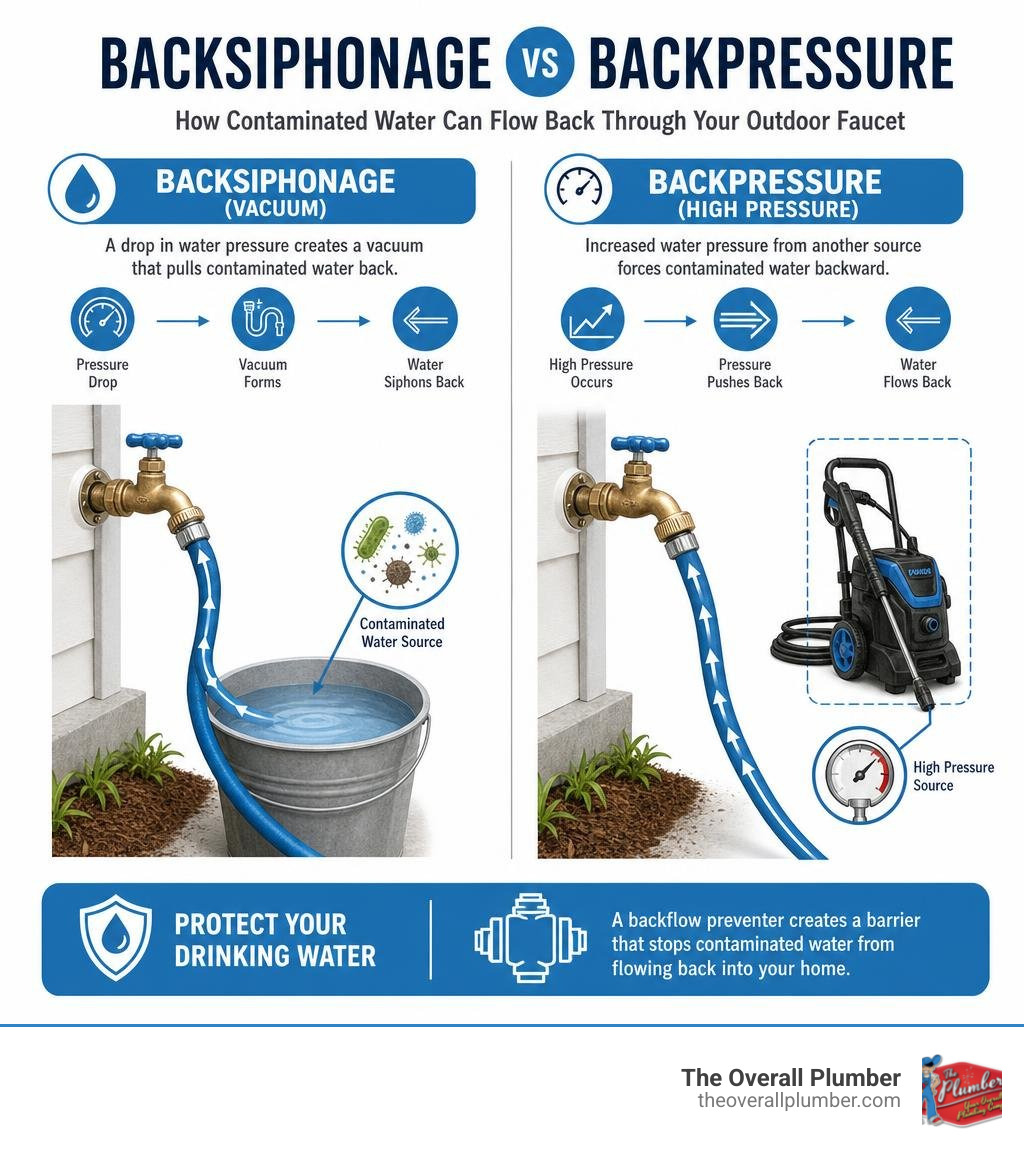
There are two primary ways backflow occurs:
- Backsiphonage: This happens when there is a sudden drop in the supply pressure. Think of it like drinking through a straw. If a water main breaks down the street in League City, or if firefighters hook up to a nearby hydrant to fight a fire, the pressure in the municipal lines drops dramatically. This creates a vacuum (negative pressure) that can pull water backward from your garden hose directly into your home’s drinking water.
- Backpressure: This occurs when the pressure downstream exceeds the supply pressure. For example, if you connect your hose to a high-pressure pump, a chemical sprayer, or an elevated irrigation system, the downstream pressure can push non-potable water backward past the faucet and into your clean water lines.
Any point where potable (drinking) water meets non-potable water is called a cross-connection. Your outdoor spigot is one of the most common and hazardous cross-connections in any residential property. If you are washing your car with a soapy sponge in a bucket, spraying weed killer with a hose-end attachment, or filling up a swimming pool, a sudden pressure drop can suck those chemicals and pathogens into your kitchen sink or shower.
To learn the industry lingo, you can explore our guide on backflow valve terms demystified.
Furthermore, protecting our public drinking water is a legal responsibility. The Texas Commission on Environmental Quality enforces strict TCEQ Cross-Connection Control guidelines to ensure that private residences do not accidentally pollute the public water distribution system. By installing a simple, inexpensive backflow preventer for outside faucet systems, you protect both your family and your neighbors.
Main Types of Outdoor Backflow Prevention Devices
Depending on your specific outdoor water setup, different types of backflow preventers may be required. While a simple garden hose only needs a basic screw-on device, dedicated outdoor irrigation systems or commercial setups require heavy-duty assemblies.
The three main types of outdoor backflow prevention devices include:
- Hose Bib Vacuum Breakers (HBVBs): These are the small, inexpensive brass devices that screw directly onto your outdoor spigot. They are designed specifically for low-hazard, non-continuous pressure applications like garden hoses.
- Double Check Valve Assemblies (DCVAs): These assemblies feature two independent spring-loaded check valves. They are designed for continuous pressure systems but are only rated for non-health hazard applications (e.g., preventing clean water from flowing backward, but not toxic chemicals).
- Reduced Pressure Zone (RPZ) Assemblies: These are the gold standard for high-hazard protection. They feature two independent check valves with an intermediate relief valve that vents to the atmosphere. If pressure drops or a valve fails, the RPZ dumps the contaminated water onto the ground rather than letting it enter your home.
Here is a quick comparison table to help you understand which device is right for your application:
| Device Type | Hazard Level | Pressure Type | Common Application | Testing Required? |
|---|---|---|---|---|
| Hose Bib Vacuum Breaker | Low to Moderate | Non-Continuous (under 12 hours) | Garden hoses, hand-watering | No (but inspect regularly) |
| Double Check Valve | Low / Non-Health | Continuous | Basic fire lines, clean water loops | Yes (Annually) |
| Reduced Pressure Zone (RPZ) | High (Health Hazard) | Continuous | Lawn sprinklers, chemical injectors | Yes (Annually) |
For larger, dedicated irrigation systems or high-hazard residential applications, we often recommend high-quality commercial-grade hardware. For instance, you can review the Zurn Wilkins 975XL2 RPZ Valve specifications, which is one of the most reliable and widely approved reduced pressure principle assemblies on the market.
How a Vacuum Breaker Works as a Backflow Preventer for Outside Faucet Systems
The most common backflow preventer for outside faucet protection is the Hose Bib Vacuum Breaker (HVB). But how does this little brass fitting actually keep your water safe?
Inside a vacuum breaker is a small, spring-loaded check valve and an atmospheric vent.
- Under normal flow: When you turn on your outdoor faucet, the water pressure pushes the internal check valve open, sealing off the atmospheric vent holes and allowing water to flow smoothly out of your hose.
- During pressure reversal: If a pressure drop occurs (causing backsiphonage), the spring-loaded valve immediately snaps shut, blocking the path back into the faucet. Simultaneously, the atmospheric vent opens, allowing air to enter the system. This breaks the vacuum (the “siphon” effect) and vents any backward-flowing water harmlessly out of the weep holes.
It is important to note that vacuum breakers are only designed for non-continuous pressure. This means you should not leave your faucet turned on with the hose shut-off valve closed for more than 12 hours at a time. Keeping a vacuum breaker under constant pressure can cause the internal spring to fatigue, leading to premature failure.
If you are dealing with older spigots or need to repair indoor plumbing fixtures alongside your outdoor upgrades, check out our comprehensive indoor faucet repair guide.
Choosing the Right Backflow Preventer for Outside Faucet Safety
When selecting a backflow preventer, you must evaluate the hazard level of whatever is connected to your faucet.
If you are simply watering your flowerbeds or rinsing off your driveway, a standard hose bib vacuum breaker is perfect. However, if your outdoor faucet feeds a dedicated underground sprinkler system where water sits stagnant in the soil, or if you run a continuous pressure line to an outdoor greenhouse, you need a more robust solution.
For continuous pressure applications that pose a non-health hazard, a double check valve is often the ideal choice. A great example of this is the Watts LF007M3 Double Check Valve Assembly, which features a lead-free copper silicon alloy body and quarter-turn shutoff valves for easy maintenance.
Always consult with a professional to ensure your backflow preventer matches the required safety rating for your specific outdoor water setup.
Key Features to Look For and Installation Steps
When shopping for a backflow preventer for outside faucet use, don’t just grab the cheapest plastic piece on the shelf. Look for these essential features to ensure durability and code compliance:
- Solid Brass Construction: Brass resists corrosion, stands up to high water pressures (often rated up to 125 PSI or more), and handles the harsh Texas sun much better than plastic.
- Standard GHT Threads: Ensure the device features standard 3/4-inch Garden Hose Threads (GHT) so it easily screws onto your existing faucet and accepts standard hoses.
- ASSE Certification: Look for devices stamped with ASSE 1011 (for hose connection vacuum breakers). This certification guarantees the device has been rigorously tested to meet safety standards.
- Breakaway Set Screw: Many high-quality vacuum breakers come with a small set screw. Once you tighten the device onto your faucet, you tighten this screw until the head shears off, making the installation permanent and preventing tampering.

Step-by-Step DIY Installation:
- Turn off the water: Shut off the water supply to the outdoor faucet (either at the local shutoff valve inside your home or at the main water meter).
- Remove existing attachments: Unscrew any garden hoses, splitters, or timers currently attached to your spigot. Clean the threads of the spigot with a wire brush to remove rust or mineral buildup.
- Thread the device: Screw the hose bib vacuum breaker directly onto the spigot threads by hand, turning clockwise. Tighten it securely using a wrench or pliers (be careful not to over-tighten and damage the spigot).
- Secure the set screw (Optional): If your device has a breakaway set screw and you want a permanent installation, use a flathead screwdriver or Allen wrench to tighten the screw until the head snaps off.
- Test for leaks: Turn the water supply back on and open the faucet. Check for any leaks around the threads. If you notice spraying or dripping, you may need to apply a small amount of Teflon tape to the spigot threads.
For more tips on dealing with stubborn drips or troubleshooting outdoor plumbing, read our guide on faucet leaks.
If you prefer a highly rated commercial option, products like the SUNGATOR 2-Pack Hose Bib Backflow Preventer, 3/4 Inch GHT… offer solid brass construction, ASSE 1011 certification, and a handy breakaway set screw for a reliable, code-compliant DIY upgrade.
Maintenance, Troubleshooting, and Plumbing Codes
Like any mechanical plumbing device, a backflow preventer for outside faucet protection requires regular maintenance to perform its job effectively.
Winterization and Freeze Protection
Here on the Texas Gulf Coast — from Houston down to Galveston — we don’t get deep freezes every week, but when we do, they can be devastating. Water trapped inside a brass vacuum breaker will expand as it freezes, cracking the brass casing or destroying the delicate plastic check valve inside.
To prevent freeze damage:
- Always disconnect your garden hoses before the first freeze.
- Drain any residual water from the spigot and the vacuum breaker.
- Cover your outdoor spigots with insulated foam faucet covers.
- If you have a larger backflow assembly (like an RPZ or double check valve) for your irrigation system, wrap the entire unit in insulated blankets or have us professionally drain and winterize the system.
Local Plumbing Codes and Regulations
Many homeowners don’t realize that backflow prevention is heavily regulated. In League City, Pearland, and across Harris and Galveston counties, local building codes require backflow protection on all outdoor water outlets.
For instance, you can review the official League City FAQ on backflow prevention to understand municipal testing mandates. For larger irrigation backflow assemblies, cities typically require annual testing performed by a licensed, certified Backflow Prevention Assembly Tester (BPAT) to verify the device is operating correctly.
If you need help ensuring your home’s outdoor plumbing is fully up to code, our team offers comprehensive residential plumbing services tailored to local municipal guidelines.
Frequently Asked Questions About Outdoor Backflow Prevention
How do I know if my outdoor spigot already has backflow protection?
Many modern frost-free outdoor spigots come with built-in backflow protection. To check, look at the top of the faucet body. If you see a wide, flat metal cap (often plastic or brass) near the handle, that is an integrated atmospheric vacuum breaker. Additionally, some newer models feature a tiny weep hole near the handle stem that vents water when turned off, indicating built-in siphon protection. If your spigot is just a basic, smooth brass pipe with threads, it does not have built-in protection, and you must install an external vacuum breaker.
Why is my hose connection vacuum breaker leaking water?
It is completely normal for a vacuum breaker to spray or drip a small amount of water from its weep holes immediately after you turn off the faucet. This is simply the device venting the pressure and releasing the water trapped in the hose. However, if the device sprays water continuously while the faucet is turned on, or if it leaks constantly when the hose is in use, the internal rubber seals are likely worn out, or debris (like sand or mineral scale) is blocking the check valve. Because these devices are inexpensive, it is usually easiest to replace the entire unit.
Can a backflow preventer freeze and burst in the winter?
Yes, absolutely. Brass is incredibly strong, but the force of expanding ice is stronger. If you leave a hose attached during a freeze, water cannot drain from the vacuum breaker, leading to cracked brass, broken internal springs, and major leaks come springtime. Always disconnect hoses and insulate your spigots before freezing temperatures hit the Texas coast.
Schedule Your Professional Backflow Valve Plumbing Inspection Today
Don’t leave the safety of your family’s drinking water to chance. Whether you need a simple hose bib vacuum breaker replaced, a heavy-duty RPZ valve tested for your lawn irrigation system, or a complete outdoor spigot upgrade, our team at The Overall Plumber is here to help.
We proudly serve homeowners throughout Brazoria County, Houston, Clear Lake, Santa Fe, League City, Texas City, La Porte, Friendswood, Pearland, Pasadena, Galveston, Harris County, and Galveston County, Texas. When you work with us, you get the peace of mind that comes with our ultimate satisfaction guarantees, priority scheduling, and absolutely no overtime fees or trip charges.
Protect your home’s water supply today. To schedule your professional backflow valve plumbing inspection or learn more about our money-saving plumbing protection plans, contact our team today at (281) 668-9000.