


Don’t Let Your Plumbing Go Rogue
Your Home’s Drinking Water Is One Pressure Drop Away From Contamination
A backflow valve residential installation is one of the most important — and most overlooked — ways to protect your family’s drinking water. Here’s what you need to know at a glance:
Quick Answer: What Does a Residential Backflow Valve Do?
| Question | Answer |
|---|---|
| What is it? | A one-way valve that stops contaminated water from flowing backward into your clean water supply |
| Why does it matter? | Pressure drops, main line breaks, or fire hydrant use can reverse water flow into your home |
| Where is it installed? | At the water meter, hose bibs, irrigation lines, or individual outlets |
| Is it required? | Often yes — especially for irrigation systems and in many new home builds |
| Who installs it? | A licensed plumber (required in most jurisdictions) |
Your home’s water supply flows in one direction — from the municipal main into your taps. But that flow can reverse. When it does, everything connected to your pipes — fertilizers from your sprinkler system, pool chemicals, even raw sewage — can be pulled backward into the water your family drinks.
This isn’t a rare edge case. A break in the main water line, a nearby fire hydrant being opened, or a sudden pressure drop in the city system can all trigger backflow in seconds. And most homeowners have no protection in place.
The average cost to repair a flooded basement from sewage backup alone tops $40,000 — not counting health risks or insurance impacts. A backflow preventer costs a fraction of that.
I’m Dayton Whitworth, a second-generation plumber serving Greater Brazoria County, Galveston County, Houston, and the surrounding Gulf Coast, with hands-on experience installing and inspecting backflow valve residential systems across dozens of local homes. In this guide, I’ll walk you through everything you need to know to protect your water supply the right way.
Understanding the Backflow Valve Residential Protection System
To understand why a backflow valve residential setup is vital, we first have to look at how your home “talks” to the city’s water supply. Think of your plumbing as a two-way street that is supposed to be a one-way alley. Under normal conditions, the city pumps water at a high pressure into your home. This pressure keeps the water moving toward your faucets, showerheads, and appliances.
However, a “cross-connection” exists anywhere your clean (potable) water supply meets a source of pollution. This could be a garden hose submerged in a swimming pool, a lawn irrigation head sitting in a puddle of fertilizer, or even a connection to a home boiler.
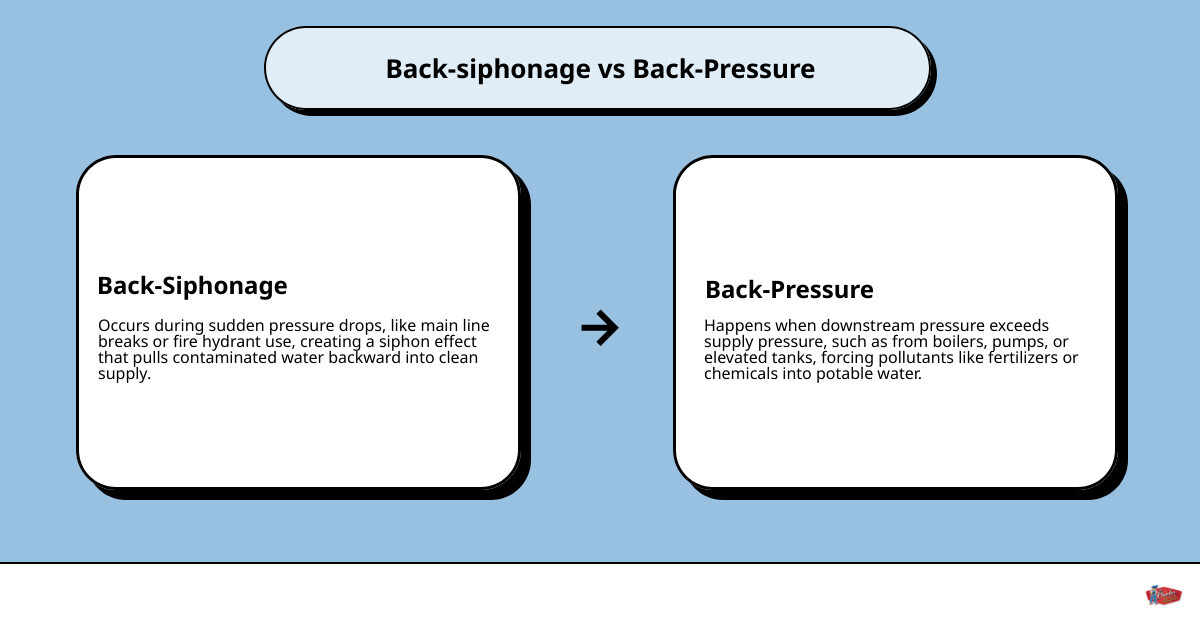
Backflow happens in two ways:
- Back-siphonage: This occurs when there is a sudden drop in city water pressure. If a water main breaks in League City or the fire department opens a hydrant in Pearland to fight a blaze, the pressure in the street drops below the pressure in your home. This creates a vacuum effect, literally sucking water backward from your pipes and into the public supply.
- Back-pressure: This happens when the pressure inside your home’s system becomes higher than the city’s supply pressure. This is common in homes with pumps, boilers, or elevated tanks.
Without a mechanical barrier, these pressure changes allow “rogue” water to travel the wrong way. The Texas Commission on Environmental Quality (TCEQ) provides extensive guidelines on Cross-Connection Control and Backflow Prevention to help municipalities manage these risks, but the responsibility for the hardware inside your property line often falls on you, the homeowner.
Essential Backflow Valve Residential Types
Not all backflow preventers are created equal. Depending on the level of “hazard” (how toxic the stuff is that might flow backward), we install different types of assemblies. In the Texas Gulf Coast region, we typically see these five types:
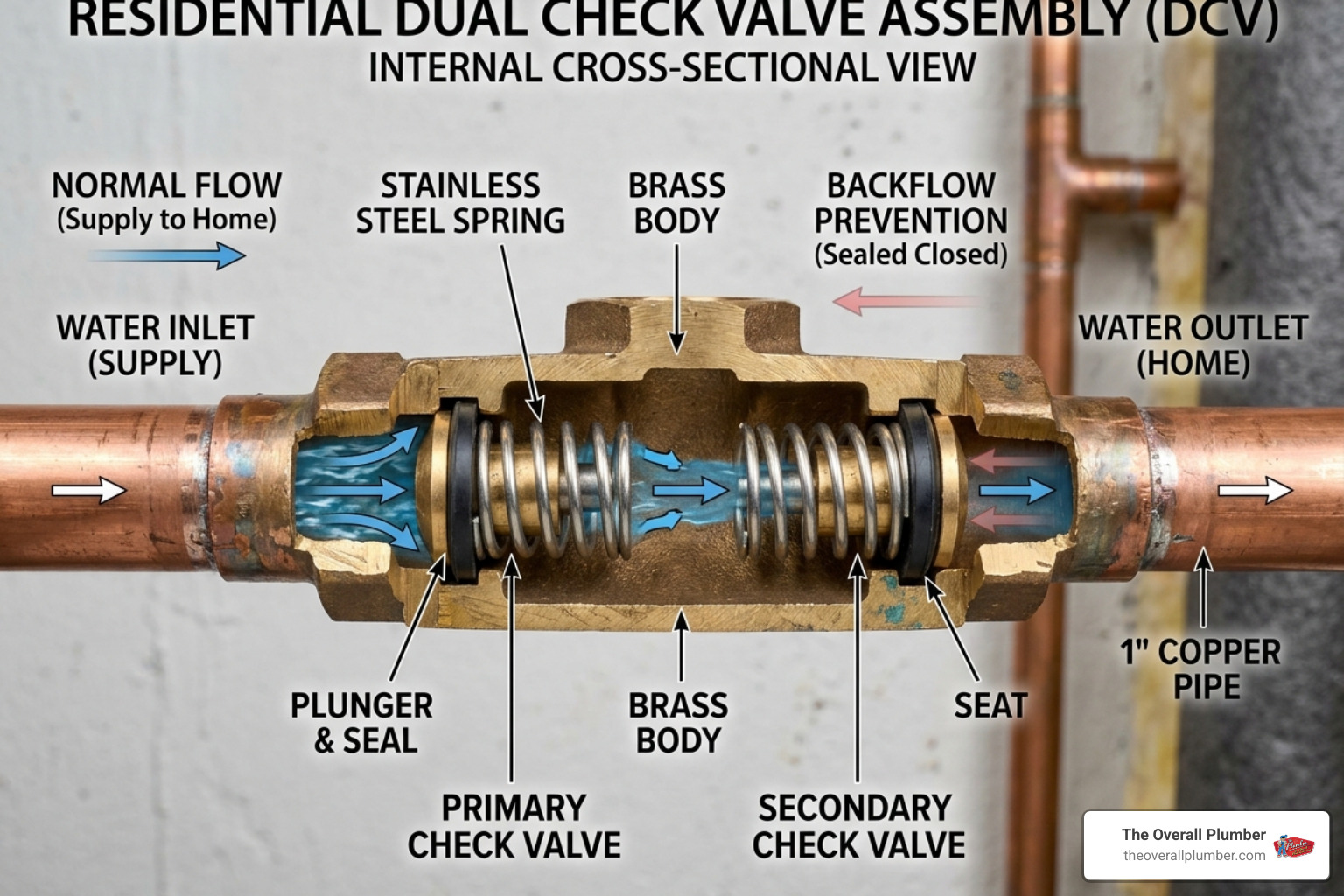
- Double Check Valve Assembly (DCVA): These consist of two independent check valves. They are great for “moderate” hazards. They are often used in underground vaults because they don’t vent water, but they must be tested annually to ensure the internal springs haven’t worn out.
- Reduced Pressure Zone (RPZ) Assembly: These are the “Gold Standard” of protection. An RPZ has two check valves plus a relief valve that dumps water out if it senses a pressure imbalance. Because they vent water, they must be installed above ground. These are required for “high-hazard” situations where the backflow could be toxic.
- Pressure Vacuum Breaker (PVB): Very common for residential irrigation systems in areas like Friendswood and Clear Lake. They protect against back-siphonage but cannot handle back-pressure. They must be installed at least 12 inches higher than the highest sprinkler head.
- Atmospheric Vacuum Breaker (AVB): The simplest form of protection, often seen on the end of a hose bib or a utility sink. These are inexpensive but only work if they aren’t under constant pressure.
- Dual Check Valve: Often used at the main water meter for residential containment. Modern versions, like the LF7R – Watts, are lead-free and feature replaceable internal modules, making them a favorite for long-term residential use.
Backflow Preventers vs. Backwater Valves
One of the most common points of confusion for homeowners in Houston and Pasadena is the difference between a backflow preventer and a backwater valve. While they sound similar, they protect against two entirely different “enemies.”
Backflow Preventers protect your drinking water. They are installed on the pipes that bring water into your house. Their job is to keep chemicals, fertilizers, and minerals out of your coffee, tea, and bathwater.
Backwater Valves protect your home from sewage. These are installed on your sewer lateral (the pipe that takes waste away). When the city’s sewer system surcharges due to a heavy Texas rainstorm, the backwater valve closes a flap to prevent raw sewage from geysering up through your basement drains or ground-floor toilets.
As noted by Backwater valves – Canada.ca, these valves are mechanical devices that require regular cleaning to ensure debris doesn’t prop the flap open. In our neck of the woods, where flooding is a constant threat, having both is the only way to ensure total plumbing security.
Why Your Home Needs a Backflow Preventer
You might think, “My water looks fine, why do I need this?” The reality is that water contamination is often invisible, odorless, and tasteless.
Consider the common garden hose. If you leave your hose submerged in a bucket of soapy car-wash water or a pool of liquid fertilizer, and a nearby water main breaks, that “chemical cocktail” is sucked directly into your kitchen faucet. This isn’t just theory; it’s a documented health risk.
According to Backflow Prevention in your Home | Water Utility | City of Madison, WI, some of the most common household contaminants include:
- Fertilizers and Pesticides: Siphoned from lawn irrigation systems.
- Human Waste: Backed up from cross-connected sewer lines.
- Pool Chemicals: Chlorine and acid from auto-fill systems.
- E. coli and Bacteria: From stagnant water in hoses or storage tanks.
- Boiler Chemicals: Anti-corrosion agents used in home heating systems.
In cities like Santa Fe and Texas City, where many homes utilize outdoor irrigation or have older plumbing configurations, the risk of “back-siphonage” is real. Installing a backflow valve residential unit ensures that even if the city’s pressure fails, your family’s health remains protected.
Choosing the Right Backflow Valve Residential Size
Choosing a valve isn’t as simple as grabbing the first one you see at the hardware store. If you install a valve that is too small, you’ll experience a massive drop in water pressure (PSI) and flow rate (GPM). If it’s too large, it may not function correctly under low-flow conditions.
When we size a valve for a home in Galveston or Harris County, we look at:
- Pipe Diameter: Most residential lines are 3/4″ or 1″. The valve must match the pipe size to avoid turbulence.
- Pressure Requirements: You need to know your home’s static pressure. Some valves, like the Watts LFH7, are rated for a maximum working pressure of 150 PSI.
- Flow Rate: For a standard home, a valve should handle at least 15–25 gallons per minute (GPM) without a significant “pressure drop.”
- Application: Is it for the whole house (premise isolation) or just a single sprinkler line?
Installation and Legal Requirements for Homeowners
In many parts of Texas, including League City and La Porte, backflow prevention isn’t just a good idea—it’s the law. Local plumbing codes usually mandate that any “high-hazard” connection, such as an irrigation system or a swimming pool, must have a certified backflow assembly installed.
Key installation considerations include:
- Orientation: Some valves only work horizontally; others can be installed vertically. Installing a valve in the wrong orientation can lead to internal failure.
- Location: Valves should be installed where they are accessible for testing. For RPZ valves, they must be above ground because they need to drain water. In our area, this often means installing them in a “hot box” or insulated enclosure to protect them from rare but damaging freezes.
- Professional Certification: In cities like Ottawa, the Backflow Prevention Program requires specific “premise isolation” for certain hazards. Locally, many Texas municipalities require that the person installing and testing the valve be a licensed Backflow Prevention Assembly Tester (BPAT).
If you are building a new home in Pearland or remodeling in Pasadena, you will likely need a permit for the installation. A licensed plumber will ensure the device is “lead-free” (compliant with the Safe Drinking Water Act) and correctly positioned to pass municipal inspection.
Maintenance, Testing, and Professional Care
A backflow valve residential assembly is a mechanical device with moving parts—springs, rubber seals, and internal gates. Over time, minerals in the water can build up (calcification), or seals can crack. If a valve fails, it won’t give you a warning sign; it will simply stop stopping the backflow.
This is why annual testing is critical. During a Back-flow Valve Plumbing Inspection, we use specialized gauges to check the pressure differential across the check valves. If the valve isn’t holding back the required amount of pressure, it needs to be cleaned or rebuilt with a repair kit.
Maintenance Frequency Comparison
| Valve Type | Recommended Maintenance | Common Failure Point |
|---|---|---|
| RPZ Assembly | Annual Testing (Required) | Relief valve fouling from debris |
| Double Check | Annual Testing | Worn rubber discs/springs |
| PVB (Irrigation) | Annual Testing / Winterization | Plastic internal parts cracking in freeze |
| Hose Bib Vacuum Breaker | Seasonal Inspection | O-ring leaks or “sticking” open |
Regular maintenance doesn’t just keep you legal; it prevents the $40,000 disaster mentioned earlier. Cleaning the valve twice a year to remove grease or silt is a simple way to extend its lifespan.
Frequently Asked Questions About Residential Backflow
Can I install a backflow preventer myself?
While you can technically buy a valve at a big-box store, we strongly advise against DIY installation. Most local regulations in Brazoria and Galveston County require a licensed plumber to pull a permit and a certified tester to “tag” the device. If installed incorrectly, you could accidentally contaminate your own home or the city’s water, leading to massive liability.
How much does a residential backflow valve cost?
A basic hose bib vacuum breaker might cost $10–$20. However, a whole-house backflow valve residential assembly (like a 1″ Double Check or RPZ) typically ranges from $150 to $600 for the hardware alone. Labor for professional installation and the initial certification test usually adds another $200–$500, depending on the complexity of your plumbing.
What are the signs of a backflow issue?
Backflow is often a “silent” problem, but you should call us immediately if you notice:
- Discolored water (yellow, brown, or green) coming from your taps.
- Foul odors like sulfur or sewage when you run the water.
- Sudden pressure changes in your home.
- Visible leaks or constant dripping from your backflow assembly’s relief valve.
Secure Your Home’s Water Safety Today
Contact our expert team today to schedule your inspection and ensure your home remains a safe haven. For more information, check out our guide on back-flow valve plumbing inspection to see how we can help.
Call us today at tel:1-800-555-0199