

The Right Basement Sewer Cleanout Kit Makes All the Difference
Quick answer: A basement sewer cleanout kit typically includes these core parts:
| Component | What It Does |
|---|---|
| Cleanout plug (brass, PVC, or expansion) | Seals the access opening in the pipe |
| Cover plate (flush or raised) | Protects the plug and integrates with flooring |
| PTFE thread tape or pipe compound | Creates a leak-proof, gas-tight seal on threads |
| Pipe wrench or channel locks | Removes and installs the plug safely |
| Stainless steel floor cover | Keeps the access point flush and walkable |
Choosing the wrong size plug or the wrong cap type means either a leaking sewer gas hazard or a cap you can’t remove during an emergency — neither is a good situation.
Most homeowners only think about their basement sewer cleanout when something goes wrong. A toilet backs up. The shower drain gurgles. Water pools on the basement floor at midnight. That’s exactly the wrong time to realize you don’t know where your cleanout is, what size it is, or whether the cap will even come off.
The good news is that getting the right parts ahead of time is simple — if you know what to look for.
I’m Dayton Whitworth, a second-generation plumber serving Greater Brazoria County, Galveston County, Houston, and the surrounding Gulf Coast, and I’ve responded to dozens of calls where the right basement sewer cleanout hardware — or the lack of it — determined whether a backup became a minor inconvenience or a costly cleanup. In the sections below, I’ll walk you through exactly what you need so you’re prepared before a problem starts.
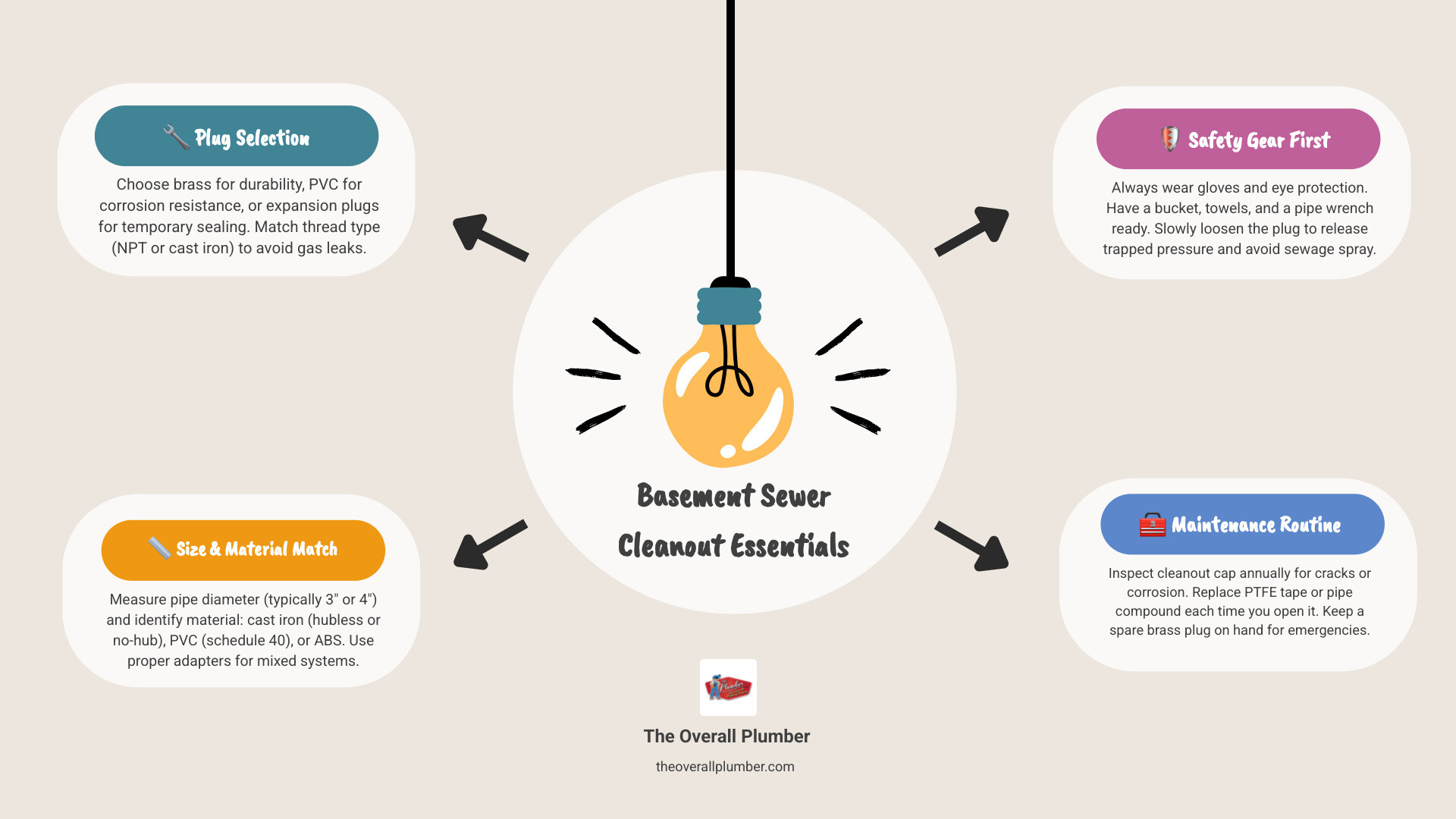
Simple basement sewer cleanout word guide:
Understanding Your Basement Sewer Cleanout and How It Works
A basement sewer cleanout is a dedicated access point on your home’s main building drain. Its sole purpose is to give plumbers—and brave DIYers—direct access to the lateral sewer line. Without this access point, clearing a major blockage requires pulling toilets off their wax rings, climbing onto the roof to run a snake down a vent stack, or, in the worst-case scenario, jackhammering your concrete slab.
Historically, sewer cleanouts became standard in US building codes during the 1940s. If your home was built before then, it might not have one at all unless a previous owner retrofitted it.
For homes that do have them, the materials used reflect the era of construction. About 76 million homes in America still have cast iron sewage lines with brass or cast iron drain cleanouts. In contrast, modern homes built over the last few decades typically feature durable white PVC or black ABS plastic pipes.
According to the International Plumbing Code (IPC) and Uniform Plumbing Code (UPC), cleanouts must be located not more than 100 feet apart for sewer lines. For smaller drain lines of 4 inches in diameter or less, the maximum spacing drops to 50 feet. Additionally, a cleanout must be installed at each change of direction greater than 45 degrees in the sewer line. These strict rules ensure that no matter where a clog forms, a plumbing snake or hydro-jetting nozzle can reach it.
Where is the Basement Sewer Cleanout Located?
Finding your cleanout in a finished or cluttered basement can feel like a treasure hunt. However, plumbing layouts follow logical patterns.
To find an indoor cleanout, look for your vertical soil stack—the large 3-inch or 4-inch pipe that runs floor-to-ceiling, carrying waste from upper floors. Follow this pipe down to where it curves to go under your concrete slab. The cleanout is typically a Y-shaped or T-shaped fitting located right at the base of this stack or within a few feet of where the main line exits the foundation wall on the street-facing side.
If you are dealing with a finished basement where the pipes are hidden behind drywall, check out Sewer Lines 101: How to Locate Them for practical strategies. If your cleanout has been buried under carpet, tile, or even a layer of poured concrete during a past renovation, you can read The Ultimate Guide to Finding Your Sewer Line Without Making a Mess to learn how we locate hidden lines using specialized diagnostic equipment.
One-Way vs. Two-Way Cleanouts
When selecting replacement parts or planning an upgrade, it is vital to understand the difference between a one-way and a two-way cleanout.
- One-Way Cleanouts: This setup features a single angled pipe that only allows a plumber to run tools in one direction—usually downstream toward the municipal sewer main or septic tank. If you have a clog directly underneath your basement floor, a one-way cleanout won’t let you run a snake backward toward the house.
- Two-Way Cleanouts: A two-way cleanout consists of a double-fitting (often shaped like a “U” or a double “Y”) that allows tools to be sent in both directions. This is the gold standard of plumbing access. It allows us to clear blockages heading out to the street as well as those running back under your home’s foundation.
If you are retrofitting or replacing your main access point, upgrading to a two-way system is always the smartest investment.
Essential Components of a Basement Sewer Cleanout Kit
If you are purchasing a basement sewer cleanout kit, you need to make sure the components match your existing pipe material, pipe size, and flooring plans. A standard kit is designed to seal the line securely against sewer gas leaks while keeping the point accessible for future maintenance.
| Plug Type | Material | Best Used For | Pros | Cons |
|---|---|---|---|---|
| Threaded Plug | Brass or PVC | Threaded female adapters | Highly durable, positive mechanical seal | Can seize over time if threads are not lubricated |
| Expansion Plug | Rubber and steel | Damaged or unthreaded pipes | Easy to install, fits irregular openings | Not as permanent as a threaded mechanical seal |
| Fit-All Plug | Lead and plastic | Seized or stripped cast iron threads | Conforms to worn out threads | Requires careful installation to avoid damage |
Choosing the Right Cleanout Plug and Cover Plate
The type of plug you choose dictates how the cleanout sits relative to your basement floor.
If your basement is unfinished, a standard raised head plug is perfectly fine. These plugs feature a square or hexagonal nut that sticks up, making them incredibly easy to grab with a pipe wrench.
However, if you are planning to finish your basement, put down new flooring, or turn the space into a playroom, a raised plug is a major tripping hazard. In this scenario, you want a flush-type plug that sits entirely inside the pipe threads, level with the floor. You can then install a stainless steel cover plate over it. This plate screws into the center of the flush plug, creating a flat, walkable surface that seamlessly integrates with your flooring. For more details on choosing these components, you can read What Does a Sewer Cleanout Look Like: Complete Guide for Homeowners – D and G Flooring.
Sizing and Material Compatibility
Before buying any parts, you must measure your pipe. Sewer cleanout pipes are typically 3 or 4 inches in diameter (and occasionally 6 inches in larger commercial properties).
You must also match materials. If you have older cast iron sewage lines, a brass or heavy-duty plastic plug works best. If you try to force a cheap, thin plastic plug into old, rusted cast iron threads, you risk stripping the plug or failing to get a gas-tight seal. For modern PVC or ABS systems, stick to matching plastic plugs to prevent thread damage. For a deep dive into how these materials interact, check out Sewer Cleanout: What it is & How to Find it | SERVPRO.
How to Safely Access and Maintain Your Cleanout
Your sewer cleanout is the gateway to your home’s waste system. While it is incredibly useful, opening it incorrectly can lead to a literal mess.
How to Safely Open a Basement Sewer Cleanout
If your home’s main line is backed up, there is a very high probability that the water level inside the pipe is higher than the cleanout itself. This means the water is under pressure. If you unscrew the cap quickly, you could face an immediate flood of raw sewage.
To open the cap safely, follow these steps:
- Wear Protection: Put on heavy-duty rubber gloves, safety goggles, and old clothes.
- Prepare the Area: Place a 5-gallon bucket directly under the cleanout and lay down old towels to catch any spills.
- Loosen Slowly: Use a high-quality pipe wrench or channel locks to turn the cap counterclockwise. Turn it extremely slowly—just a fraction of a turn at a time.
- Listen and Watch: If you hear air escaping, see water dripping out of the threads, or feel significant pressure pushing back against your wrench, stop turning immediately. Tighten the cap back up. This pressure indicates a massive column of standing sewage is waiting behind the plug. In this situation, trying to open the cap yourself will flood your basement, and it is time to call in a professional.
- Apply Lubricant: If the cap is seized (especially common with brass caps in old cast iron pipes), spray it with a generous amount of penetrating oil (like WD-40) and let it sit for 10 to 15 minutes before trying again.
For more safety protocols, read Sewer Line Clean Out Explained: 9 Critical Facts Property Owners Miss.
Managing Hidden Cleanouts Under New Flooring
If you are remodeling your basement, you might be tempted to lay carpet, luxury vinyl plank (LVP), or laminate right over that ugly cleanout cap. Do not do this.
Burying your cleanout is a recipe for disaster. If your sewer backs up at midnight, a plumber will have to cut through your brand-new flooring just to find the access point, turning a minor plumbing repair into an expensive flooring replacement.
Instead, install a flush-type plug and use a stainless steel floor cover plate. You can cut your flooring material neatly around the cleanout pipe and place the cover plate over it. If you are using LVP or laminate, some homeowners even build a small, removable access hatch that blends perfectly with the rest of the floor. This keeps the cleanout 100% accessible while keeping your basement looking beautiful. You can read more about flooring integration strategies at Sewage Clean Out: Complete Guide for Homeowners – D and G Flooring and What Is a Sewer Cleanout and Why Every Chicago Home Needs One.
If you’ve recently had your line cleared and are wondering why you’re still experiencing drainage issues, read Sewer Line Backing Up Days After Snaking: Here Is the Dirty Truth.
Frequently Asked Questions About Sewer Line Maintenance
What should I do if sewage spills out when opening the cleanout?
If you crack the seal and sewage starts pouring out, immediately tighten the plug back down. Stop using all water in the house—do not flush toilets, run the washing machine, or use the showers, as any water sent down the drains will only worsen the backup. Once the line is stabilized, call a licensed plumber to clear the main line blockage from an exterior cleanout or alternative access point.
Can I permanently cover my basement cleanout with carpet or concrete?
No. Building codes require cleanouts to remain fully accessible. Permanently covering a cleanout with concrete, tile, or carpet is a code violation and will dramatically increase your labor costs during a plumbing emergency. Always use a flush-fitting plug and an approved access cover.
How often should a basement sewer line be inspected?
For a standard single-family home, we recommend a professional sewer line inspection every 18 to 24 months. However, if your property has mature trees with invasive root systems, or if your home has older cast iron or clay pipes, you should have it inspected annually.
Regular inspections help catch root intrusion, pipe scale, and bellies before they cause a catastrophic backup. You can learn more about how we inspect these lines by visiting our page on Video Camera Sewer Line Inspection.
Professional Sewer Line Services and Solutions
While a DIY cleanout kit is excellent for minor cap replacements and aesthetic upgrades, clearing a major main line blockage requires professional power. Heavy-duty sewer blockages—like thick tree root intrusions, heavy grease buildup, or collapsed lines—cannot be solved with a basic hand snake.
At The Overall Plumber, we provide comprehensive drain cleaning using professional-grade motorized augers and high-resolution camera inspections to pinpoint the exact location and cause of your clog. We also offer plumbing protection plans to keep your home’s systems running smoothly year-round. Best of all, we offer repair services with no trip charges, satisfaction guarantees, priority scheduling, and absolutely no overtime fees.
If you are in Brazoria County, Houston, Clear Lake, Santa Fe, League City, Texas City, La Porte, Friendswood, Pearland, Pasadena, Galveston, Harris County, or Galveston County, we are here to help.
Schedule professional sewer line services in Houston with our experienced team today. For immediate assistance with your basement plumbing, contact our team today at 713-555-0199.