


Why Hot Water Service Installation Matters More Than You Think
Hot water service installation is one of those home jobs that affects your daily life more than almost anything else — and most people don’t think about it until they’re standing in a cold shower.
Here’s what you need to know right away:
- A licensed plumber should handle all hot water system installations for safety and code compliance
- Most standard installations take 2 to 4 hours
- Tank-style water heaters last 8 to 12 years; tankless systems can last up to 20 years
- The right system depends on your household size, fuel source, available space, and budget
- Heat pump water heaters may qualify for up to $1,750 in tax rebates
- Always pull required permits and schedule inspections — skipping this can void your warranty and create serious safety risks
Whether you’re replacing an aging unit or upgrading to a more efficient system, getting the installation right the first time saves money, stress, and cold mornings.
I’m Dayton Whitworth, a second-generation plumber serving Greater Brazoria County, Galveston County, Houston, and the surrounding Gulf Coast, with hands-on experience across every type of hot water service installation — from straightforward tank swaps to full fuel-source conversions. In this guide, I’ll walk you through everything you need to make a confident, informed decision for your home.
Key hot water service installation vocabulary:
- cost of a 50 gallon electric water heater
- cost to have water heater installed
- hot water expansion tank install
Choosing the Right Hot Water System for Your Home
Selecting a new water heater is not a one-size-fits-all decision. The system you choose dictates your daily comfort, monthly utility bills, and how much space is left in your garage or utility closet. Across Houston, Pearland, and Pasadena, homeowners typically choose between five main types of hot water systems:
Electric Storage Water Heaters
These traditional systems use insulated tanks to keep a reservoir of water hot and ready. They rely on electric heating elements submerged inside the tank. They are highly reliable, have a lower upfront purchase price, and do not require venting. However, they are generally more expensive to run monthly compared to gas.
Gas Storage Water Heaters
Operating similarly to electric storage tanks, gas models use a burner at the bottom of the tank to heat the water. They require proper venting to safely exhaust combustion gases outside. Gas models heat water much faster than electric ones (a faster recovery rate), making them excellent for busy households in League City and Friendswood.
Tankless (On-Demand) Systems
Instead of keeping 40 or 50 gallons of water hot all day, tankless systems use powerful gas burners or electric elements to heat water instantly as it flows through the unit. This means you enjoy endless hot water and a much smaller physical footprint. While the initial hot water service installation is more complex, they last up to 20 years and cut energy waste significantly.
Solar-Boosted Systems
Solar water heaters use roof-mounted collectors to absorb solar energy, transferring that heat to your water supply. Because we get plenty of Texas sunshine, solar-boosted systems can dramatically lower your energy bills. They usually feature an electric or gas backup element to keep things hot on cloudy days.
Heat Pump (Hybrid) Water Heaters
These highly efficient systems pull heat from the surrounding air and transfer it into the storage tank. They use up to 60% less electricity than standard electric water heaters. Because they require at least 450 cubic feet of air space to operate effectively, they are perfect for open garage installations in places like Santa Fe and Galveston.
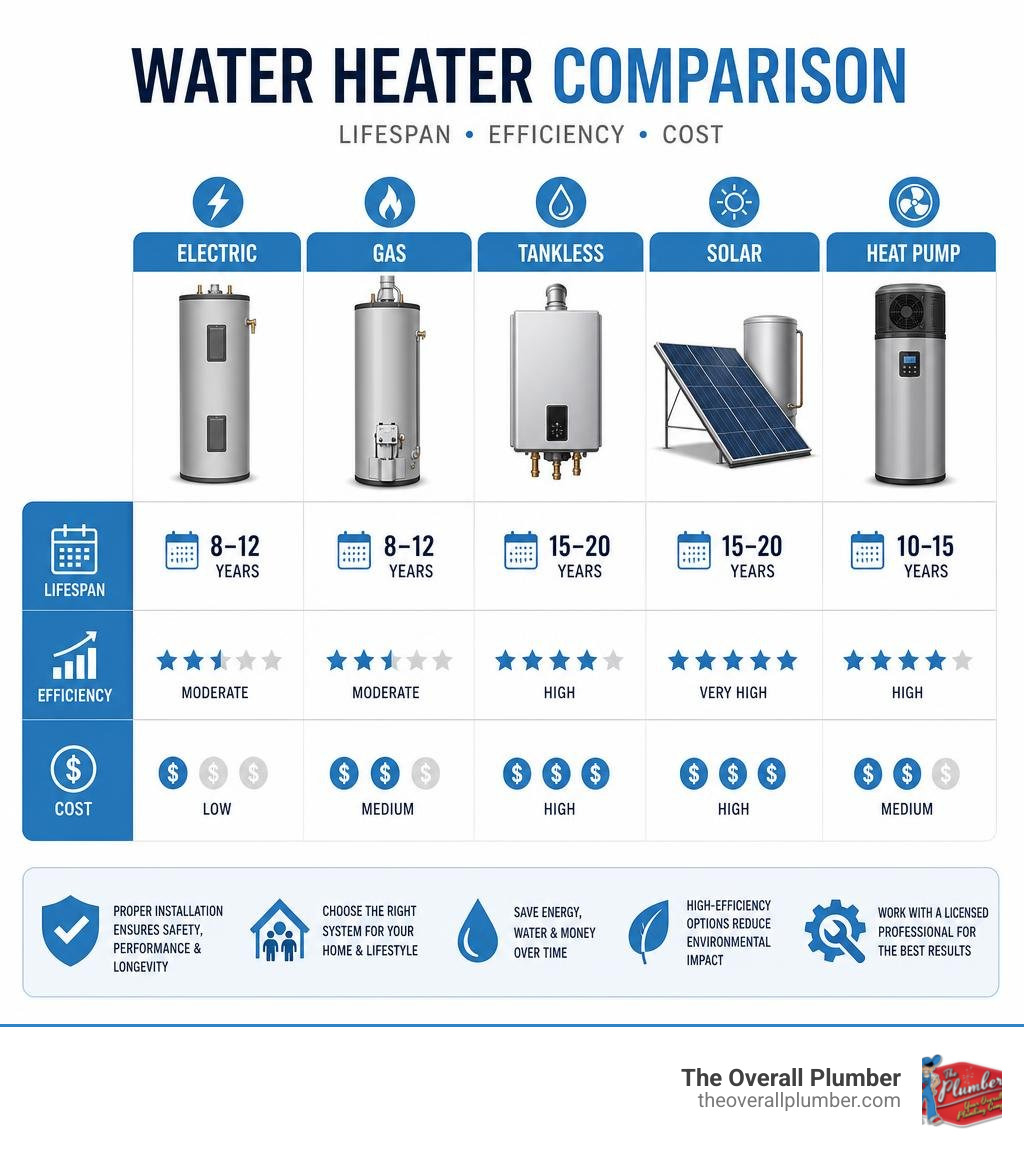
To help you understand your choices at a glance, here is a comparison of what to expect from each system type:
| Water Heater Type | Average Lifespan | Relative Upfront Cost | Energy Efficiency |
|---|---|---|---|
| Electric Storage | 8–12 Years | Low | Moderate |
| Gas Storage | 8–12 Years | Moderate | Moderate |
| Tankless (On-Demand) | Up to 20 Years | High | Very High |
| Heat Pump (Hybrid) | 10–15 Years | High | Extremely High |
| Solar-Boosted | 15–20 Years | Very High | Extremely High |
Sizing your system correctly is just as important as choosing the fuel type. A tank that is too small leaves you shivering mid-shower, while an oversized tank wastes energy keeping unnecessary water hot. Most average families of three to four people require a 40- to 50-gallon tank. For tankless systems, sizing is calculated by flow rate (gallons per minute) to ensure the unit can handle multiple fixtures running at the same time.
If you want to dive deeper into system options, brands, and price points, check out our guide on Heating Up: Everything You Need to Know About Water Heater Sales.
Key Factors Influencing Hot Water Service Installation Costs

When budgeting for a new water heater, the cost of the physical unit is only one part of the equation. Several site-specific variables dictate how complex—and costly—the actual installation will be.
- Site Conditions and Access: If your water heater is located in a tight attic, an awkward crawlspace, or behind a narrow closet door in an older home, maneuvering the old tank out and the new one in takes extra time and labor.
- Existing Plumbing and Pipework: Over time, copper and PEX pipes degrade, and shutoff valves can freeze in place. If we need to replace corroded lines, install a new thermal expansion tank, or upgrade your drainage lines to prevent water damage, this adds to the overall scope of the project.
- Fuel Source Conversions: Swapping an old electric water heater for a new electric model is relatively straightforward. However, converting from electric to gas—or switching from a traditional tank to a tankless system—requires running new gas lines, updating electrical circuits, and installing dedicated ventilation pathways.
- Local Climate Requirements: Along the Gulf Coast, from Texas City to Clear Lake, local building codes require specific windstorm strapping and elevated platforms in flood-prone areas to secure the system safely.
Understanding these variables ahead of time prevents surprise expenses. For a detailed breakdown of what to expect financially, read our article on How Much to Budget for Your New Water Heater Installation.
Step-by-Step Removal and Installation Process
A successful water heater replacement requires an organized, meticulous process to protect your home from water damage, gas leaks, and electrical hazards. Below is the general workflow our professional team follows for every standard replacement.
First, we isolate the system. This involves turning off the electrical breaker for electric models or shutting off the gas control valve for gas models. Next, we close the cold-water inlet valve to stop new water from entering the tank.
To drain the tank safely, we attach a heavy-duty hose to the drain valve at the bottom of the unit and run it to a safe drainage destination. We open a nearby hot water faucet to break the vacuum, allowing the water to drain smoothly. Once the tank is completely empty, we disconnect the water supply lines, gas connections, or electrical wiring, and carefully remove the old unit for eco-friendly disposal.
For more technical background on general setup and preparation, you can read A Comprehensive Guide to Water Heater Installation.
Step-by-Step Gas Hot Water Service Installation
Installing a gas water heater demands absolute precision to ensure fuel lines are sealed and exhaust fumes exit your home safely.
- Positioning and Leveling: We place the new water heater in position, ensuring it sits perfectly level on an approved drain pan to prevent structural water damage in case of a future leak.
- Water Connections: We connect the hot and cold water lines using high-quality flexible connectors and apply plumber’s tape to all threaded joints to prevent slow leaks.
- Venting Setup: We connect the draft hood to the vent pipe, checking that the exhaust flue has a continuous upward slope to safely carry carbon monoxide out of your home.
- Gas Line Connection: We connect the gas supply line to the water heater’s control valve using an approved flexible gas connector and a dedicated gas shutoff valve.
- Leak Testing: Before lighting the burner, we perform a soap bubble test. We coat all gas joints with a specialized soap solution; if bubbles form, it indicates a tiny gas leak that must be tightened and retested immediately.
- Filling and Ignition: We open the water valves to fill the tank completely. Once full, we purge air from the lines, check for water leaks, and safely light the pilot light following the manufacturer’s instructions.
For detailed technical specifications on gas safety and heavy-duty gas systems, you can review the official Owner’s Guide Installation Instructions .
Step-by-Step Electric Hot Water Service Installation
Electric water heaters do not require gas lines or exhaust venting, but they demand highly precise electrical work to avoid short circuits and fire hazards.
- Placement: We position the unit in its drain pan, making sure there is adequate clearance to access the side panels where the heating elements are housed.
- Plumbing Integration: We hook up the cold-water inlet and hot-water outlet pipes, ensuring the temperature and pressure relief (TPR) valve is properly installed with a discharge pipe pointing down toward a drain.
- Electrical Wiring: We route the electrical cable through a conduit connector into the water heater’s junction box. We connect the ground wire, followed by the two power leads, securing all wire nuts tightly.
- Filling the Tank (Crucial Step): We must fill the water heater tank completely before turning the power back on at the circuit breaker. Turning on the electricity to an empty tank will instantly burn out the upper heating element—a costly mistake known as “dry firing.”
- Testing: Once the tank is full and the power is restored, we test the voltage at the heating elements to ensure proper power delivery and monitor the water temperature as it heats up.
For more information on electrical requirements, wire sizing, and cost factors, refer to our Electric Water Heater Costs: A 50 Gallon Guide.
Safety, Permits, and Professional Compliance
When performing a hot water service installation, compliance with local safety standards and building codes is non-negotiable.
Gas systems carry the risk of carbon monoxide poisoning if venting is misaligned, as well as fire hazards from improperly sealed gas connections. Electric water heaters carry severe shock hazards if wired incorrectly. Additionally, because water expands when heated, every system requires a properly rated Temperature and Pressure Relief (TPR) valve and an expansion tank to prevent extreme pressure buildup that could cause a tank rupture.
Local building codes across Harris County and Galveston County require official permits and post-installation inspections for water heater replacements. These regulations are designed to protect your family and property. Skipping the permit process or hiring an unlicensed installer can void your manufacturer’s warranty, lead to costly code violations, and even cause your homeowner’s insurance company to deny coverage if a leak or fire occurs.
While local regulations in Texas govern our daily operations, we often look to rigorous international frameworks like the AS/NZS 3500.4:2025 | Standards Australia Store as a benchmark for world-class plumbing safety, thermal expansion management, and hot water delivery standards.
If you ever experience a sudden water heater emergency, knowing who to call makes all the difference. Learn how to select a reliable service provider by reading Don’t Get Left in the Cold: Choosing a 24-Hour Water Heater Service.
Why Professional Hot Water Service Installation Beats DIY
While home improvement shows make water heater replacement look like a quick weekend DIY project, the risks of improper installation are incredibly high.
Professional, licensed plumbers bring specialized tools, years of training, and a deep understanding of local plumbing codes to every job. When you hire a professional, you receive peace of mind, a fully compliant installation, and a labor warranty that protects your investment. We ensure your gas lines are perfectly sealed, your electrical connections are safe, and your home is fully protected from future water damage.
Post-Installation Maintenance for Longevity
Investing in a professional hot water service installation is the first step; maintaining it is the second. With simple, consistent upkeep, you can extend the life of your water heater and keep your utility bills low.
- Annual Flushing: Over time, dissolved minerals in our local water supply settle to the bottom of the tank, forming a thick layer of sediment. This buildup insulates the water from the heating element, forcing the system to work harder and wear out faster. Flushing your tank once a year removes this sediment.
- Anode Rod Inspection: Inside every steel tank is a sacrificial anode rod. This rod is designed to attract corrosive elements in the water, rusting away so your tank doesn’t have to. Checking and replacing this rod every 2 to 3 years can easily double the lifespan of your water heater.
- Testing the TPR Valve: Gently lift the easing lever on your temperature and pressure relief valve once a year to ensure water flows out freely and stops immediately when you release the lever. This ensures the valve will function correctly if pressure ever spikes.
- Optimizing Temperature Settings: Keep your water heater’s thermostat set to 120°F. This temperature is hot enough to prevent harmful bacterial growth (like Legionella) while preventing accidental scalding and reducing standby energy loss.
Frequently Asked Questions About Hot Water Systems
How long does a typical water heater installation take?
For a standard like-for-like replacement (such as swapping an old gas tank for a new gas tank in the same location), the installation typically takes 2 to 4 hours. If we need to perform complex upgrades, run new gas lines, update electrical wiring, or bring older plumbing up to current local building codes, the process can take a bit longer.
What are the signs that I need to replace my water heater instead of repairing it?
If your water heater is over 10 years old, has a visible leak coming from the main steel tank, or produces rust-colored water that doesn’t clear up, replacement is generally your best option. While minor electrical elements or gas valves can be repaired, a compromised, leaking tank cannot be fixed and must be replaced immediately to avoid catastrophic water damage.
Are tankless water heaters worth the upgrade?
Yes, for many families, tankless systems are highly beneficial. They provide an endless supply of hot water, save significant physical space, and are up to 34% more energy-efficient than traditional tanks. While the upfront installation cost is higher, their 20-year lifespan and monthly energy savings make them an excellent long-term investment. You can explore current options and savings by viewing Tankless Water Heaters on Sale.
Schedule Your Professional Hot Water Service Today
At The Overall Plumber, we are committed to keeping your home comfortable and your hot water running reliably. We proudly serve homeowners across Brazoria County, Galveston County, Harris County, and nearby communities, including Houston, Clear Lake, Santa Fe, League City, Texas City, La Porte, Friendswood, Pearland, Pasadena, and Galveston.
When you choose us, you benefit from our firm satisfaction guarantees, priority scheduling, and our policy of no overtime fees or trip charges. We also offer comprehensive plumbing protection plans to keep your entire system in top-tier shape year-round.
To learn more about our services, visit our dedicated page on Hot Water Heater Replacement.
Don’t let a failing water heater ruin your morning routine. Contact our licensed plumbing experts today at (281) 668-8055 to schedule your professional hot water service installation and enjoy reliable, energy-efficient hot water once again.