


Find the Right Tankless Gas Water Heater Installer Near You
For dependable tankless gas water heater installation near me, choose a licensed, insured plumber who will inspect your gas line, venting route, water demand, and permit needs before recommending a unit. A properly sized gas tankless system can provide continuous hot water, save valuable floor space, and use less energy than a storage-tank heater because it heats water only when you need it.
Gas tankless units are not a simple swap for an old tank. Many whole-home models need far more gas input than a standard tank heater, and the installation may require a larger gas line, approved venting, condensate drainage, and annual descaling in hard-water areas. Most standard installations take about 6 to 8 hours, though gas-line or venting upgrades can add time.
The Overall Plumber serves homeowners across Brazoria County, Houston, Clear Lake, Santa Fe, League City, Texas City, La Porte, Friendswood, Pearland, Pasadena, Galveston, Harris County, Galveston County, and surrounding Gulf Coast communities. When homeowners search for tankless gas water heater installation near me, the focus is clear communication, proper installation, and reliable hot water that fits their home.
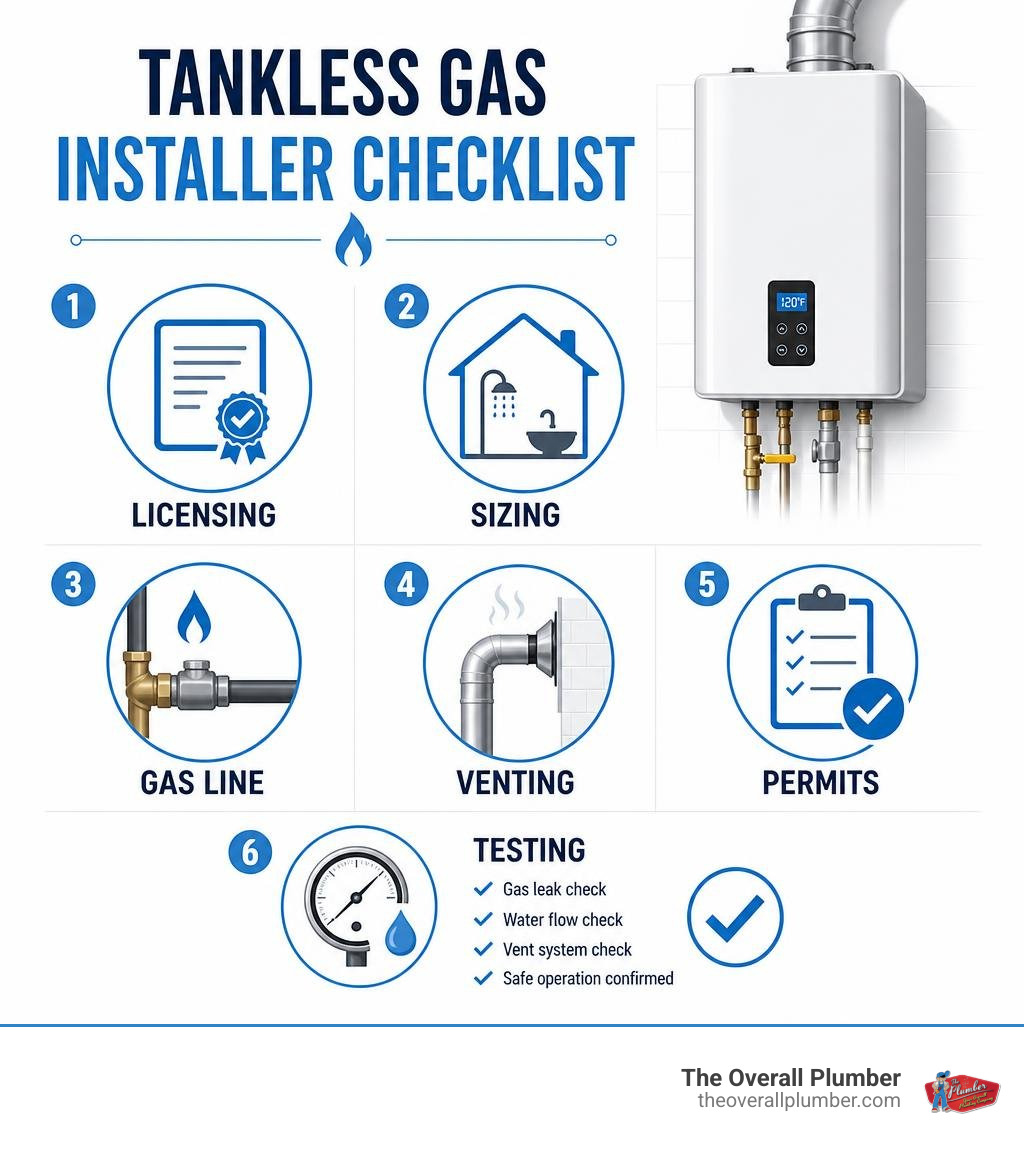
Terms related to tankless gas water heater installation near me:
- tankless electric water heater installation near me
- tankless water heater installation cost near me
- gas hot water heater installation near me
Why Searching for Tankless Gas Water Heater Installation Near Me Upgrades Your Home

Traditional water heaters act essentially like massive, insulated kettles kept at a rolling simmer all day and night. They continuously burn fuel to maintain 40 to 80 gallons of hot water, heating your supply even when your entire household is fast asleep or away at work. Upgrading your property with modern equipment begins with reviewing A Comprehensive Guide to Water Heater Installation to understand how moving away from storage tanks revolutionizes home utility efficiency.
Replacing a bulky cylinder with a wall-hung unit clears up significant floor space in garages and utility closets. More importantly, it eliminates standby heat loss, lowers energy consumption, and provides continuous hot water that will not suddenly run freezing cold midway through a morning routine. The ENERGY STAR water heater guide also explains how efficient water-heating equipment can reduce household energy use when properly selected and installed.
Key Benefits and Energy Efficiency
Leading systems such as Rinnai tankless units use up to 40% less energy than standard storage tank models. Because water is only brought to temperature when a fixture opens, homeowners see significant reductions in monthly utility bills.
Key advantages of making the switch include:
- Continuous Supply: Deliver endless hot water across back-to-back showers and simultaneous appliance cycles without depleting a storage reservoir.
- Flood Risk Mitigation: Without 50 gallons of pressurized water standing inside a metal tank, the risk of catastrophic indoor tank rupture and flooding is virtually eliminated.
- Space Reclamation: Roughly the dimensions of a standard carry-on suitcase, tankless units mount cleanly to interior or exterior walls, freeing valuable square footage.
- Serviceable Modular Components: Unlike traditional tanks that must be discarded when internal rust forms, tankless systems feature modular components that can be individually serviced and replaced over time.
How On-Demand Gas Technology Operates
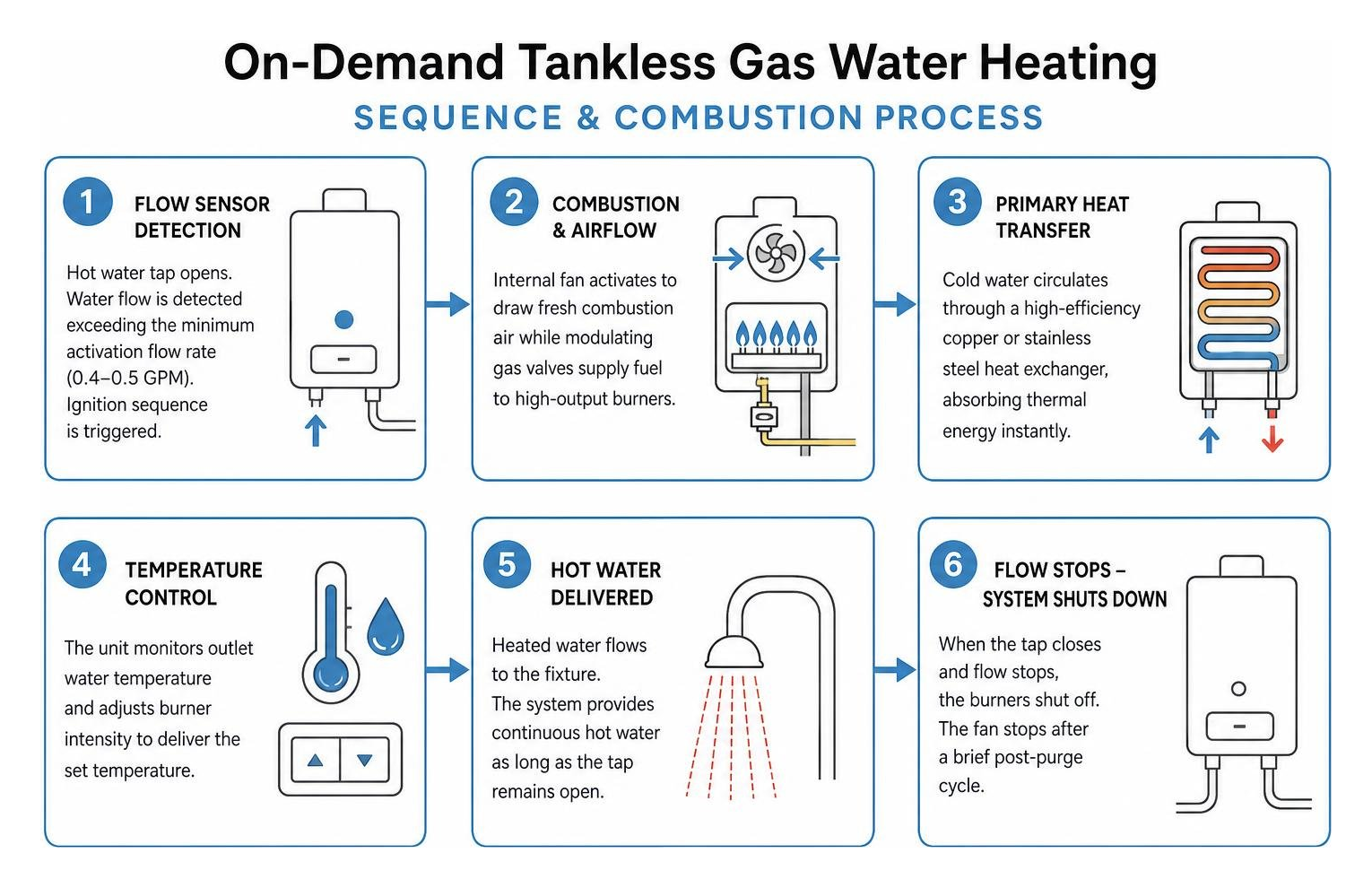
The internal mechanics of a gas tankless system represent advanced plumbing engineering. When a hot water tap is turned on anywhere in your home, the sequence operates as follows:
- Flow Sensor Detection: The system detects water movement exceeding the minimum activation flow rate (typically 0.4 to 0.5 GPM) and triggers an electronic ignition sequence.
- Combustion and Airflow: The internal fan activates to draw fresh combustion air while modulating gas valves supply fuel to high-output burners.
- Primary Heat Transfer: Cold water circulates through a high-efficiency copper or stainless steel heat exchanger, absorbing thermal energy instantly.
- Secondary Condensing Stage: In high-efficiency condensing systems, a secondary heat exchanger captures latent heat from exhaust gases before venting, pushing thermal efficiency above 90%.
- Precision Output: A microprocessor monitors output water temperature, modulating the gas flame in real time to deliver steady, exact water temperatures directly to your fixture.
Evaluating Gas vs. Electric Tankless Water Heating Systems
Choosing the appropriate fuel source depends on utility availability, household demand, and existing infrastructure. While an electric unit may appear straightforward, whole-home electric models place massive loads on residential electrical panels. Homeowners exploring all fuel paths can review our Shockingly Simple Guide to Tankless Electric Water Heater Installation to weigh electric setups against high-output gas options.
| System Feature | Gas Tankless Water Heater | Electric Tankless Water Heater |
|---|---|---|
| Heating Capacity | High (150,000 to 199,000+ BTUs) | Moderate (18 kW to 36 kW) |
| Flow Rate (GPM) | 5.0 to 11.0+ GPM | 2.0 to 5.0 GPM |
| Infrastructure Needs | 3/4-inch gas line, direct venting | 150-200+ amp panel capacity, 2-4 dedicated breakers |
| Cold Climate Performance | Superior; easily handles large temp rises | Limited simultaneous fixture flow |
| Operating Cost | Lower ongoing monthly fuel cost | Higher ongoing utility operating cost |
Fuel Supply and Gas Line Requirements
A standard storage water heater uses roughly 35,000 to 40,000 BTUs per hour, whereas a whole-home gas tankless water heater demands up to 199,000 BTUs per hour when running at peak capacity. Supplying that instantaneous burst of thermal power requires adequate pipe sizing.
Older homes commonly feature 1/2-inch black iron gas supply branches. Transitioning to a high-demand tankless unit often requires upsizing the branch line to a dedicated 3/4-inch line to prevent burner fuel starvation. Ensuring safe delivery requires hiring a Certified Plumber for Gas System Testing to confirm proper supply pressure, prevent pressure drops to other appliances, and ensure sealed direct venting and combustion air intake pipes meet municipal safety codes.
Flow Rates and Temperature Rise Capacity
Proper equipment selection is governed by flow rate (measured in Gallons Per Minute or GPM) and Delta T (the temperature rise needed between incoming groundwater and target output temperature).
Across Texas and Gulf Coast communities including Houston, Pasadena, Pearland, League City, and Galveston, average incoming groundwater temperatures range from 65°F to 75°F for much of the year, though winter temperatures can dip into the 50s.
- Standard Showerhead: 2.0 to 2.5 GPM
- Kitchen Faucet: 1.5 to 2.2 GPM
- Washing Machine: 2.0 to 3.0 GPM
- Dishwasher: 1.0 to 2.0 GPM
If your home runs two showers (4.0 to 5.0 GPM) and a dishwasher (1.5 GPM) simultaneously on a chilly morning, you need a unit capable of delivering at least 6.5 GPM at a 50°F temperature rise to maintain steady temperatures without flow restriction.
Understanding Installation Costs, Lifespan, and Return on Investment
A quality water heating conversion is a long-term home improvement project that delivers reliable performance when budgeted accurately. To understand the complete financial picture, review Don’t Get Burned by Tankless Water Heater Installation Costs before selecting your equipment.
Upfront Pricing, Tax Credits, and Financing
Complete professional installation packages for high-efficiency tankless water heaters typically start around $4,999, with convenient financing options beginning as low as $49.99 per month.
To offset upfront equipment and installation expenses, several financial incentives are available in August 2026:
- Federal Tax Credits: Homeowners upgrading to qualified energy-efficient tankless systems can qualify for a $300 federal energy efficiency tax credit under current clean energy guidelines.
- Utility Rebates: Local gas utility providers frequently offer cash-back incentives and mail-in rebates for replacing atmospheric draft tanks with high-efficiency condensing gas appliances.
- Operational Utility Reductions: Consuming up to 40% less fuel translates to continuous savings on monthly natural gas or propane bills for the lifespan of the equipment.
Extended Durability and Home Resale Value
Traditional storage tank heaters generally last between 8 and 12 years before their inner steel lining succumbs to corrosion and leaks. By comparison, modern gas tankless systems boast an operating lifespan of 20+ years when maintained correctly.
This longevity provides outstanding return on investment. Research conducted by real estate platforms like Zillow indicates that homes equipped with tankless water heaters sell for approximately 4% more than expected compared to similar properties with standard storage tanks.
To protect this investment against mineral buildup in regions with hard municipal water, units must feature accessible isolation valves. Scheduling a brief annual flush clears calcium and magnesium deposits from the heat exchanger, preserving thermal transfer efficiency for decades.
Selecting and Scheduling the Right Local Professional Plumber
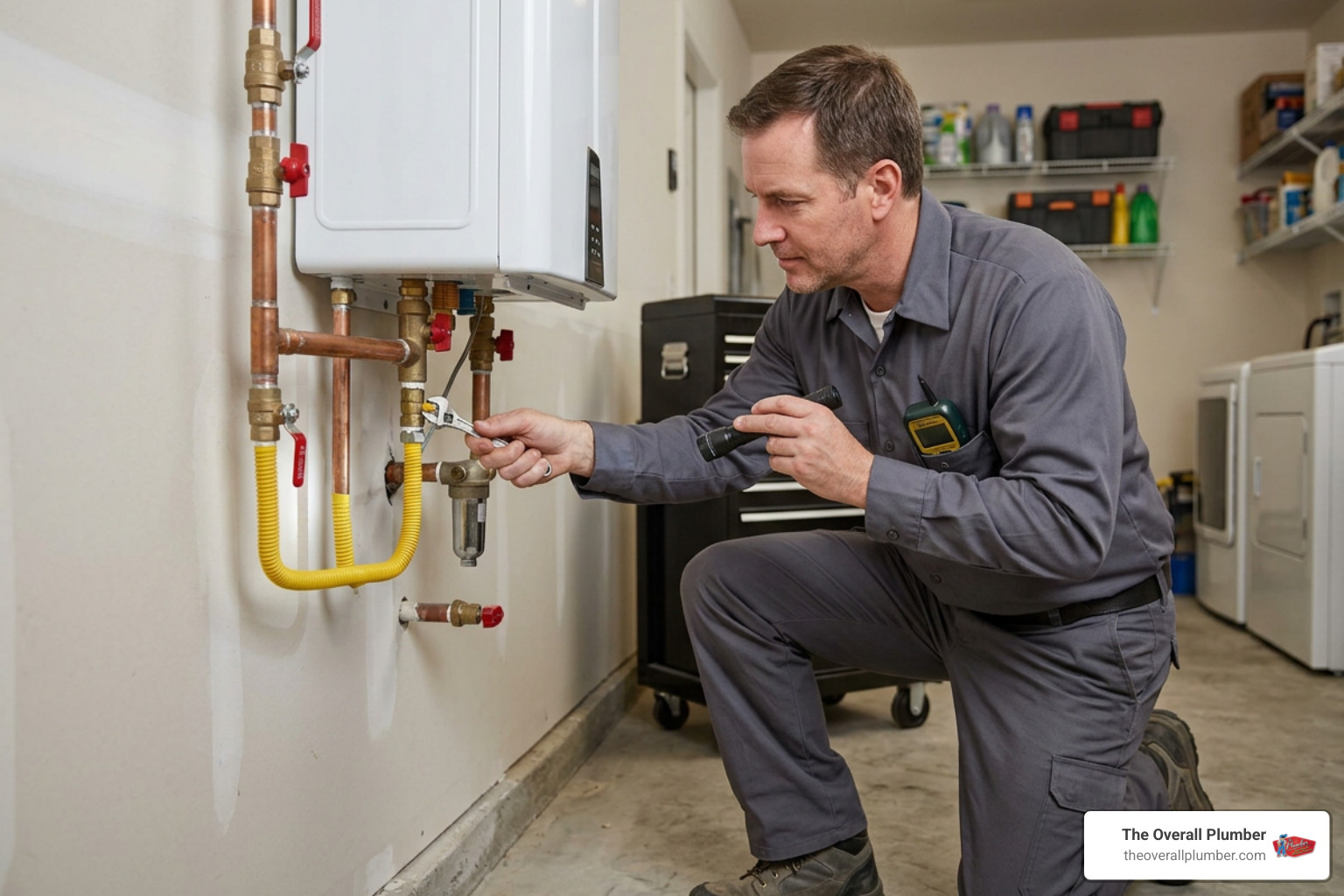
Because gas tankless systems combine pressurized gas lines, high-voltage electrical ignition controls, potable water lines, and sealed exhaust ventilation, proper contractor vetting is essential for home safety.
Finding Certified Tankless Gas Water Heater Installation Near Me
When vetting local contractors across Harris County, Galveston County, and Brazoria County, verify the following qualifications:
- State Plumbing Licensing: Ensure work is overseen by licensed Master or Journeyman plumbers who understand fuel gas codes and local municipal amendments.
- Permitting and Inspections: Confirm the contractor pulls required city or county building permits, ensuring work passes inspection for vent clearances, seismic restraints, and pressure testing.
- Manufacturer Certification: Technicians trained directly by leading manufacturers (such as Rinnai and Navien) understand exact fuel delivery parameters and warranty registration guidelines.
- Transparent Guarantees: Look for established local companies providing clear upfront pricing, robust craftsmanship guarantees, and dedicated plumbing protection plans.
Average Timeline for Tankless Gas Water Heater Installation Near Me
A standard residential tank-to-tankless conversion generally takes 6 to 8 hours to complete. A typical installation day follows an orderly workflow:
- Site Preparation and Protection: Technicians lay floor coverings and verify gas and water main shutoffs.
- Old Tank Draining and Removal: The outdated storage tank is fully drained, disconnected, and hauled away for recycling.
- Wall Mounting and Line Modifications: The new tankless unit is secured to structural studs, while water supply lines are retrofitted with full-port service isolation valves.
- Gas Supply and Vent Line Installation: Dedicated 3/4-inch gas connections are completed and direct-vent exhaust lines are routed safely outdoors.
- Testing and Homeowner Orientation: Technicians perform gas pressure drop tests, bleed air from water lines, commission the digital temperature interface, and guide the homeowner through system controls.
Frequently Asked Questions About Tankless Gas Water Heaters
What is the average cost to install a tankless gas water heater?
Complete tankless installation packages typically start at $4,999 or $49.99 per month with financing. Overall costs vary based on unit heating capacity, venting complexity, municipal permit fees, and whether existing gas lines require branch upsizing to 3/4-inch pipe to meet burner BTU specifications.
How long does a tankless gas water heater last compared to a tank model?
A properly maintained gas tankless water heater lasts 20 years or more—roughly double the 8 to 12-year lifespan of a traditional tank heater. Because components are modular, individual parts such as sensors, fans, and valves can be serviced independently without replacing the entire system.
Can an existing gas line support a new tankless water heater?
Standard tank heaters draw roughly 40,000 BTUs, while whole-home tankless units demand up to 199,000 BTUs. While certain specialized retrofits utilize short 1/2-inch runs, most installations require upgrading the gas supply line to 3/4-inch pipe to supply sufficient volume and maintain steady gas pressure during peak operation.
Upgrade to Endless Hot Water and Superior Energy Savings
Schedule your installation consultation today through The Overall Plumber’s Hot Water Heater Replacement team to connect with a licensed plumbing professional.