

Stop a Cracked PVC Drain Pipe Before the Leak Gets Worse
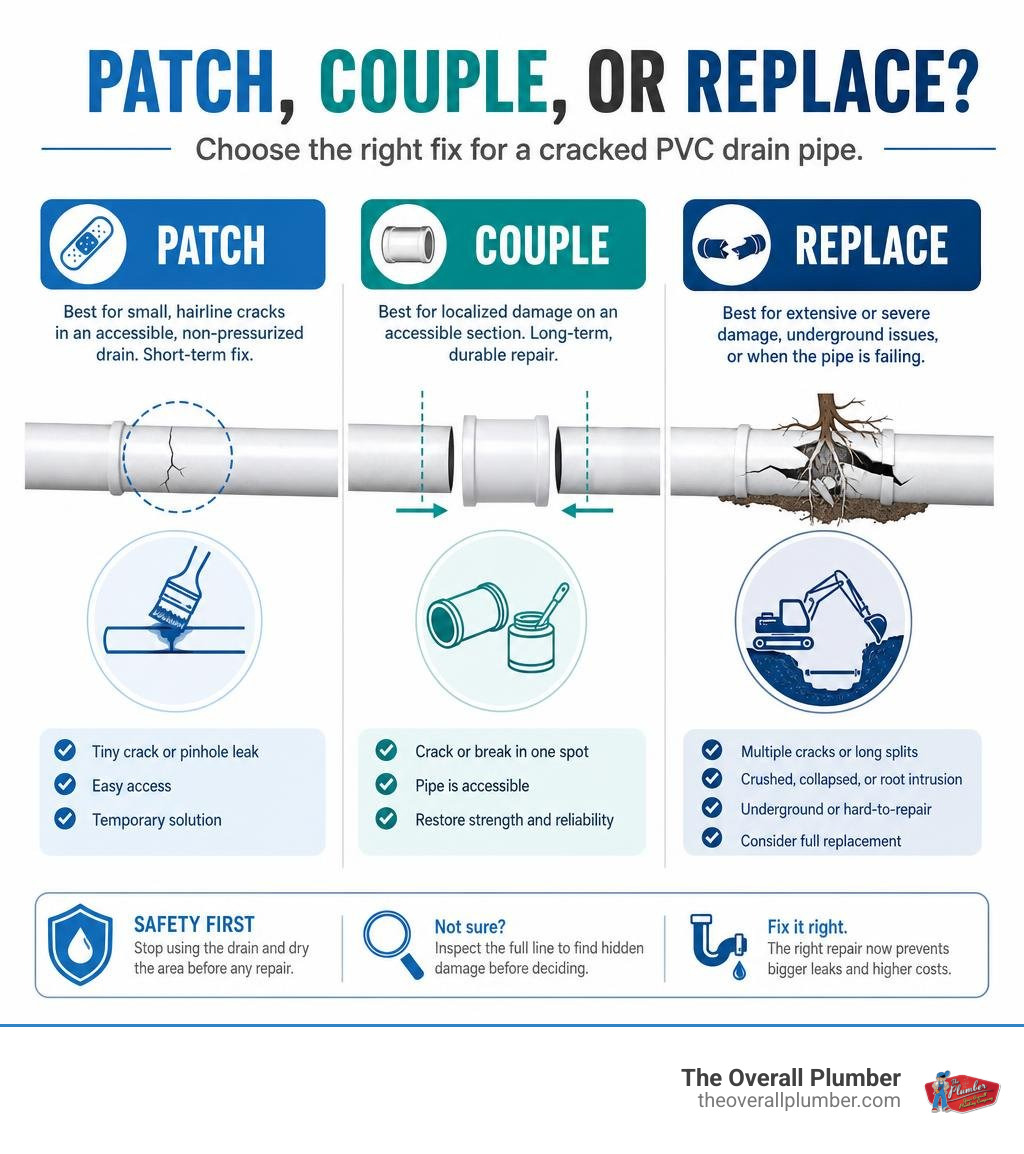
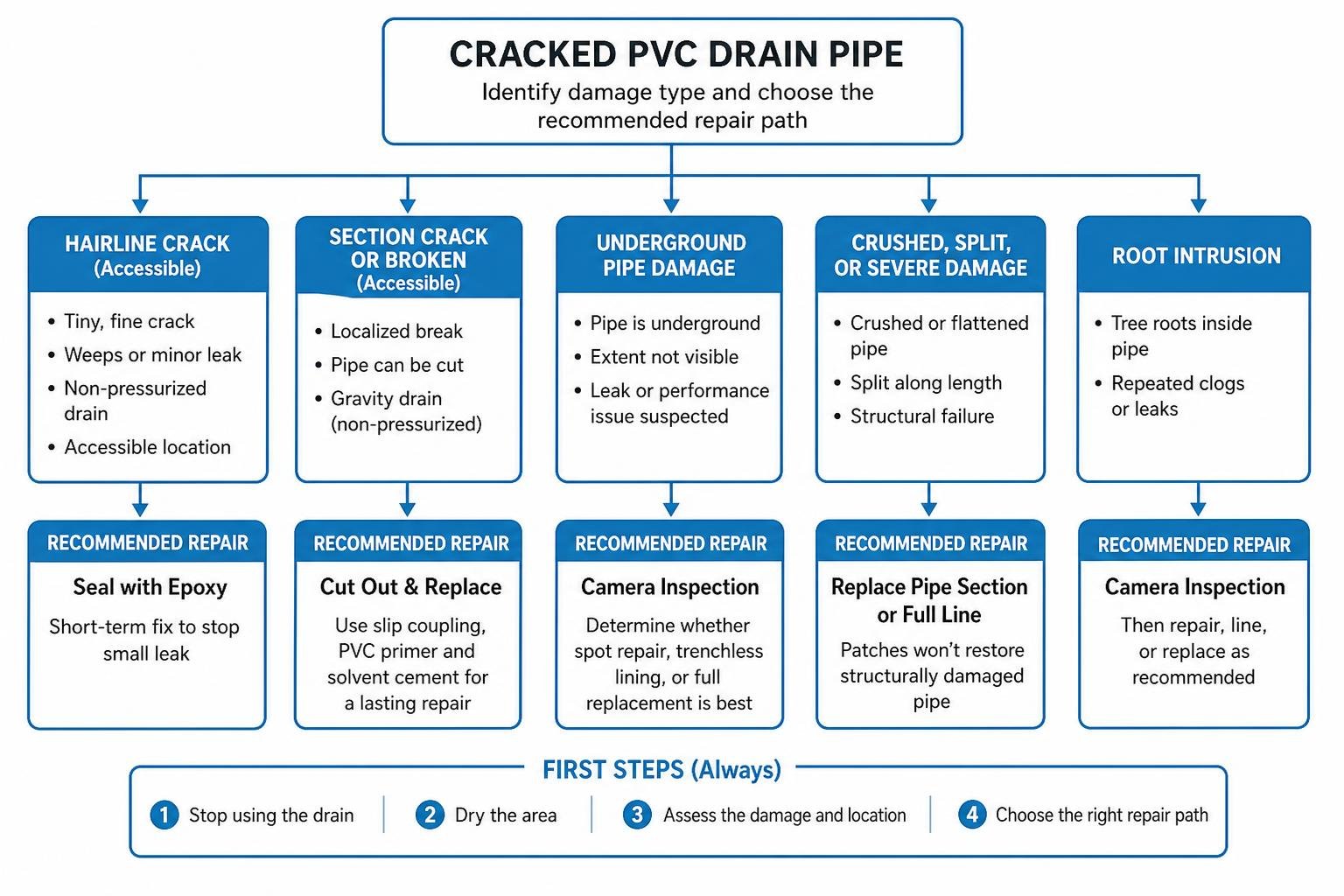
To repair cracked PVC drain pipe, first stop using the drain and dry the area. A tiny hairline crack in an accessible, non-pressurized drain can be sealed with epoxy as a short-term measure. For a lasting repair, cut out the damaged section and install new PVC with a slip coupling and PVC primer and solvent cement. If the pipe is underground, crushed, split along its length, or affected by tree roots, a camera inspection can show whether a spot repair, trenchless lining, or replacement is the smarter fix.
PVC drain pipe is durable, but it can crack from impact, age, UV exposure, shifting soil, temperature changes, poor support, and root intrusion. Patches can stop a leak for now, but they do not restore a pipe that is structurally damaged. The right repair depends on the crack type, pipe location, and whether the line is a gravity drain or a pressurized water line.
I’m Dayton Whitworth, a second-generation plumbing professional serving the Greater Houston and Gulf Coast area. My team and I help homeowners repair cracked PVC drain pipe, diagnose hidden sewer damage, and choose dependable fixes before a small leak becomes an emergency.
Easy repair cracked pvc drain pipe glossary:
Identifying PVC Damage: Cracks, Splits, and Joint Failures
Polyvinyl chloride (PVC) is the backbone of modern residential plumbing. In fact, PVC accounts for over 65% of new water and sewer pipe installations across North America. It is lightweight, smooth-walled, and naturally impervious to standard chemical corrosion. However, rigid plastic is not invincible. When stress builds inside the drainage system or external forces press upon the line, the material will eventually fracture. Knowing how to assess the damage properly helps you choose whether you can tackle the issue yourself or need professional residential plumbing support.
Understanding the specific nature of a break determines whether you need a quick patch, an inline fitting, or a structural rebuild. Resources like the Cracked PVC Pipe Repair: Complete Guide to Methods, Costs & When to Replace (2026) outline how failure modes dictate repair longevity. When dealing with an active drip under your flooring or inside a crawl space, learning how to fix a leaking pipe quickly can protect your structural framing from rot and mold colonization before you make a permanent repair.
Hairline Cracks vs. Structural Longitudinal Splits
Not all fractures behave identically. Hairline cracks are tiny, fine fractures that often emerge near over-tightened mechanical fittings or where a drain line has been subjected to mild, localized physical impacts. While a hairline crack might only weep moisture when a sink is drained, structural longitudinal splits present a far greater threat.
Longitudinal splits run parallel along the length of the pipe wall. These splits typically develop due to severe thermal expansion stress—where rigid framing prevents the line from expanding naturally during hot water discharges—or internal pressure spikes. Because PVC expands at a rate of approximately 0.0005 inches per degree Fahrenheit per foot, an unyielding pipe will split right down its seam when exposed to continuous cycles of boiling waste and cold water.
| Repair Method | Best Used For | Durability / Lifespan | Typical Material / Pro Cost (2026) | Permanent or Temporary? |
|---|---|---|---|---|
| Epoxy Putty / Paste | Accessible hairline surface cracks, emergency patches | 6 to 24 Months | $10 – $30 (DIY) | Temporary |
| Fiberglass Repair Wrap | Non-pressurized minor surface fractures, irrigation | 1 to 3 Years | $15 – $45 (DIY) | Temporary / Semi-Perm |
| Shielded Rubber Coupling (Fernco) | Underground sewer lines, lateral joints, vibration dampening | 3 to 10+ Years | $25 – $60 (DIY) / $500 – $1,500 (Pro) | Semi-Permanent / Perm (Code Dependent) |
| Solvent-Welded Slip Coupling | Accessible Schedule 40 DWV lines, clean cuts | 50+ Years (Lifetime of pipe) | $30 – $80 (DIY) / $300 – $800 (Pro) | Permanent Chemical Weld |
| Trenchless CIPP Lining | Broken, cracked, or root-invaded underground sewer laterals | 50+ Years | $3,000 – $8,000 (Pro lateral install) | Permanent Structural Relining |
Attempting to smear epoxy putty over a longitudinal split is an exercise in futility. As the pipe shifts and flexes under thermal loads, the structural crack beneath the putty will continue to travel, breaking the temporary adhesive seal within weeks.
Underground Sewer Lateral and Joint Failures
Underground PVC pipes face an entirely different set of environmental hazards. Buried drain lines, such as sewer laterals running beneath lawns and driveways, are subjected to crushing soil loads, ground settlement, and aggressive vegetation. In areas with expansive clay soils, such as coastal Texas and greater Houston, the soil swells dramatically when wet and shrinks when dry. This cyclic ground movement places immense shear pressure on subterranean pipes, leading to snapped bell-and-spigot hubs and sheared joints.
Furthermore, thirsty root systems will seek out microscopic water vapor escaping from microscopic imperfections or degrading glue joints. Once inside, fine root hairs expand into dense root balls that exert thousands of pounds of outward force, splitting the pipe wide open. When an underground lateral breaks, raw sewage can saturate your yard or back up into clean fixtures, requiring comprehensive repair broken sewer line Houston solutions to restore proper sanitation and drainage grade.
Permanent Methods to Repair Cracked PVC Drain Pipe
When restoring non-pressurized drain, waste, and vent (DWV) systems, temporary wraps should only buy you time until you can execute a mechanical or solvent-welded replacement. Standard household adhesives and tapes simply cannot withstand dynamic pipe movement or grease degradation. To complete a permanent repair on an accessible line, you must physically remove the damaged section and bridge the gap with code-compliant PVC fittings.
Following our guide on how to fix a broken pipe in 7 easy steps will keep your workspace organized and safe. Always verify whether your line is Schedule 40 PVC (thick-walled, standard for indoor DWV and pressure applications) or thin-walled SDR-35 (common for gravity sewer runs) so your repair components match the pipe’s internal diameter and wall thickness exactly.
Step-by-Step Slip Coupling Method to Repair Cracked PVC Drain Pipe
The solvent-welded slip coupling (also known as a repair coupling or slip-fix) is the gold standard for restoring rigid PVC lines that cannot be flexed or shifted outward. Unlike standard couplings that feature an internal center stop ridge, a slip coupling has an entirely smooth interior bore, allowing it to slide freely over the pipe. Professional techniques detailed in How to Repair a Broken PVC Drain Pipe highlight how this method creates a permanent, monolithic seal.
- Isolate the System and Dry the Pipe: Cease running water through any upstream fixtures. Use dry towels or a shop vacuum to extract all residual moisture from inside the pipe bore. Solvent cement cannot properly fuse wet plastic.
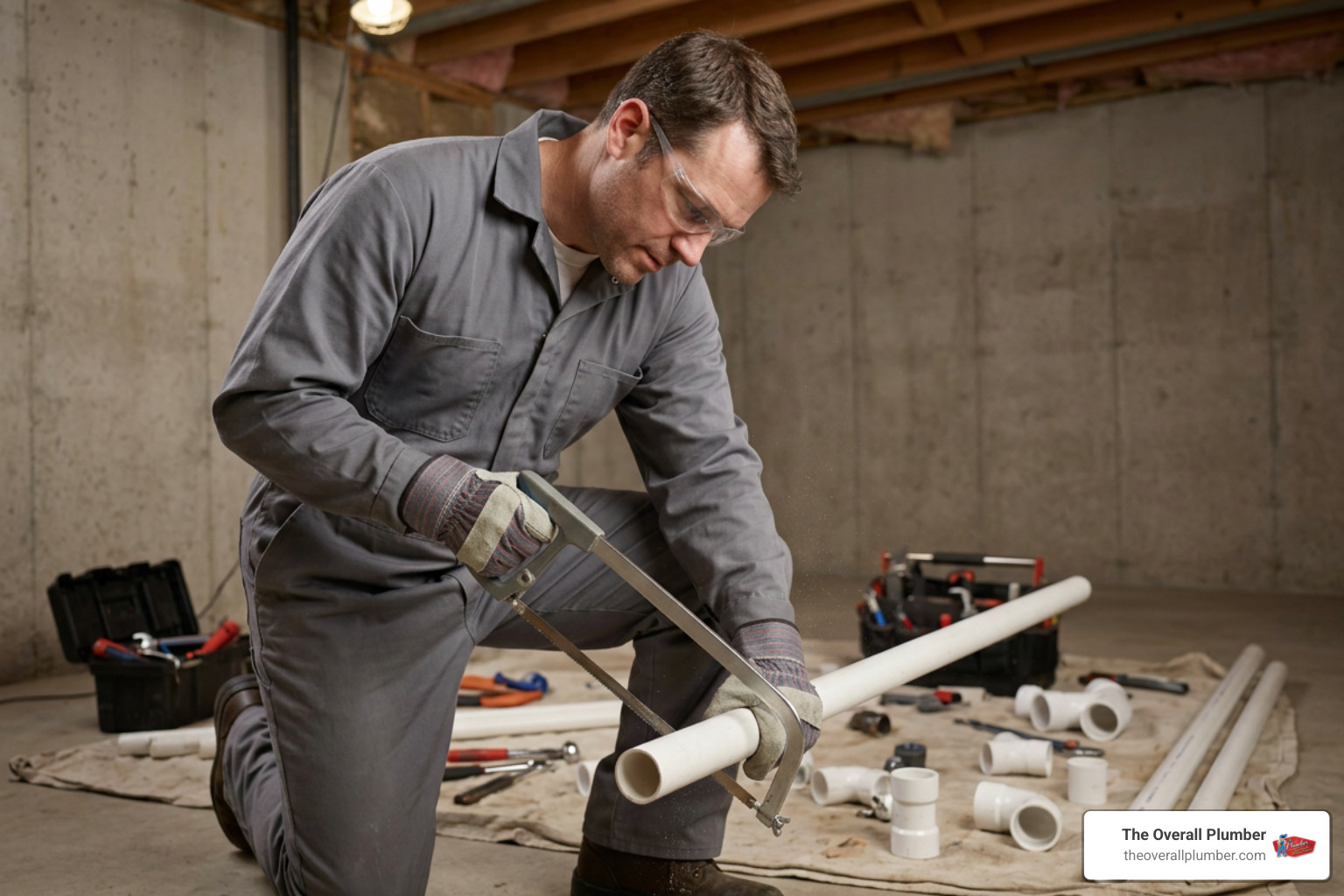
- Cut Out the Damaged Segment: Using a fine-tooth hacksaw, ratcheting PVC cutter, or wheel cutter, cut through the pipe at least 2 inches past the visible ends of the crack on both sides. Ensure all cuts are strictly square (90 degrees to the pipe axis); angled cuts create weak structural joints prone to fluid leakage.
- Deburr and Chamfer the Cut Ends: Every cut leaves a lip of plastic shavings (burrs). Use a deburring tool, utility knife, or medium-grit sandpaper to remove burrs inside and outside the pipe. Bevel (chamfer) the outer leading edge slightly at a 15-degree angle. This prevents the sharp pipe edge from scraping away the wet solvent cement when sliding fittings into place.
- Dry-Fit and Mark Insertion Depths: Cut a new piece of Schedule 40 PVC pipe to bridge the gap, factoring in the depth of two slip couplings or a standard coupling paired with a slip coupling. Slide the slip fitting completely onto the pipe and make alignment marks with a permanent marker to confirm you can achieve full, even overlap over the joints.
- Apply Purple Primer: Liberally apply purple PVC primer to the outside of the pipe ends and the inside hubs of the couplings. Primer strips away the smooth factory glaze and chemically softens the plastic resin.
- Apply Solvent Cement and Join: While the primer is still tacky, apply an even, generous layer of medium-body PVC solvent cement to both matching surfaces. Immediately slide the slip coupling over the cut line, rotating the fitting one-quarter turn as you push it into final position to eliminate trapped air pockets.
- Hold Firmly: Hold the joint firmly in place for at least 30 to 60 seconds. Fresh solvent cement produces hydrostatic backpressure, and without continuous manual pressure, the fitting can “push out” or wander off center.
Using Shielded Rubber Couplings for In-Ground Repairs
For buried drainage runs and transitions between mismatched pipe materials, shielded rubber couplings (often called Fernco or Mission couplings) are exceptional. While unshielded rubber boots are prone to shearing under heavy soil loads, shielded couplings feature a heavy-duty stainless steel sleeve that bridges the rubber gasket, preventing pipe misalignment and root penetration. Guidance from How to Repair PVC Sewer Pipe in the Ground emphasizes their mechanical flexibility.
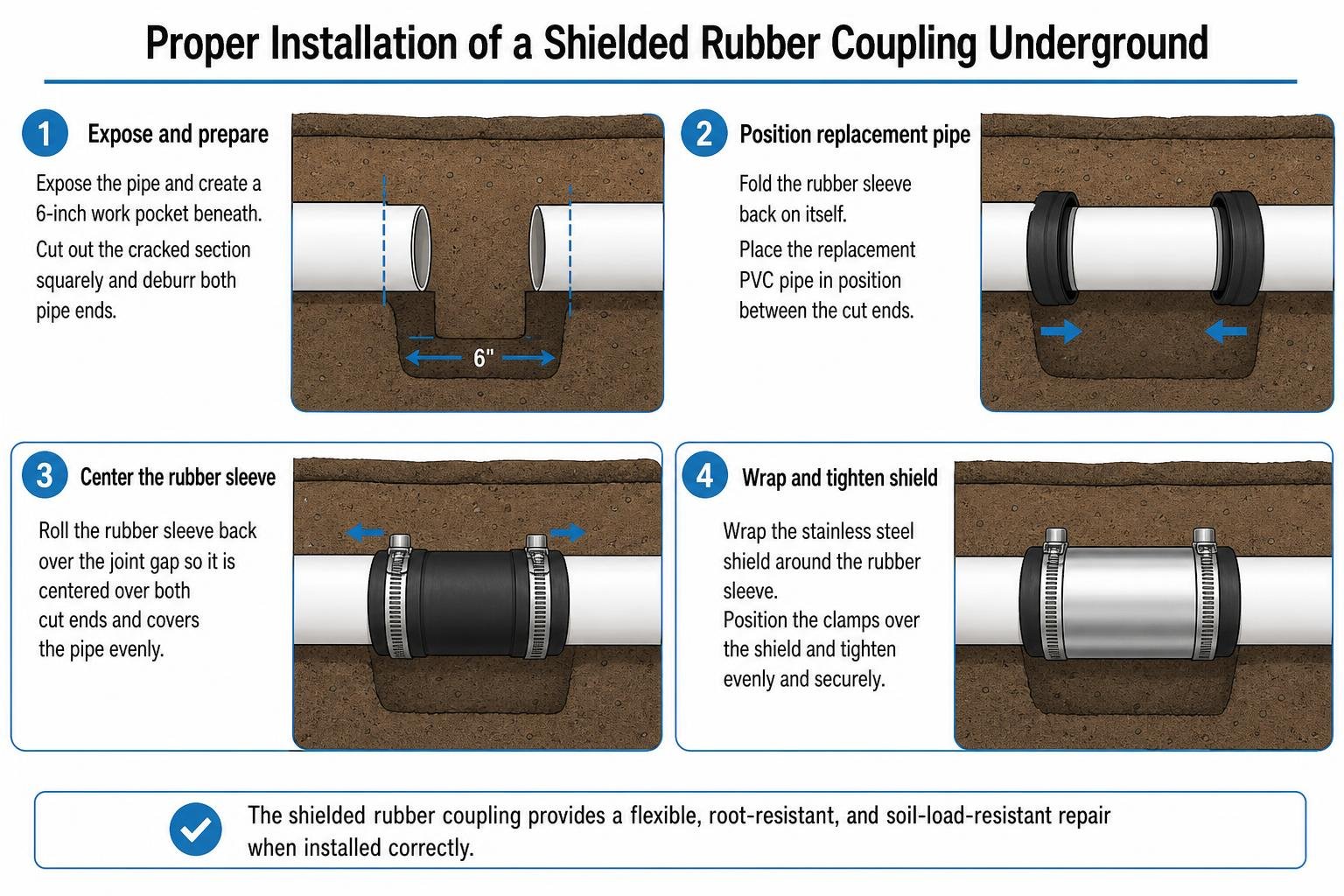
To install a shielded rubber coupling:
- Expose the pipe, clearing a 6-inch work pocket beneath the pipe bottom.
- Cut away the cracked section squarely and deburr the pipe ends.
- Fold the elastomeric rubber sleeve back on itself, place the replacement PVC pipe into position, and roll the rubber back over the joint gap so it sits centered over both cut ends.
- Wrap the stainless steel outer shield around the rubber sleeve.
- Tighten the worm-gear stainless steel bands using a torque wrench calibrated to roughly 60 in-lbs (or manufacturer specifications) to ensure an airtight, watertight seal that won’t crush the PVC.
- Bed the repaired pipe in crushed gravel or coarse sand before backfilling to provide a non-compressible structural foundation that prevents future pipe sagging.
Socket Saver Technique for Broken Pipe Joints
A common nightmare for homeowners and trade technicians occurs when a PVC drain pipe snaps flush with a hub fitting—such as inside an expensive wye, sanitary tee, or wall penetration—where cutting the pipe back would require tearing out drywall or demolition of structural concrete framing.
Rather than demolishing the entire drainage assembly, use a socket saver (fitting reamer). This specialized tool attaches to a standard power drill and features a precision-guided cutting bit matched to the inside diameter of the fitting hub (e.g., 1.5″, 2″, 3″, or 4″).
Operate the drill at moderate speeds (roughly 250 to 500 RPM) to bore away the remaining broken pipe stub while leaving the interior wall of the existing fitting hub completely undamaged. Once reamed, deburr the hub, apply purple primer and solvent cement, and insert a fresh segment of PVC pipe as though the original fitting were brand new.
Underground and Trenchless Repair Options
When an underground sewer pipe suffers extensive cracking, multiple offset joints, or widespread root invasion, digging trenches across paved driveways, pristine landscaping, or patio concrete can become wildly expensive. Full open-cut excavation replacement for severely damaged subterranean runs can easily range from $5,000 to $15,000+. Fortunately, modern trenchless technologies provide non-invasive remedies that restore structural drainage without tearing up your property.
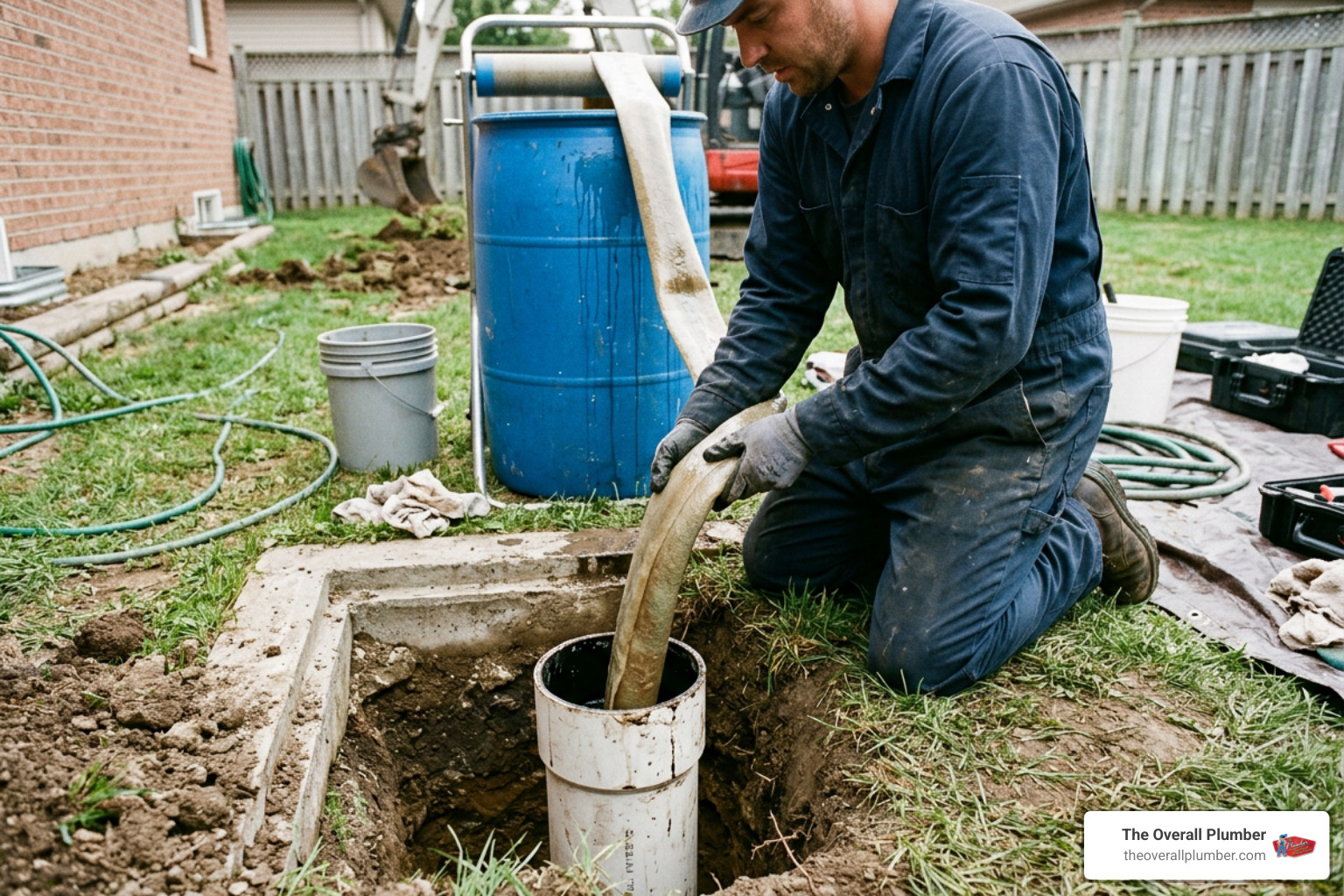
Before undertaking any underground repair, safe excavation protocols demand calling 811 to locate buried electrical, gas, and communications infrastructure. For damaged residential lateral lines, modern trenchless options include:
- Cured-in-Place Pipe (CIPP) Lining: Technicians clean the damaged pipe with hydro-jetting, then invert an epoxy-saturated felt tube into the damaged host pipe through an existing cleanout access point. Once cured with hot water, steam, or UV light, this resin creates a seamless, joint-free “pipe within a pipe” with a 50+ year expected lifespan. CIPP lateral lining typically costs between $3,000 and $8,000 for a 30 to 60-foot residential run, bypassing the disruption of heavy machinery.
- Pipe Bursting: When a PVC sewer line has completely collapsed or lost its structural circular profile, pipe bursting pulls a heavy conical bursting head through the old line. The head shatters the damaged PVC, pushing fragments outward into the surrounding soil, while simultaneously pulling a brand-new, seamless High-Density Polyethylene (HDPE) pipe directly into its place.
If your home is experiencing frequent backups, our specialized technicians inspect and repair complex sewer lines in Houston using high-definition video diagnostics to pinpoint whether spot excavation or trenchless restoration is the most cost-effective path.
Critical Best Practices and Cure Times for PVC Repairs
Executing a durable solvent-welded joint is not a matter of simply “gluing plastic.” Solvent welding is a chemical fusion process in which volatile solvents melt the mating surfaces together, forming an inseparable molecular weld. Following expert guidance on How to Cover and Repair Holes in PVC Pipe will ensure your joints never leak under stress.
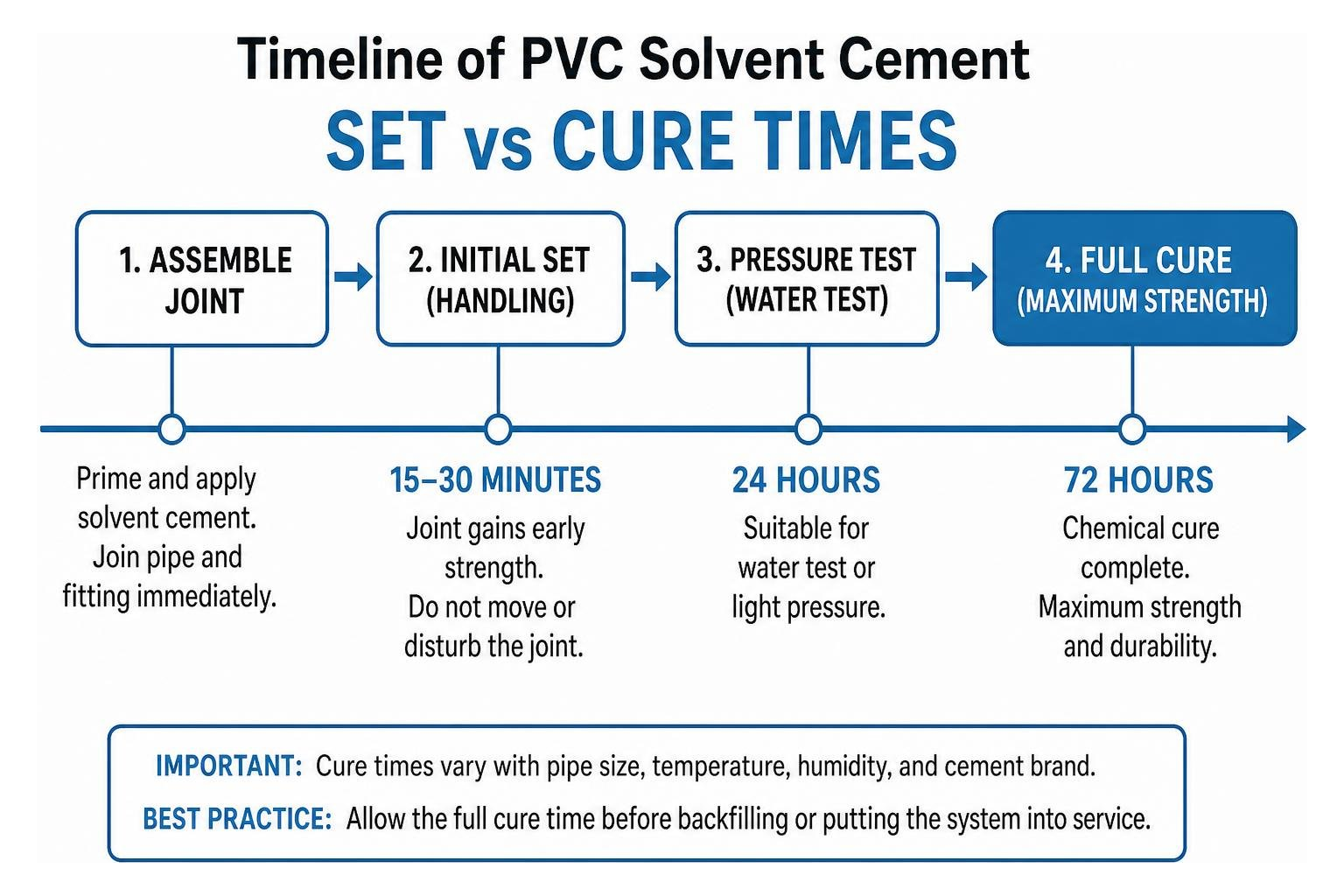
To guarantee a leak-free installation, observe these critical curing and preparation factors:
- Clean and Sand: Clean the pipe exterior of all dirt, grease, and moisture. Lightly scuff the bonding area using 80-grit sandpaper to break surface tension and promote optimal chemical reaction.
- Always Use Purple Primer: Primer is non-negotiable. It chemically prepares the PVC matrix so the cement can fuse the polymer chains. In many jurisdictions, purple dye is strictly mandated by local plumbing codes so municipal building inspectors can verify proper installation.
- Respect Chemical Cure Schedules:
- Initial Set Time: 15 to 30 minutes (do not move or disturb the joint during this phase).
- Functional Cure for Gravity Drain Lines: A minimum of 2 hours at temperatures above 60°F (15°C).
- Full Structural / Pressure Cure: 24 hours at standard room temperature.
- Compensate for Weather: In cold temperatures (below 40°F / 4°C) or high humidity, solvent evaporation slows dramatically. In chilly conditions, extend the initial cure time to 4 hours and wait a full 24 to 48 hours before subjecting the line to hot water drainage or chemical drain flushes.
How to Avoid Common Mistakes When You Repair Cracked PVC Drain Pipe
Small oversights during a PVC repair can turn a simple afternoon project into an expensive emergency water cleanup. Watch out for these frequent mistakes:
- Using Expired Solvent Cement: PVC glue has a limited shelf life. If the cement inside the can is stringy, lumpy, or jelly-like, discard it immediately. Expired cement cannot adequately soften the plastic, resulting in a brittle mechanical joint that will fail under structural vibration.
- Leaving Internal Burrs: Plastic burrs left inside the pipe snag hair, lint, and food waste, quickly triggering recurring drain blockages right at your repair seam.
- Applying Plumber’s Tape to Socket Joints: Plumber’s PTFE tape is strictly designed for tapered threaded metal or plastic connections. Never use tape or paste inside slip-fit, solvent-weld PVC sockets.
- Over-Tightening Mechanical Clamps: When installing rubber couplings, cranking down on the stainless steel band clamps with excessive force can warp or crack the underlying PVC pipe. Always use a proper torque-limiting tool or hand driver.
- Rushing the Water Test: Restoring drainage before the chemical solvent weld has fully cured will cause boiling water or soap suds to wash away uncured resins, creating microscopic channels that develop into permanent leaks.
Frequently Asked Questions About Cracked PVC Drain Pipe Repair
How long does PVC glue need to cure before running water?
For non-pressurized gravity drain lines (such as kitchen or bathroom DWV systems), PVC solvent cement requires an initial set time of 15 to 30 minutes, during which the pipe must not be handled or moved. You should wait a full 2 hours for a functional cure before running normal ambient drainage. If the drain will carry hot water discharges (e.g., dishwasher or laundry waste) or if ambient temperatures are below 60°F, allow 8 to 24 hours before restoring full flow.
Is epoxy putty a permanent fix for a cracked PVC drain?
No. Epoxy putty is strictly an emergency, temporary fix for non-pressurized drain pipes. While two-part epoxy sticks provide strong mechanical adhesion and can stop slow drips for 6 to 24 months, epoxy cannot chemically fuse with PVC. Over time, normal thermal expansion, contraction, and structural pipe vibration will break the mechanical adhesive bond, causing the crack underneath to spread and leak again. Replacing the cracked section with a solvent-welded coupling is the only permanent solution.
Can tree roots crack underground PVC sewer pipes?
Yes. While intact, properly solvent-welded Schedule 40 PVC is exceptionally resistant to root penetration, tree roots readily target microscopic moisture paths escaping through dry-fitted joints, unprimed seams, or minor hairline ground fractures. Once a microscopic root hair gains entry, it rapidly consumes nutrient-rich wastewater, expanding into a thick root mass that acts like a wedge, splitting PVC hubs apart and creating massive structural collapses.
Long-Term Solutions for Restoring Damaged Drainage
At The Overall Plumber, we eliminate the stress of plumbing failures across Houston, Clear Lake, Pearland, Pasadena, Friendswood, League City, Galveston, and surrounding communities. Our licensed plumbing professionals utilize high-definition video camera diagnostics to inspect your entire drain and sewer network, ensuring all hairline fractures, root intrusions, and joint misalignments are definitively resolved. With upfront pricing, no trip charges, flexible plumbing protection plans, and our 100% satisfaction guarantee, we deliver dependable repairs that keep your plumbing running smoothly.
If you are dealing with a damaged sewer lateral or suspect a leak behind your walls, don’t wait for water damage to spread. Schedule your expert broken pipe repair with our local plumbing team today, or call The Overall Plumber at (281) 888-1386 for prompt help.