


How Much Does a Sewer Line Replacement Cost? Here’s What to Expect in 2026
How much does a sewer line replacement cost is one of the first things homeowners want to know when a drain backs up or a plumber mentions the words “full replacement.” Here’s a quick answer:
- National average: ~$3,319
- Typical range: $1,388 to $5,323
- Per linear foot: $50 to $250 (average $150)
- Complex projects: Up to $20,000
- Trenchless methods: $60 to $250 per linear foot
- Traditional excavation: $50 to $125 per linear foot
That’s a wide range — and for good reason. The final number depends on your pipe material, the length and depth of the line, whether you’re under a driveway or open lawn, and which replacement method your plumber recommends.
This guide breaks down every cost factor so you can budget clearly and avoid surprises.
I’m Dayton Whitworth, a second-generation plumber serving Houston and the greater Gulf Coast area, and understanding how much does a sewer line replacement cost is something I walk homeowners through every week. Let’s make sure you have the full picture before any work begins.
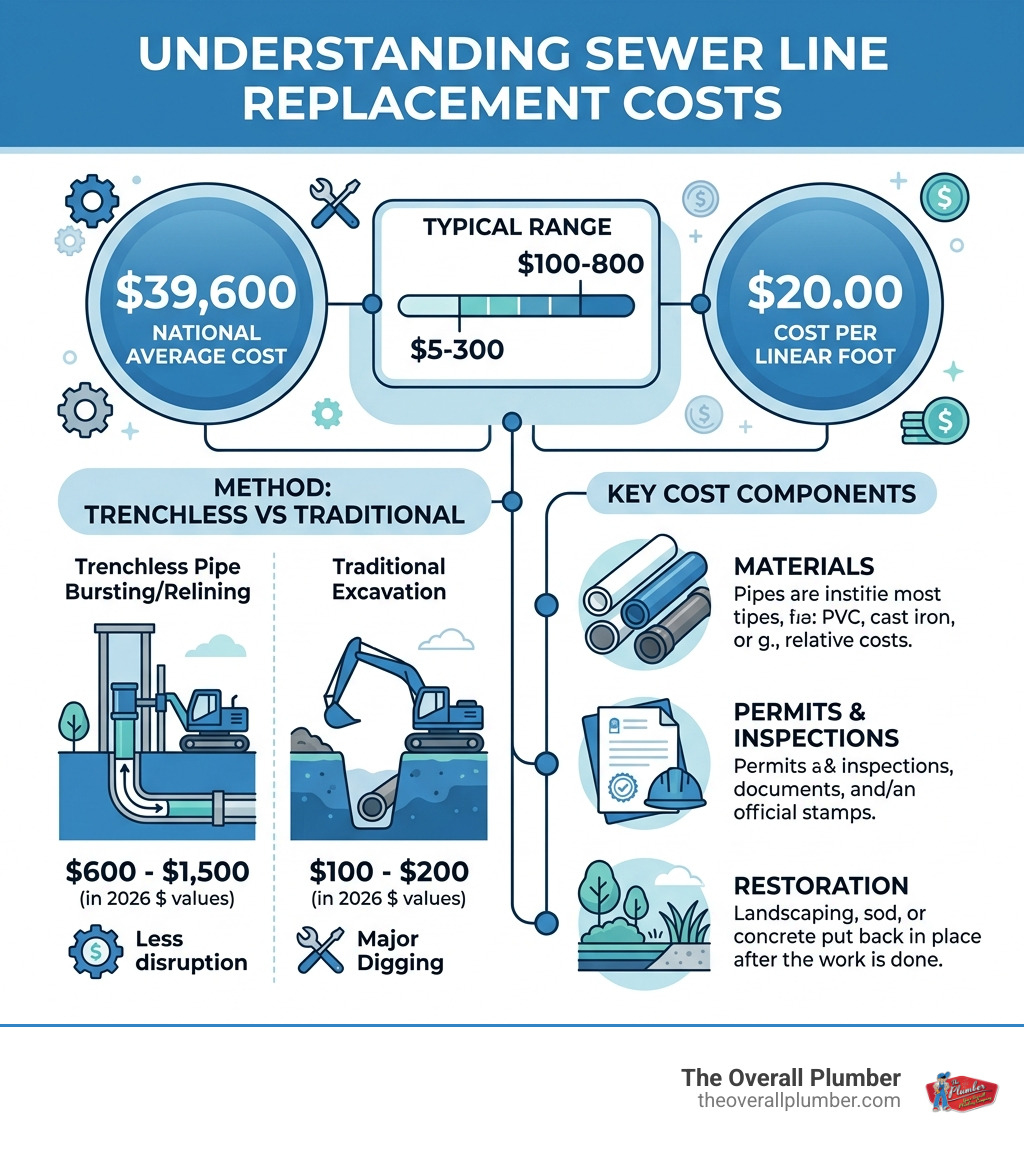
Understanding the Average Sewer Line Replacement Cost in 2026
When we talk about the national average of $3,319, it is important to remember that this figure includes everything from small residential lines to more standard suburban setups. However, for most homeowners in our service areas like Pearland or League City, the typical range falls between $1,388 and $5,323.
If you have a particularly long run from your house to the city main, or if your line is buried exceptionally deep, those costs can climb. In the most extreme scenarios—think lines buried under thick concrete driveways or those requiring major street-side excavation—you could see a total bill reach $20,000. While that number is scary, most residential projects stay well within the four-figure range. You can find more detailed breakdowns on How Much Does Sewer Line Replacement Cost? to help you benchmark your specific situation.
How much does a sewer line replacement cost per linear foot?
On a per-foot basis, you should expect to pay anywhere from $50 to $250 per linear foot. The average most of our customers see is around $150 per foot. Why the massive gap? It usually comes down to three things:
- Pipe Length: A standard residential line is usually between 20 and 100 feet. The longer the pipe, the higher the total, though the “per foot” rate sometimes drops slightly on very long runs due to setup efficiencies.
- Depth: In Texas, we don’t usually deal with the deep “frost lines” found up north, but sewer lines still need a specific “fall” or slope. If your line is 6 to 8 feet deep, it requires more labor and safety equipment to excavate than a line buried only 3 feet down.
- Soil Conditions: Here in the Houston area, we deal with a lot of expansive clay. This soil shifts and can be difficult to work with, sometimes adding 10% to 30% to the labor cost compared to easier, sandy soils.
How much does a sewer line replacement cost for trenchless vs. traditional methods?
This is where modern technology can actually save you a lot of heartache (and lawn care bills).
Traditional Excavation ($50 – $125 per linear foot): This is the “old school” way. We bring in a backhoe or a crew with shovels and dig a trench from your house to the street. While the plumbing labor itself is often cheaper per foot, the “hidden” cost is the destruction of your yard, sidewalk, or driveway.
Trenchless Methods ($60 – $250 per linear foot): These methods are becoming the gold standard for homeowners who love their landscaping.
- CIPP Lining: This involves pulling an epoxy-saturated “sleeve” through your old pipe. It hardens into a brand-new pipe inside the old one.
- Pipe Bursting: We pull a new high-density polyethylene (HDPE) pipe through the old one, literally “bursting” the old pipe out of the way as the new one takes its place.
While trenchless can have a higher upfront price tag per foot, it often ends up being more affordable because you aren’t paying thousands of dollars to replant trees or repave your driveway afterward. We’ve written extensively on Why Trenchless Sewer Line Replacement is the Best Way to Save Your Yard to help you weigh these options.
Material Choices and Their Impact on Your Budget
The type of pipe we put in the ground dictates how much you pay today and how long you’ll stay worry-free. In 2026, PVC is the industry standard for a reason: it’s durable and affordable.
| Pipe Material | Cost Per Linear Foot | Expected Lifespan | Pros/Cons |
|---|---|---|---|
| PVC (Polyvinyl Chloride) | $4.50 – $10.00 | 50 – 100 Years | Affordable, smooth interior, rust-proof. |
| ABS (Acrylonitrile Butadiene Styrene) | $6.00 – $12.00 | 50 – 80 Years | Similar to PVC, very strong, but can warp in high heat. |
| Cast Iron | $50.00 – $100.00 | 50 – 75 Years | Extremely durable and quiet, but prone to internal corrosion. |
| Copper | $85.00 – $150.00 | 70 – 100 Years | Longest lasting, but incredibly expensive and rarely used for main sewer lines. |
For most sewer line services in Houston, we recommend PVC or HDPE. These materials don’t corrode like the old cast iron pipes found in many Galveston or Pasadena homes built in the mid-20th century. If you have Orangeburg pipe (a tar-paper composite used decades ago), it should be replaced immediately, as it has a nearly 100% failure rate once it reaches a certain age.
Diagnostic Costs and Necessary Permits
You shouldn’t ever start digging without knowing exactly what is wrong. That’s why we always start with a camera inspection.
Camera Inspections ($100 – $500): We run a high-definition waterproof camera through your line to see if you have a simple clog, a root intrusion, or a total pipe collapse. This small investment can save you thousands by preventing unnecessary digging. Check out The Homeowners Guide to Sewer Camera Inspections to see how we use this tech to pinpoint problems in places like Texas City and La Porte.
Permits and Regulations ($100 – $1,000): Because sewer lines carry hazardous waste, every city—from Santa Fe to Houston—requires a permit for replacement. These fees ensure that a city inspector verifies the work meets health and safety codes. Typically, you can expect permit fees to hover around $200, though they can be higher in certain Harris County jurisdictions.
Utility Marking: Before we touch the ground, we have to call for utility marking. This ensures we don’t accidentally hit a gas or power line. Fortunately, this service is usually free, but it is a vital step in the timeline. For more on the paperwork and prep side, Angi’s 2026 Data provides an excellent overview of what to expect nationwide.
Restoration and Hidden Project Expenses
The quote you get for “sewer line replacement” often only covers the plumbing work. But what happens to the hole in your yard?
When budgeting for how much does a sewer line replacement cost, don’t forget these “after-the-fix” expenses:
- Driveway Repair: If we have to cut through concrete or asphalt, repairs can cost between $1 and $25 per square foot. A full driveway section replacement can easily add $2,000 to your budget.
- Landscaping and Sodding: Even with a clean trench, you’ll likely need new sod or bushes. Budget $500 to $2,500 depending on the size of your yard.
- Tree Root Removal: If a massive oak tree is the reason your pipe broke, we may need to remove roots or the tree itself to prevent a repeat performance.
- Labor Rates: Professional plumbers in the Houston area generally charge between $45 and $200 per hour. At The Overall Plumber, we try to take the sting out of this with our no trip charges and no overtime fees—which is a huge relief if your sewer line decides to give up on a Saturday night.
Frequently Asked Questions about Sewer Line Replacement
Does homeowners insurance cover sewer line replacement?
This is the most common question we get. The short answer is: usually not. Standard policies typically view sewer line failure as “wear and tear,” which isn’t covered.
However, there are exceptions. If the damage was caused by a sudden “peril” (like an explosion or, in some cases, a third-party contractor hitting the line), you might have a claim. Many of our customers in Friendswood and Clear Lake have started adding “Sewer Line Riders” to their insurance. These usually cost between $5 and $15 a month and can cover up to $10,000 in replacement costs. It is well worth checking your policy today before a problem starts.
How long does a new sewer line last?
If we install a new PVC or HDPE line for you, you can breathe easy for a long time.
- PVC/ABS: 50 to 100 years. These are essentially “forever” pipes for most homeowners.
- Cast Iron: 50 to 75 years. While strong, they eventually succumb to rust.
- Maintenance Impact: Regular hydro-jetting every few years to clear out grease or small root intrusions can easily add a decade or more to the life of any pipe.
What are the signs I need a new sewer line?
Don’t wait for a total backup to start budgeting. Look for these red flags:
- Frequent Backups: If you’re calling a plumber to snake your drain every 3 months, you don’t have a clog; you have a pipe problem.
- Sewer Odors: A healthy system is airtight. If you smell rotten eggs or sulfur in your yard or basement, there’s a leak.
- Lush Grass Patches: Is one part of your lawn much greener and faster-growing than the rest? It might be getting “fertilized” by a leaking sewer line.
- Gurgling Drains: If your toilet bubbles when you run the shower, your line is struggling to vent or move waste.
If you notice any of these, it’s time to Stop the Guesswork with a Camera Line Inspection in Texas City or wherever you happen to live in our service area.
Schedule your professional sewer line inspection today or call us at 281-668-8055 for a transparent estimate and expert service.