

Why Backflow Prevention Testing Matters for Your Drinking Water
Backflow prevention testing is the annual process of checking whether your backflow prevention assembly is working correctly to keep contaminated water out of your home’s clean drinking water supply.
Here’s what you need to know at a glance:
- What it is: A certified tester uses pressure gauges to verify your backflow prevention assembly is functioning properly
- Who needs it: Commercial properties, irrigation systems, fire lines, and most multi-unit residential properties
- How often: Once per year, as required by state and local regulations
- Who does it: A licensed backflow prevention assembly tester (not a standard plumber)
- What if it fails: Repairs must be made and the assembly retested — usually within 30 days
- Where results go: Test reports are submitted to your local water authority or an approved online portal
Every time you turn on your tap, you expect clean, safe water. But that water travels through a complex network of pipes — and in some situations, pressure changes can cause water to flow backward. When that happens, contaminants from irrigation systems, fire sprinkler lines, or industrial equipment can enter your drinking water supply. This is called backflow, and it’s a real public health risk.
Water authorities across the country take this seriously. In Texas, for example, the Texas Commission on Environmental Quality (TCEQ) requires annual testing of backflow prevention assemblies to protect potable water quality. Cities like Boulder, Colorado enforce fines ranging from $250 to $1,500 for non-compliance. And programs like those in Los Angeles County track more than 51,000 backflow prevention devices to make sure they’re tested and working.
I’m Dayton Whitworth, a second-generation plumber serving Greater Brazoria County, Galveston County, Houston, and the surrounding Gulf Coast, with hands-on experience in backflow prevention testing and cross-connection control for both residential and commercial properties. In this guide, I’ll walk you through everything you need to know — from understanding how backflow happens to what to do if your assembly fails a test.
Understanding Backflow and Cross-Connections in Water Systems
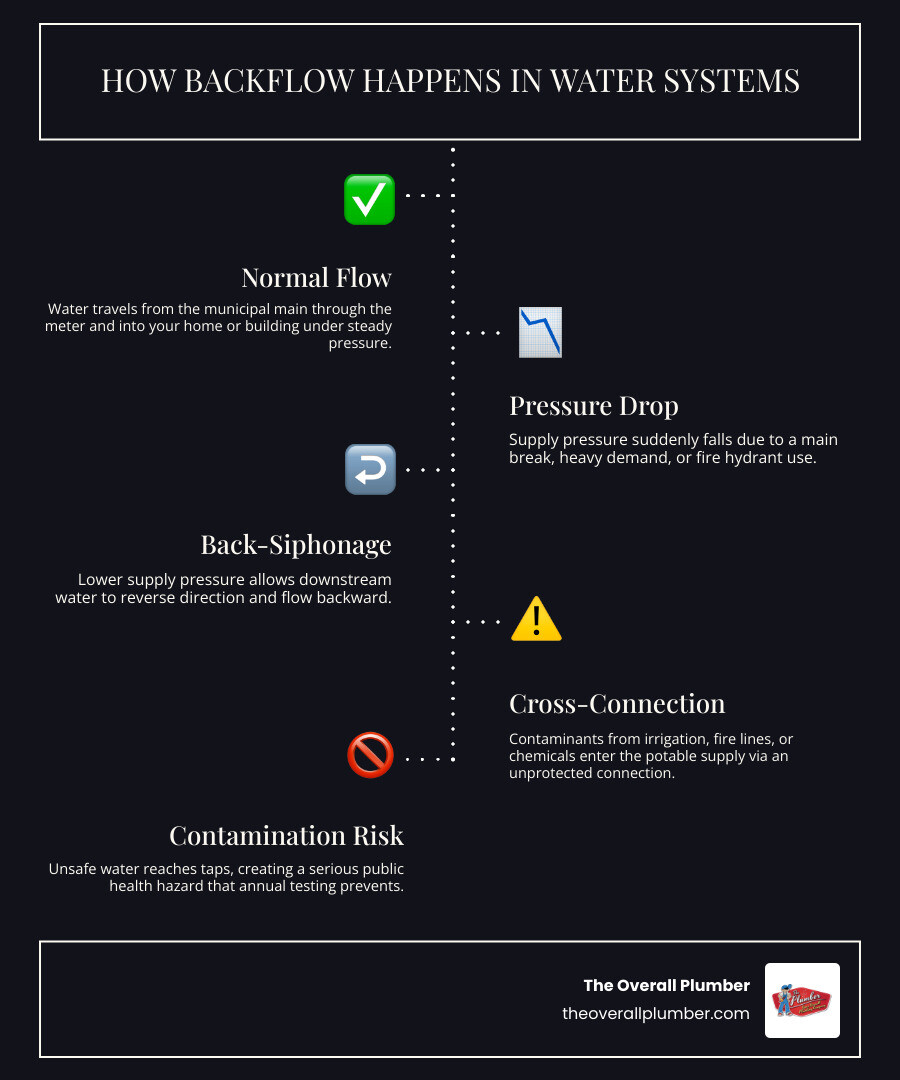
To understand why we test these assemblies, we first have to understand the plumbing mechanics behind backflow. In a perfect world, water flows in one direction: from the municipal water main, through your water meter, and out of your faucets, showerheads, or sprinkler systems.
However, water systems are dynamic. Pressures constantly fluctuate. If a sudden drop in supply pressure occurs, or if a downstream system generates more pressure than the supply line, the direction of the water flow can reverse. This reversal is called backflow.
There are two primary hydraulic conditions that cause backflow:
- Backpressure: This occurs when the pressure in a downstream system (such as a commercial boiler, a private well, or a circulating pump) exceeds the pressure in the public water distribution system. The higher pressure pushes the non-potable water backward into the clean drinking water line.
- Backsiphonage: This is caused by negative or sub-atmospheric pressure in the supply line, which acts like a giant vacuum cleaner. It literally sucks water backward from your property into the public main. Backsiphonage is commonly triggered by a water main break, frozen pipes, or high-volume water usage nearby, such as firefighters drawing water from a hydrant.
For backflow to pose a danger, there must be a cross-connection. A cross-connection is any physical link between a potable water supply and a non-potable source (like wastewater, chemicals, or stagnant water).
Common examples of cross-connections include:
- A garden hose submerged in a swimming pool or a bucket of soapy water.
- An irrigation system with sprinkler heads resting in muddy soil containing fertilizers, pesticides, or animal waste.
- A commercial fire sprinkler system where water sits stagnant in black iron pipes for years.
To learn more about the specific terminology used in these systems, check out our guide on Backflow Valves Terms Demystified.
When these cross-connections are left unprotected, backflow can contaminate water on a single-building scale, an entire city block, or even a whole municipal system. This is why municipalities like the City of Houston enforce rigorous standards through their Cross Connection Control Program | City of Houston. By isolating hazards at the meter, we ensure that what happens on your property stays on your property and doesn’t compromise the community’s drinking water.
Why Annual Backflow Prevention Testing Is Mandatory
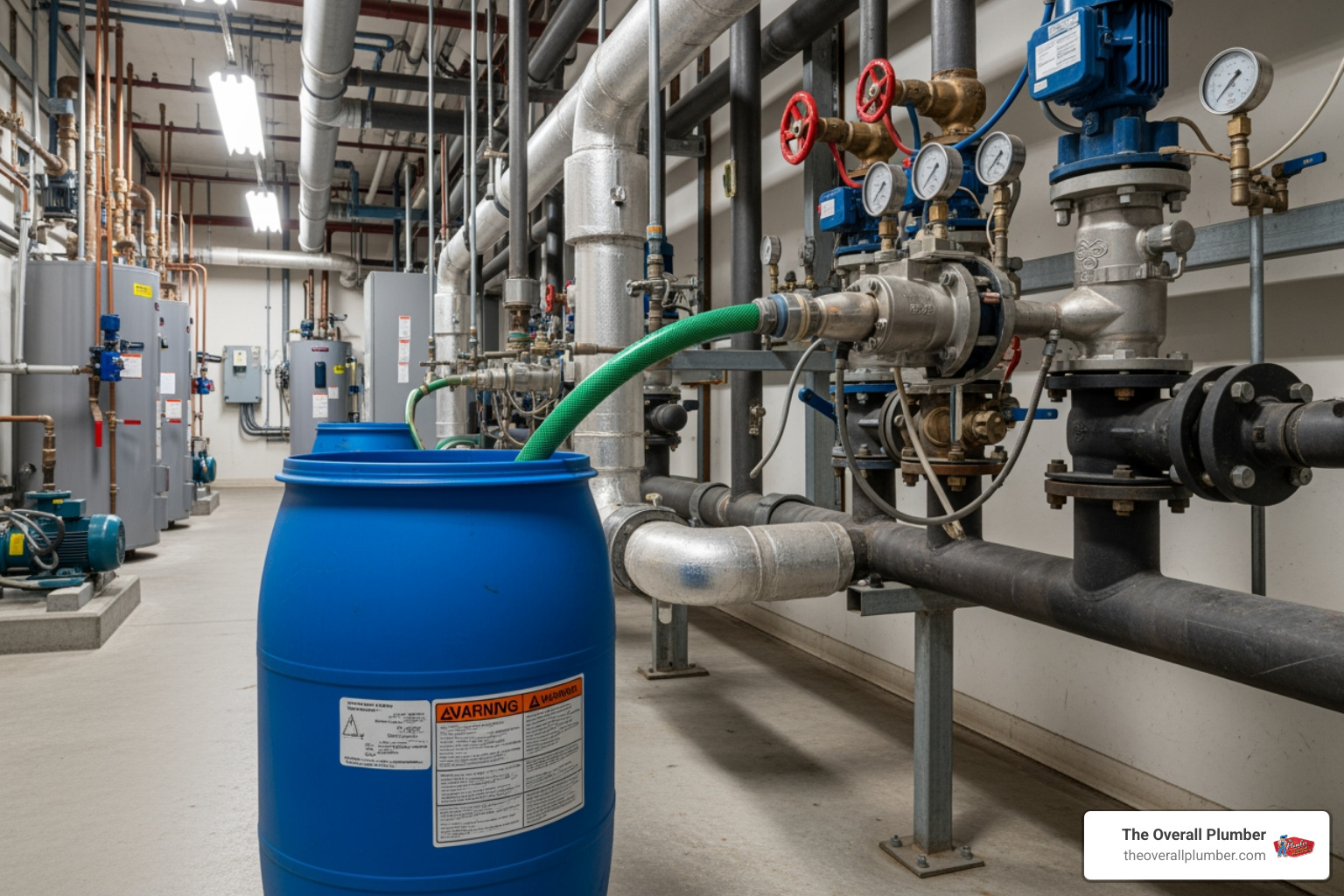
Because backflow prevention assemblies are mechanical devices with moving parts, springs, and rubber seals, they are subject to wear and tear. Over time, mineral deposits can build up, springs can weaken, and rubber gaskets can crack or perish. A failing backflow assembly will not prevent contaminated water from entering your drinking supply during a pressure event.
That is why annual backflow prevention testing is strictly mandated. It is the only way to verify that the internal check valves and relief valves are opening and closing at the exact pressures required to keep you safe.
In Texas, public water systems are legally required to protect their distribution networks from contamination. This mandate comes directly from the state level through the Texas Commission on Environmental Quality (TCEQ), specifically outlined in 30 TAC Chapter 290. The TCEQ provides comprehensive guidelines on how municipalities must structure their safety programs, which you can read about in the document on Establishing and Managing an Effective Cross-Connection Control Program.
Local cities and water districts across our Texas service areas implement these state rules through local ordinances:
- League City: The city actively manages local compliance and tracking to protect municipal lines. You can learn more on the Backflow Testing Program | The League City Official Website!.
- Friendswood: Recent updates require specific reporting procedures for local property owners. Read the official update via the [PDF] NOTICE OF CHANGE IN BACKFLOW PROCEDURE.
- La Porte: Property owners must use city-approved forms and certified testers, which you can find detailed in the [PDF] City of La Porte Backflow Prevention Assembly documentation.
- Texas City: The local utility department monitors backflow compliance to keep coastal waters and municipal lines clean. See Utilities | Texas City, TX for more information.
- Brazoria County: Local water quality testing and laboratory services help track and prevent environmental hazards. For details on local water testing, check out the Water Lab | Brazoria County, TX.
That while a backflow test ensures your containment assembly is working, it does not replace the need to inspect other critical home safety devices. For instance, you still need to regularly inspect your thermal expansion tanks and water heater pressure relief valves, which can be affected by closed plumbing systems. For a complete look at what a full system evaluation entails, read our guide on Back Flow Valve Plumbing Inspection.
Types of Backflow Prevention Assemblies and Their Uses
Different plumbing setups require different levels of protection. Backflow prevention assemblies are categorized by how they operate and the level of hazard they are designed to protect against.
| Assembly Type | Abbreviation | Hazard Protection Level | Common Applications | Can Protect Against Backpressure? | Can Protect Against Backsiphonage? |
|---|---|---|---|---|---|
| Double Check Valve Assembly | DCVA | Low Hazard (Non-Health) | Fire sprinkler systems, light commercial | Yes | Yes |
| Reduced Pressure Principle Assembly | RPBA | High Hazard (Health Hazard) | Commercial kitchens, chemical facilities, irrigation with chemical injection, auto-fills | Yes | Yes |
| Pressure Vacuum Breaker | PVB | High or Low Hazard (Continuous Pressure) | Lawn irrigation systems, swimming pool fill lines | No | Yes |
| Air Gap | AG | Maximum Hazard | Water storage tanks, pool fill lines (non-mechanical) | Yes | Yes |
Selecting the Right Device for Your Property
Choosing the right assembly comes down to assessing the “hazard level” of the cross-connection. Water authorities classify hazards into two categories:
- High Hazard (Health Hazard): A cross-connection that could introduce toxic substances, bacteria, or chemicals into the water supply. Examples include medical facilities, car washes, pest control operations, and irrigation systems that use chemical fertilizer injectors. These applications require a Reduced Pressure Principle Assembly (RPBA) or a physical Air Gap.
- Low Hazard (Non-Health Hazard): A cross-connection that might affect the taste, odor, or aesthetic quality of the water but won’t cause illness. Examples include standard fire sprinkler systems without chemical additives. These can often be protected by a Double Check Valve Assembly (DCVA).
While commercial properties and multi-family complexes are almost always required to have containment assemblies at their water meters, single-family residential homes are often exempt unless they have specific high-hazard features. These features include dedicated lawn irrigation systems, auxiliary water wells, or swimming pools with automatic fill lines.
The Process of Backflow Prevention Testing
When we perform a backflow test, we follow strict, standardized procedures. In Texas, testers must follow the University of Southern California (USC) Foundation for Cross-Connection Control and Hydraulic Research 10th Edition manual.
Here is what happens during a typical test:
- Notification and Isolation: We notify the property owner that the water will be temporarily shut off. We then close the shutoff valves on the backflow assembly to isolate it from the water system.
- Attaching the Test Kit: We connect a set of highly accurate, calibrated test gauges to the test cocks on the side of the assembly. These gauges measure the pressure drop across the internal check valves.
- Testing Check Valve 1: We measure the pressure differential across the first check valve to ensure it holds tight and doesn’t allow water to leak backward.
- Testing Check Valve 2: We repeat the process for the second check valve.
- Testing the Relief Valve (on RPBA devices): For RP devices, we bleed pressure to ensure the relief valve opens at the exact required threshold (at least 2.0 psi below the supply pressure) to discharge water before backflow can occur.
- Recording and Reporting: We record all measurements on the official TCEQ Form 20700 – BACKFLOW PREVENTION ASSEMBLY TEST AND MAINTENANCE REPORT.
All test gauges must be calibrated annually to maintain their accuracy, and the serial number of the calibrated gauge kit must be recorded directly on the test report.
What Happens If an Assembly Fails a Test?
It is not uncommon for a backflow assembly to fail its annual test. The most common culprits are small pieces of debris (like sand, pebbles, or rust from the water main) getting lodged in the check valve seats, preventing them from sealing completely. Other common failure modes include worn rubber disc rings, corroded guide stems, or broken internal springs.
If your assembly fails the test, don’t panic. It simply means the device did its job of alerting us to a vulnerability before an actual backflow event occurred.
Here is the step-by-step process for handling a failed test:
- Disassembly and Cleaning: We carefully open the assembly’s canopy or cover, remove the internal check modules, and thoroughly clean the rubber seals and seats. Often, flushing out a bit of grit is all it takes to restore a perfect seal.
- Component Replacement: If the rubber seals are cracked, indented, or worn, we replace them using an approved manufacturer repair kit. If the springs are weak or broken, we install new ones.
- Retesting: Once the repairs are complete, we reassemble the unit and perform the pressure differential test again.
- Compliance Timeline: Under most local Texas ordinances, property owners have up to 30 days to complete repairs and submit a passing test report. However, if the device protects against an immediate high-hazard source, the water authority may require immediate repair or shut off the water supply to protect the public.

Submitting Your Backflow Prevention Testing Results
Once we complete a passing test, the paperwork must be submitted to the appropriate water purveyor. The submission process varies depending on where your property is located.
Many modern water systems have transitioned to electronic submission platforms. For example, some cities use third-party databases like BSI Online or Aqua Backflow, which charge a small filing fee to process the report. Other cities, such as the municipal program highlighted in the Backflow Prevention | City of Boulder guidelines, use direct online portals where certified testers upload reports immediately.
Regardless of the system your city uses, we handle the entire submission process for you. We recommend keeping a physical or digital copy of your passed test report for at least three years, as water districts occasionally audit records or experience database transitions.
Protect Your Property with Professional Plumbing Services
Keeping your drinking water safe shouldn’t be stressful. At The Overall Plumber, we make backflow compliance simple. Our team of certified backflow prevention assembly testers is fully licensed to inspect, test, repair, and certify assemblies throughout Brazoria County, Galveston County, Harris County, and the surrounding communities.
Beyond backflow testing, we provide a full suite of plumbing services designed to keep your entire system in peak condition. From detailed drain cleaning with augers and camera inspections to advanced leak detection, we have you covered. We stand behind our work with industry-leading satisfaction guarantees, priority scheduling, and we never charge overtime fees or trip charges.
If you want ongoing peace of mind, consider joining our Overall Plumbing Protection Plan. This plan includes annual safety inspections to catch minor plumbing issues before they turn into costly emergencies. And if you are located in the La Porte area and suspect you have an underground leak wasting water and dropping your system’s pressure, check out our specialized La Porte Texas Leak Detection & Repair services. Contact our team today at (281) 668-8055 to schedule your backflow testing or plumbing service.