


Why Leak Location Matters More Than Most Homeowners Realize
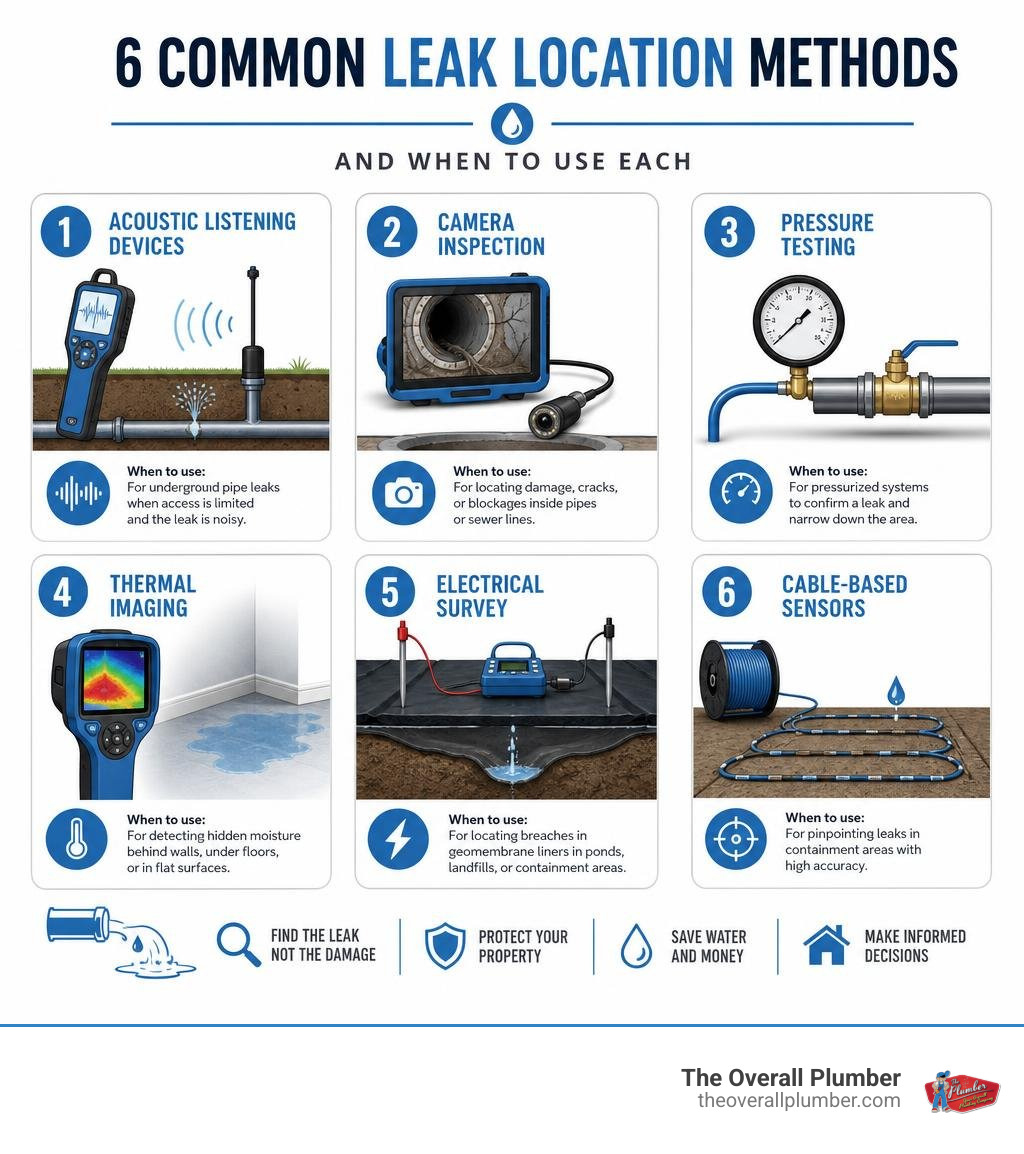
Leak location is the process of finding exactly where water (or another fluid) is escaping from a pipe, liner, or containment system. Here are the most common methods used today:
- Acoustic listening devices – detect the sound of water escaping underground pipes
- Camera inspection – a small camera is sent through pipes to visually find damage
- Pressure testing – monitors pressure drops to narrow down where a leak exists
- Thermal imaging – detects temperature differences caused by hidden moisture
- Electrical survey – uses electrical current to find breaches in geomembrane liners
- Cable-based sensors – a sensing cable pinpoints water contact to within 15 cm
A small leak can do a lot of damage fast. It can rot wood, crack a foundation, contaminate groundwater, or run up a water bill for months before anyone notices. The tricky part is that most leaks are completely invisible. There is no puddle on the floor, no dripping sound, no obvious sign at all.
That is what makes accurate leak location so important. Finding that there is a leak is only half the job. Finding exactly where it is saves you from tearing up floors, walls, or yards in the wrong spot.
I’m Dayton Whitworth, a second-generation plumber serving Houston and the Gulf Coast area, and leak location is one of the most common — and most misunderstood — services my team handles. Whether it’s a hidden slab leak under a foundation or a slow seep in an underground line, pinpointing the source before any digging begins is always the first step we take.
The Science of Electrical Leak Location in Geomembranes
While we often think of leak location in terms of household plumbing, the same core principles apply to massive industrial and environmental containment systems. In landfills, wastewater treatment plants, and mining operations, geomembrane liners act as the ultimate barrier preventing hazardous waste from leaching into local groundwater. Finding a hole as small as 1 mm in these massive plastic sheets is a highly scientific process that relies on electrical current.
Because geomembranes are made of materials like high-density polyethylene (HDPE), they are excellent electrical insulators. The soil or water underneath them, however, is conductive. Electrical leak location surveys take advantage of this physical difference by introducing an electrical potential across the liner. If the liner is completely intact, no current can pass through. But if there is even a tiny pinhole, the electrical current will find that path of least resistance, flowing through the breach and allowing technicians to pinpoint its exact coordinates.
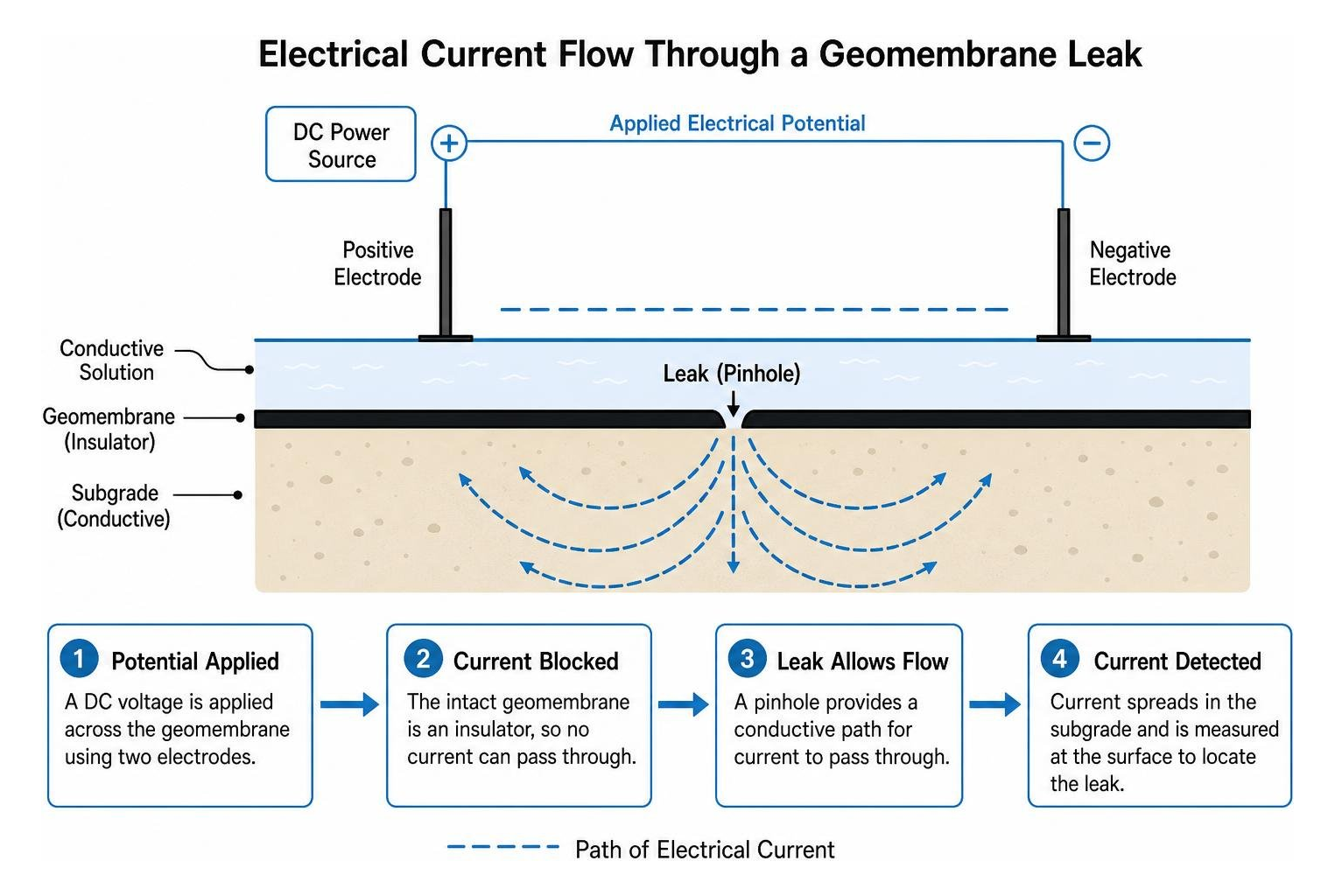
There are three primary electrical survey methods used depending on the stage of construction and site conditions:
- Bare Liner Surveys (ASTM D7002): These are performed on exposed liners before any soil or water is placed on top. Technicians use a water puddle or water lance system to spray a conductive stream of water over the liner, or they use high-voltage arc testing in dry conditions. This is the most sensitive method and can easily identify pinholes down to 1 mm.
- Water Surveys (ASTM D7007): When a geomembrane is covered with water—such as in an active wastewater pond or reservoir—technicians use a dipole method. By wading through the water or towing an array of sensors, we map the electrical field. This allows us to locate leaks without the massive expense and operational disruption of draining the facility.
- Soil Surveys (ASTM D7007): Heavy construction equipment can easily puncture a liner while spreading protective soil layers. Soil-covered surveys utilize a mobile dipole receiver dragged across the soil surface to detect localized electrical anomalies indicating a leak beneath the dirt.
To ensure compliance with environmental regulations and guarantee unbiased results, these surveys should always be performed in accordance with ASTM standards (including ASTM D6747 for selecting leak location techniques). Utilizing independent, third-party testing providers is critical to satisfy EPA requirements and avoid conflicts of interest with the liner manufacturers or installers.
Advanced Tools for Geomembrane Leak Location
Historically, conducting an electrical leak survey on dry or frozen subgrades was incredibly difficult because dry dirt does not conduct electricity well. This often led to unreliable results or false positives. To solve this, manufacturers developed conductive-backed geomembranes. These liners feature a co-extruded, highly conductive bottom layer. This built-in conductivity ensures that the electrical circuit can be completed even if the ground beneath the liner is bone dry.
Testing these advanced liners requires specialized tools designed to isolate the electrical current and prevent false readings:
- S-100 Spark Tester: This tool uses a high-voltage power source and a conductive brush or neoprene squeegee electrode to sweep across the dry liner. When it passes over a leak, a visible spark and audible alarm are triggered.
- Iso-wedge Seam Isolation Tool: Welded seams are notorious for causing false positives during spark testing because the overlapping plastic can trap moisture or create conductivity breaks. The patented Iso-wedge tool temporarily isolates the welded seam, allowing technicians to test the seam integrity without triggering false alarms.
- Water Puddle Tester: A handheld tool that distributes a thin layer of water over the bare liner to establish an electrical connection in dry climates.
- Deep-Water Towed Arrays: Specialized sensor rigs that allow operators to scan the bottom of deep, active reservoirs without sending divers underwater.
Permanent Monitoring vs. Periodic Leak Location Surveys
When managing high-risk containment facilities, operators must choose between periodic surveys and permanent, 24/7 monitoring systems.
Periodic surveys are typically performed as a quality assurance measure during construction or immediately after soil placement. They provide a highly accurate snapshot of the liner’s health at that specific moment. However, they cannot detect leaks that develop months or years later due to ground settling, seismic activity, or chemical degradation.
For long-term peace of mind, permanent monitoring systems like Electrical Leak Imaging Monitoring (ELIM) are installed during construction. These systems place a permanent grid of sensors beneath the geomembrane. The system continuously monitors the electrical field 24/7. If a leak occurs, the system immediately flags the change in electrical potential, calculates the coordinates, and alerts facility managers. This real-time approach prevents minor punctures from turning into catastrophic environmental disasters.
Data-Driven Machine Learning vs. Physical Water Network Inspections
In municipal water distribution networks, finding leaks is a race against time. Traditional physical inspections rely on crews walking the streets with acoustic listening devices, ground-penetrating radar, or correlating sensors. While highly accurate for pinpointing, physical inspections are slow, labor-intensive, and impossible to scale across thousands of miles of underground pipes.
In recent years, water utilities have turned to data-driven machine learning (ML) models. By analyzing continuous flow and pressure data from sensors placed throughout the network, these models can flag anomalies and predict leak locations in near real-time. However, implementing these models in the real world comes with severe practical challenges, including limited historical leak data, optimal sensor placement, and distinguishing a single leak from simultaneous leak scenarios.
| Feature / Capability | Traditional Physical Inspections | Data-Driven Machine Learning Models |
|---|---|---|
| Speed of Detection | Slow (requires manual dispatch) | Near real-time (continuous monitoring) |
| Labor Requirement | High (field technicians required) | Low (automated software analysis) |
| Equipment Cost | Low to moderate | High (requires extensive sensor network) |
| Pinpoint Accuracy | Extremely high (within inches) | Moderate (defines search areas/zones) |
| Performance in Noisy Areas | Poor (traffic drowns out acoustic signals) | Moderate (can filter out background noise) |
| Adaptability | High (technicians adapt to site conditions) | Poor (requires continuous model retraining) |
A major breakthrough in addressing these limitations is detailed in the study Near Real-time Leak Location by Inverse Analysis Integrating Measurement Uncertainty. Traditional algorithms often fail because they try to pinpoint an exact coordinate while ignoring unavoidable sensor measurement noise. By integrating expected sensor error margins directly into the mathematical analysis, this approach shifts the goal from “pinpoint accuracy” to defining a highly reliable, narrow search area. This allows physical plumbing teams to bypass the guesswork and go straight to the zone where the leak is hidden.
Classifier vs. Regressor Models in Hydraulic Networks
When designing machine learning models for municipal leak location, engineers typically choose between two mathematical approaches: classifiers and regressors.
A classifier model treats the water network as a collection of predefined zones or nodes. It analyzes pressure drops and attempts to classify the leak as belonging to “Node A” or “Node B.” The critical limitation of this approach is that it assumes you have historical leak data for every single node in the network to train the model. In the real world, municipal networks are constantly changing, and historical data is incredibly sparse.
A regressor model, on the other hand, predicts the actual spatial coordinates (latitude and longitude) of the leak. This is a far more realistic and flexible approach because it doesn’t rely on predefined nodes and can predict leaks in areas of the network that have never experienced a failure before.
However, evaluating these models carries a massive data-modeling trap. Many researchers use “random partitioning” to split their hydraulic data into training and testing sets. As exposed in the study Towards a Realistic Data-Driven Leak Localization in Water Distribution Networks, random partitioning allows the model to “cheat” by analyzing data points from the exact same leak event across different times. This inflates model accuracy up to four-fold on paper, achieving up to 100% accuracy in the lab.
When these models are deployed in the real world, their performance plummets. To get a realistic evaluation, developers must use “temporal (nodal) partitioning”—training the model on past leak events and testing it on entirely separate, future leak events.
Industrial Cable-Based Sensors for Real-Time Water Detection
For mission-critical facilities like data centers, clean rooms, and power stations, even a few drops of water can cause millions of dollars in equipment damage and downtime. In these environments, wait-and-see approaches are not an option.
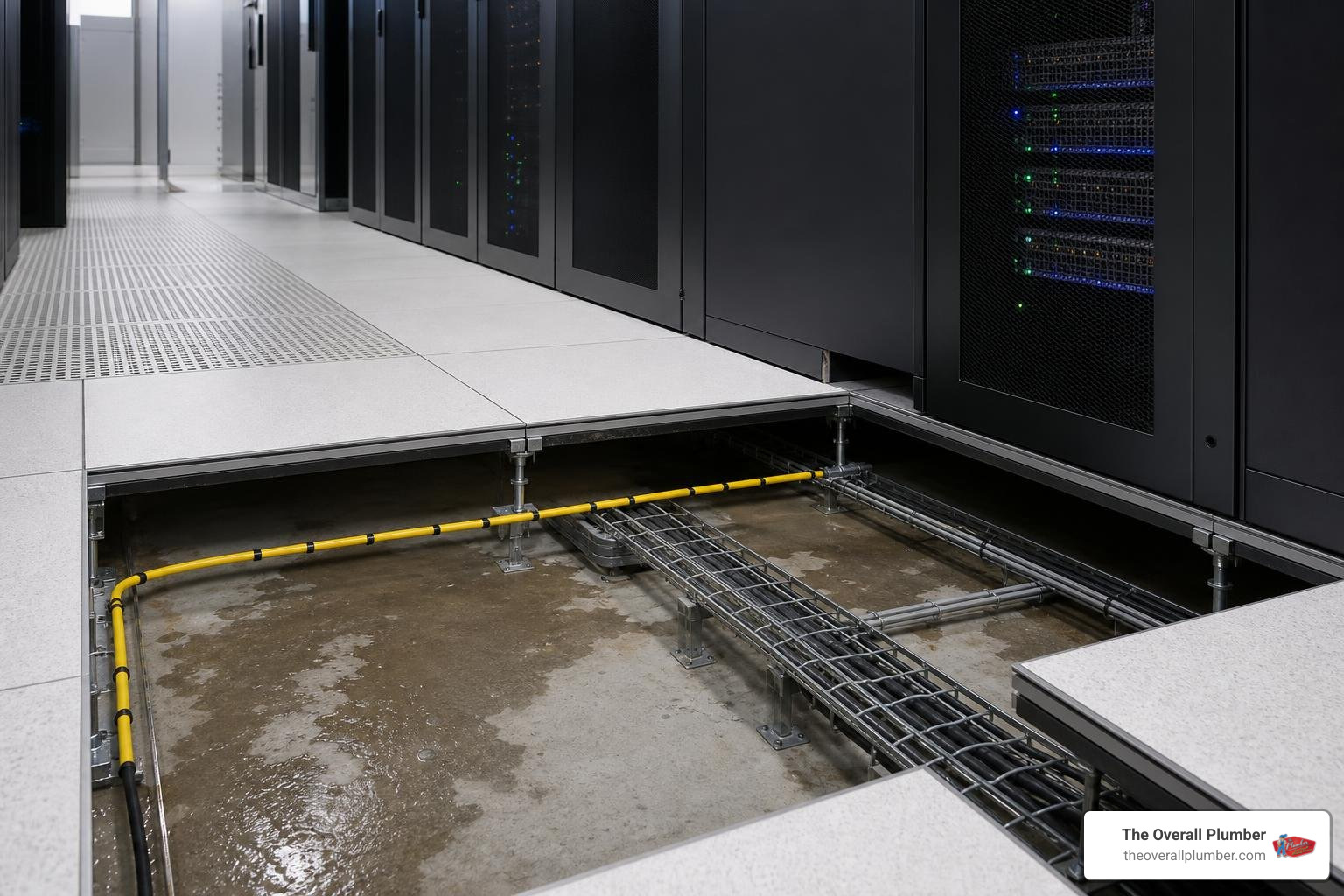
These facilities rely on continuous, cable-based water leak detection sensors. The sensing cable consists of conductive wires wrapped around a central fluoropolymer carrier rod. This specialized construction keeps the wires separated but exposed. When water touches any part of the cable, it bridges the gap between the sensing wires, completing an electrical circuit.
Key features of industrial cable-based systems include:
- Pinpoint Accuracy: Unlike simple spot detectors that only tell you if there is water, these advanced cables can pinpoint exactly where water has made contact along the cable’s path to within a 15 cm (6-inch) range.
- Power and Integration: These systems are powered via Power over Ethernet (PoE) or DC power and integrate seamlessly with building management systems using protocols like Modbus TCP, SNMP, SMS, or email alerts.
- Extensive Range: Individual sensing cables are typically reusable and can be daisy-chained to cover distances of up to 102 meters (330 feet) or more, running under raised floors, along water pipes, and around air conditioning units.
While these high-tech industrial systems are perfect for server rooms, residential properties face different challenges. If you suspect a leak under your home’s foundation, you don’t need a daisy-chained sensor cable—you need professional slab leak detection to map out the hidden pipes beneath your concrete floor.
Frequently Asked Questions About Leak Detection
If you are dealing with a mystery water bill or a damp spot on your drywall, finding the right path forward can be confusing. If you are trying to figure out how to navigate this process, our guide on how to find a plumber to find water leak is a great starting point. Below, we answer some of the most common technical questions about advanced leak detection.
What is the most accurate method for geomembrane leak detection?
The most accurate method is the Bare Liner Survey conducted in accordance with ASTM D7002. Because the liner is completely exposed, technicians can use high-voltage spark testing or water-puddle methods to locate pinholes as small as 1 mm with virtually 100% accuracy. Once soil or water covers the liner, technicians must shift to ASTM D7007 dipole surveys, which are highly effective but require more complex data analysis to filter out background electrical noise.
How do machine learning models fail in real-world water networks?
Machine learning models usually fail in the field because of simulation bias and random partitioning traps. If a model is trained purely on clean, simulated data from software like EPANET, it will struggle with real-world sensor noise, seasonal water demand fluctuations, and open/closed valves that aren’t logged in the system. Furthermore, if the model was validated using random data splits, its reported accuracy is often inflated by up to 400%, masking its inability to handle unseen leak scenarios.
Can cable-based sensors pinpoint the exact location of a water leak?
Yes. Industrial cable-based sensors can locate water contact along the length of the cable with an accuracy of up to 15 cm (6 inches). The system calculates the location by measuring the change in electrical resistance along the sensing wires when water completes the circuit. These cables are ideal for wrapping around high-risk pipes or laying in grids beneath raised floors in server rooms.
Professional Water Leak Detection and Repair Services
At The Overall Plumber, we believe that you shouldn’t have to guess where a leak is hiding. Whether you are dealing with a hidden residential slab leak in Pearland, a clogged sewer line in Pasadena, or a mystery water loss in League City, our team is here to help. We combine decades of physical plumbing expertise with advanced camera inspections and non-invasive diagnostic tools to find the exact source of your problem without destroying your property.
We are proud to serve homeowners and businesses across Brazoria County, Houston, Clear Lake, Santa Fe, League City, Texas City, La Porte, Friendswood, Pearland, Pasadena, Galveston, Harris County, and Galveston County. When you choose us, you get the peace of mind that comes with our satisfaction guarantees, priority scheduling, and absolutely no overtime fees or trip charges.
Don’t let a hidden leak drain your wallet or damage your property. Learn more about our Professional Leak Detection and Repair Services and let our expert team handle the hard work for you.
Contact our team today at (281) 668-5056 to schedule your non-invasive inspection.