


How to Start Troubleshooting Low Water Pressure in Alvin
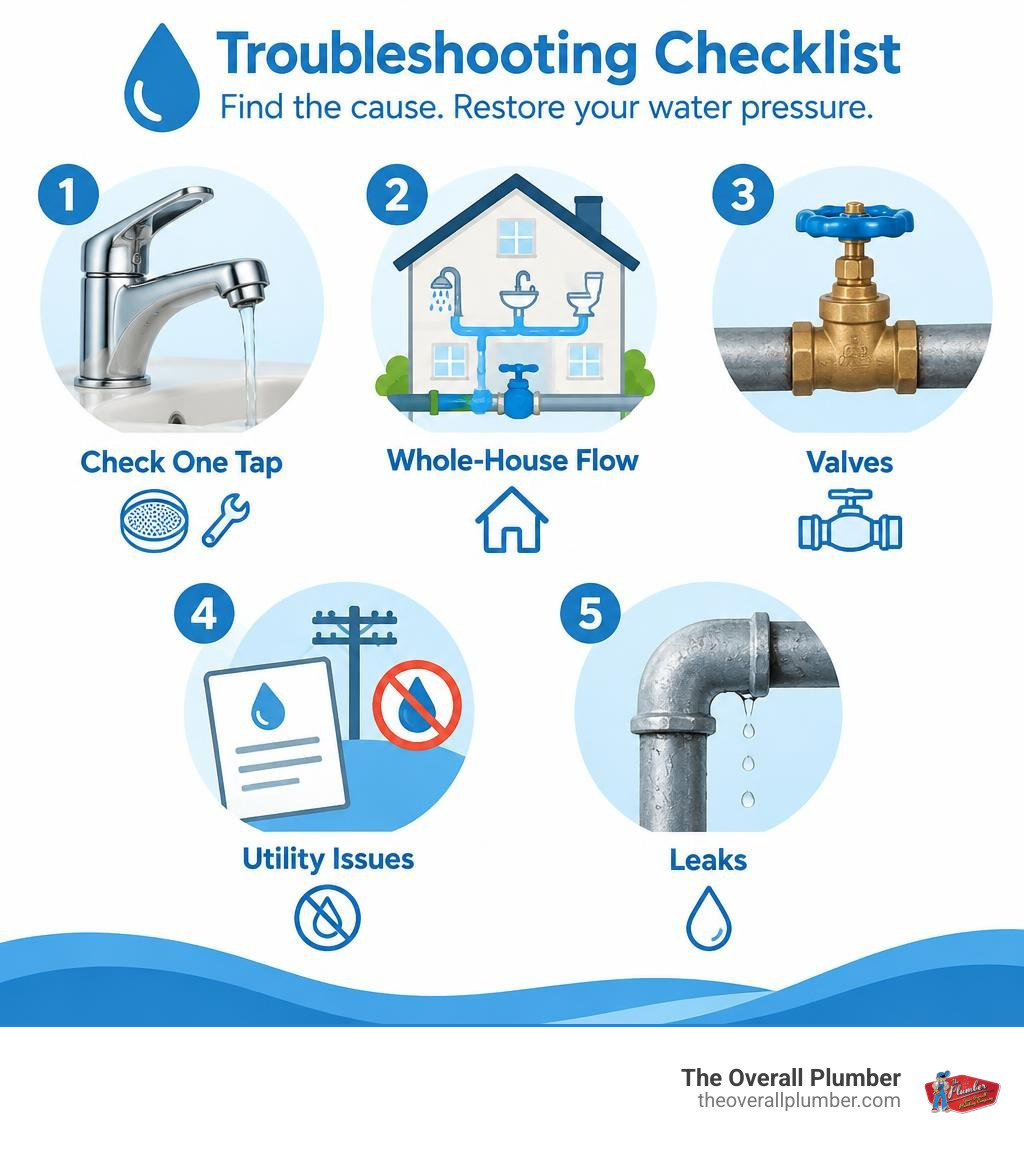
If water barely flows, check several taps first. If only one is weak, clean its aerator and check its shutoff valve. If the whole house is affected, make sure the main valve is open, ask a neighbor if they have the same problem, and check your water utility for an outage. Call a plumber if pressure stays low or you find signs of a leak.
A pressure gauge can help you put a number on the problem: many homes work well at 40-60 psi. The next steps will help you tell a simple fixture clog from a problem deeper in your plumbing.
I’m Dayton Whitworth, a second-generation plumbing professional serving Alvin and the surrounding Gulf Coast. As a low water pressure plumber with The Overall Plumber, I focus on finding the cause before recommending a repair.
Understanding What Causes Low Water Pressure in Alvin Homes
When you turn on the shower in the morning, you expect an invigorating cascade, not a sad, unenthusiastic trickle. Weak water flow turns basic chores into tedious time-wasters and makes rinsing shampoo feel like an endurance test. In Alvin and throughout Brazoria County, low water pressure is one of the most frequent plumbing complaints we encounter.
Plumbing systems rely on a careful balance of volume, pipe diameter, and force. When something interrupts that balance, water flow drops noticeably. The root causes generally fall into three categories:
- Mechanical Obstructions and Valve Issues: Main shut-off valves, water meter valves, or local angle stops that are partially closed or seized will restrict volume immediately.
- Systemic Deterioration: Mineral scale, rust, and internal pipe corrosion gradually narrow the interior passage of your lines. Older properties with legacy lines often benefit from comprehensive repiping services for older homes to permanently resolve severe internal restriction.
- Loss of Integrity or Regulation: Hidden subterranean leaks, failed pressure regulators, or municipal infrastructure disruptions compromise delivery before water reaches your fixtures.
Let’s look at how to determine whether your issue is limited to one sink or spread across your entire house.
Localized Fixture Restrictions vs. Whole-House Pressure Drops
Before assuming your entire plumbing system has failed, isolate where the weak flow is happening. The troubleshooting path changes completely depending on whether the issue affects a single fixture or your whole home.
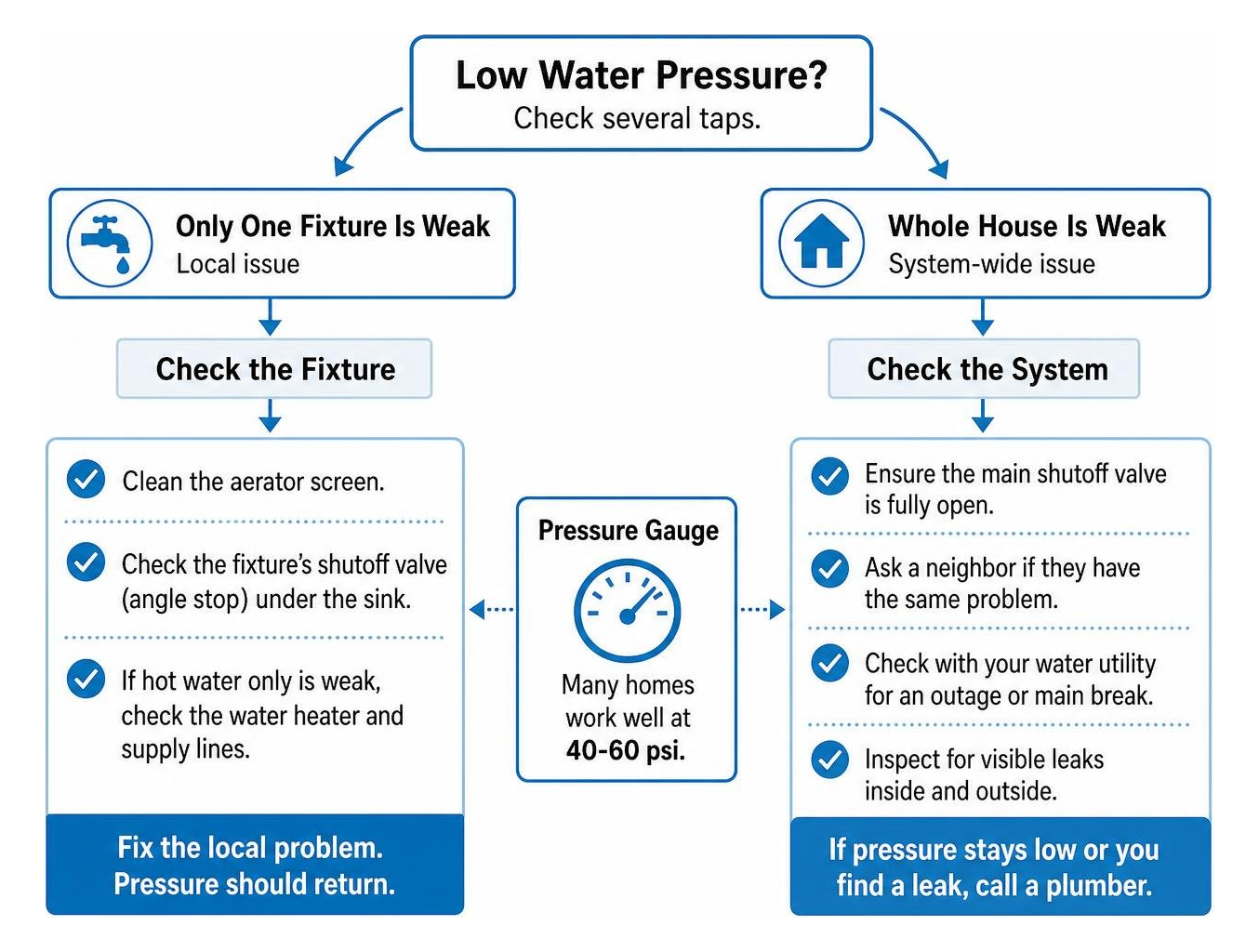
- Single-Fixture Weakness: If your kitchen faucet trickles but the bathroom sink blasts full force, the issue is strictly localized. The main culprits are clogged aerator screens, mineral-encrusted mixing cartridges, or a partially closed supply stop under the sink cabinet.
- Hot-Water-Only Drops: If cold water runs strong everywhere but hot water barely flows, the problem points straight to your water heater. Sediment accumulation in the tank or a crimped flexible supply line is likely choking hot water delivery.
- Whole-House Pressure Drops: When every fixture—indoor sinks, showers, toilets, and exterior hose bibs—displays weak flow simultaneously, the restriction is located on your main supply line, pressure-reducing valve (PRV), water meter, or municipal feed.
The Impact of Hard Water Scale on Plumbing Fixtures and Regulators
The water across our region carries dissolved minerals, primarily calcium and magnesium, a condition commonly referred to as water hardness. Over time, these minerals precipitate out of the water and form a rock-hard crust known as limescale.
Limescale loves to build up anywhere water experiences a pressure drop or temperature shift. Over several years, scale coats the fine mesh of faucet aerators, clogs showerhead nozzles, and coats internal valve seats. In older homes with original galvanized steel piping, mineral scale combines with internal oxidation. A 3/4-inch galvanized line that has been in service for decades is frequently narrowed to under a quarter inch of open bore due to severe internal corrosion and mineral buildup. When your pipe’s diameter is choked down by half or more, running two fixtures at once causes pressure to drop instantly.
How to Diagnose Water Pressure Problems at Home
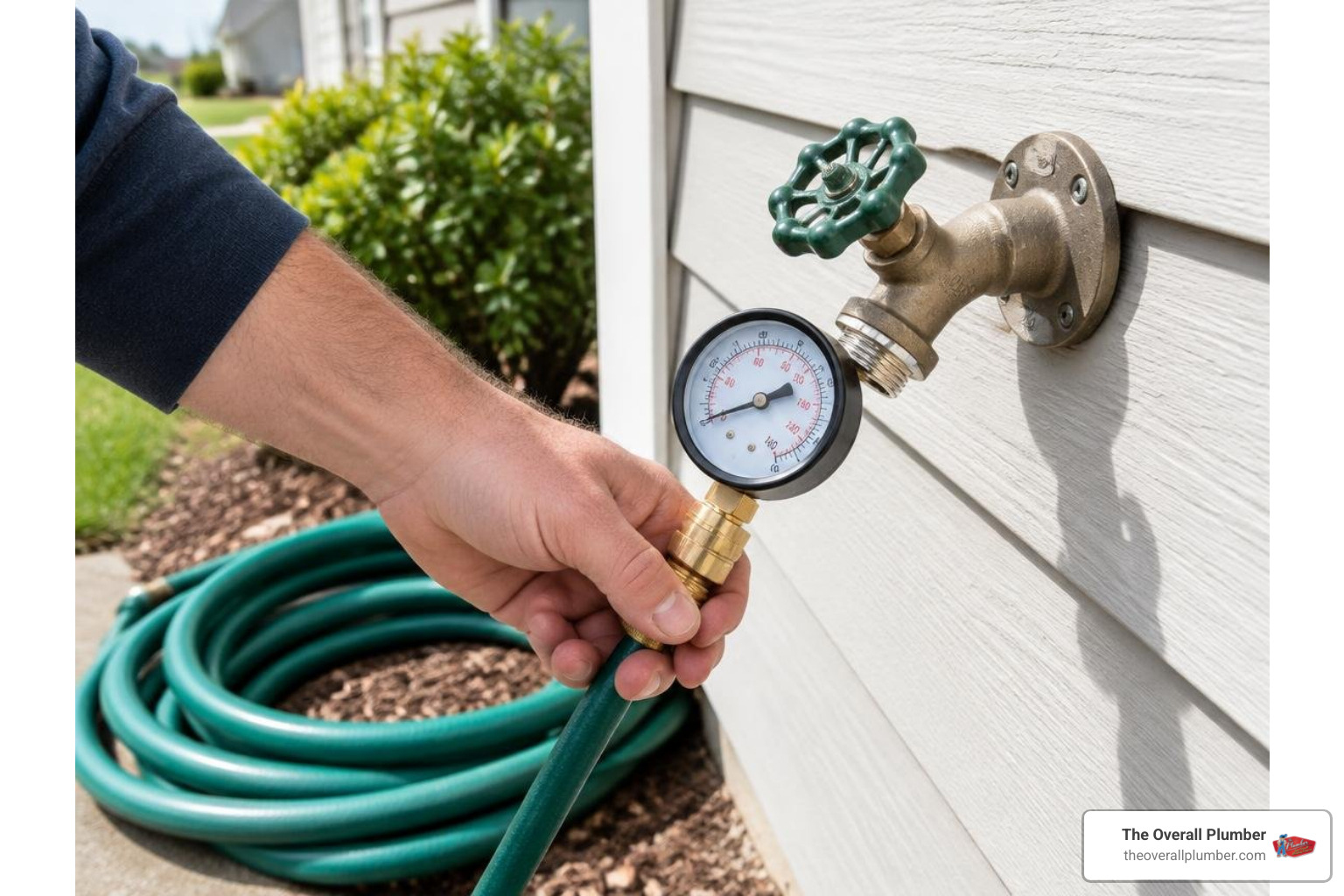
You do not need specialized plumbing gear to run initial diagnostics. With a few simple household tools, you can pinpoint whether your system is starved for flow or losing static pressure.
Step-by-Step DIY Flow and Static Pressure Testing
To gather accurate data, perform two simple tests: a static pressure test with a mechanical gauge and a bucket flow test.
1. The Static Pressure Gauge Test
Purchase an inexpensive water pressure test gauge with female hose threads from a local hardware store.
- Locate an outdoor hose bib closest to where your main water line enters your home.
- Ensure all indoor water fixtures, washing machines, and irrigation zones are completely shut off.
- Thread the pressure gauge tightly onto the hose bib.
- Open the bib valve completely and read the dial.
Normal baseline reading: A healthy residential system should read between 40 and 60 psi. If the reading sits below 40 psi, you are dealing with inadequate pressure. If it spikes above 80 psi, your system is running dangerously high and risks damaging internal appliance valves and seals.
2. The Timed Container Flow Test
Flow rate measures the volume of water delivered over time, typically in gallons or liters per minute. You can run a quick check using a standard 1-liter measuring jug at your main cold tap.
| Time to Fill 1-Liter Container | Calculated Flow Rate | System Condition |
|---|---|---|
| Under 6 seconds | ~10+ Liters/min (2.6+ GPM) | Normal, Healthy Flow |
| 6 to 10 seconds | 6–9 Liters/min (1.6–2.4 GPM) | Borderline Restriction |
| Over 10 seconds | Under 6 Liters/min (<1.5 GPM) | Severe Low Pressure |
Identifying Signs of Hidden Water Leaks Behind Walls and Slabs
A sudden drop in whole-house water pressure can point to an active, hidden pipe rupture. If pressurized water escapes under your foundation or inside a wall cavity, your fixtures lose volume.
To check for a hidden leak:
- Turn off every tap and water-consuming appliance inside and outside your house.
- Walk out to your water meter box near the street curb.
- Open the cover and inspect the meter face. Look for a small red or silver triangle or star (the low-flow indicator dial). If all water is off inside and this indicator is spinning, water is actively escaping somewhere on your property.
- Check your digital or analog odometer reading, wait 30 minutes without using water, and check it again. Any movement confirms a leak.
If you notice unexplained warm spots on your flooring, damp drywall along baseboards, or a suddenly surging utility bill alongside weak water flow, contact our team for comprehensive leak detection and repairs right away to prevent structural foundation damage.
Why Your Pressure-Reducing Valve (PRV) Might Be Failing
A Pressure-Reducing Valve (PRV) is a bell-shaped brass device usually installed on your main water line near the outdoor shutoff or where the supply enters your home. Its primary job is to throttle down high municipal water pressure from the street—which can run between 90 and 150 psi—down to a safe household range of 40 to 60 psi.
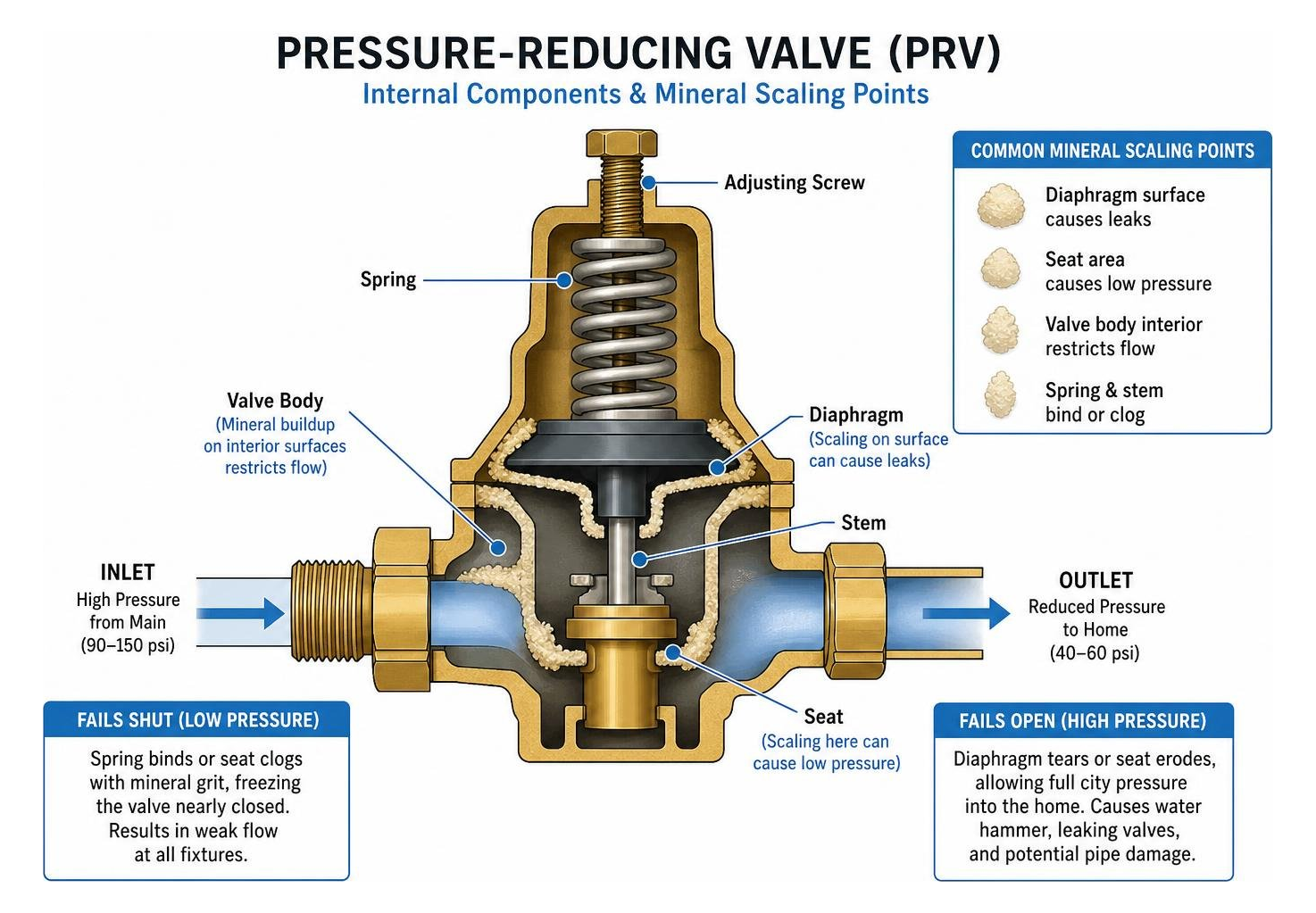
Like any mechanical component containing rubber diaphragms, internal springs, and moving brass seats, PRVs have a limited lifespan. In mineral-rich water conditions, PRVs scale up and fail predictably inside 8 to 10 years (and rarely last beyond 12 years).
When a PRV fails, it typically exhibits one of two symptoms:
- Fails Shut (Low Pressure): The internal spring binds or the moving seat clogs with mineral grit, freezing the valve in a nearly closed position. This chokes your household flow down to a weak trickle across all fixtures.
- Fails Open (High Pressure & Water Hammer): The internal diaphragm tears or the seat erodes, allowing full city main pressure to surge into your home. This can cause violent pipe banging (water hammer), leaking toilet fill valves, and blown supply lines on washing machines or water heaters.
Adjusting or replacing a PRV requires specialized plumbing tools to ensure line pressures are balanced correctly and verified with downstream gauges.
When to Call a Low Water Pressure Plumber for Professional Help
While cleaning out a crusty faucet aerator with white vinegar is an easy weekend DIY task, extensive pressure drops require licensed professional intervention. You should contact a professional plumber when:
- Low pressure affects the entire house and does not improve after verifying that your main valves are fully open.
- You experience a sudden, dramatic drop in water pressure without prior notification of municipal utility work.
- Pipes bang, whistle, or vibrate violently whenever a tap is opened.
- Water comes out rusty, discolored, or gritty alongside weak flow.
- You suspect a subterranean line break or slab leak.
For sudden, severe pressure drops or active line breaks, our 24 hour emergency plumbing services are available around the clock to protect your home from water damage.
Diagnostic Tools Used by a Low Water Pressure Plumber
When our technicians arrive at your home, we do not guess or rely on quick surface patches. We use professional diagnostic equipment to trace the exact source of flow restrictions:
- Digital Manometer & Inline Flow Gauges: We measure both static pressure (when water is closed) and dynamic pressure drop (when fixtures run) at multiple points in your system. This immediately tells us whether you have a supply pressure issue or an internal volume restriction.
- High-Definition Video Pipe Inspection Cameras: For drain systems and large-diameter supply branches, camera feeds reveal internal scale, blockages, and pipe wall collapse.
- Ultrasonic Acoustic Leak Detectors: When a buried line or under-slab pipe is leaking and bleeding off pressure, acoustic sensors detect the exact frequency of escaping water through concrete and soil without destructive digging.
Repair Solutions and Estimated Costs from a Low Water Pressure Plumber
Because every plumbing system is configured differently, repair solutions depend on the underlying cause. At The Overall Plumber, we believe in straightforward, upfront pricing with no trip charges and zero overtime fees.
- PRV Replacement: Replacing a worn, seized pressure regulator with a commercial-grade brass unit typically costs between $350 and $850, depending on accessibility, pipe sizing, and whether additional shutoff valves require updating.
- Targeted Sectional Clearing & Valve Replacement: Replacing corroded gate valves with full-port brass ball valves or clearing localized mineral blockages generally runs from $175 to $450.
- Underground Main Supply Line Repairs: Repairing a cracked main supply line between the meter and your home generally ranges from $650 to $2,200, depending on depth, soil conditions, and excavation requirements.
- Whole-Home System Repiping: For older homes with heavily corroded galvanized pipe networks that choke flow to a fraction of an inch, our team provides complete residential plumbing solutions using modern PEX or copper piping, typically ranging from $4,000 to $10,000+ depending on property size and fixture count.
Frequently Asked Questions About Low Water Pressure in Alvin
What is considered normal water pressure for a residential home?
Normal residential water pressure should register between 40 and 60 psi (pounds per square inch). Any reading below 40 psi will feel sluggish and weak, while readings consistently exceeding 80 psi violate plumbing codes and risk damaging water heaters, washing machines, and fixture cartridges over time.
Can sediment buildup in a water heater cause low hot water pressure?
Yes. Over time, dissolved minerals settle to the bottom of the water heater tank, creating a dense layer of hardened sediment. This buildup can clog the hot-water outlet nipple, foul heat traps, and restrict overall volume. Flushing your water heater annually clears sediment accumulation and keeps hot water flowing at full pressure.
How do I know if low water pressure is a municipal utility issue?
Start by checking with your immediate neighbors. If their water pressure dropped at the exact same time as yours, the issue is almost certainly on the municipal supply side (such as a nearby water main break, hydrant flushing, or city maintenance). If your neighbors have strong, normal water flow, the restriction is located within your private property lines.
If you are dealing with unresolved low pressure or need a professional diagnostic inspection, contact The Overall Plumber to speak with a licensed technician.