

What Is a Gas Line Pressure Test in Houston — and Do You Need One?
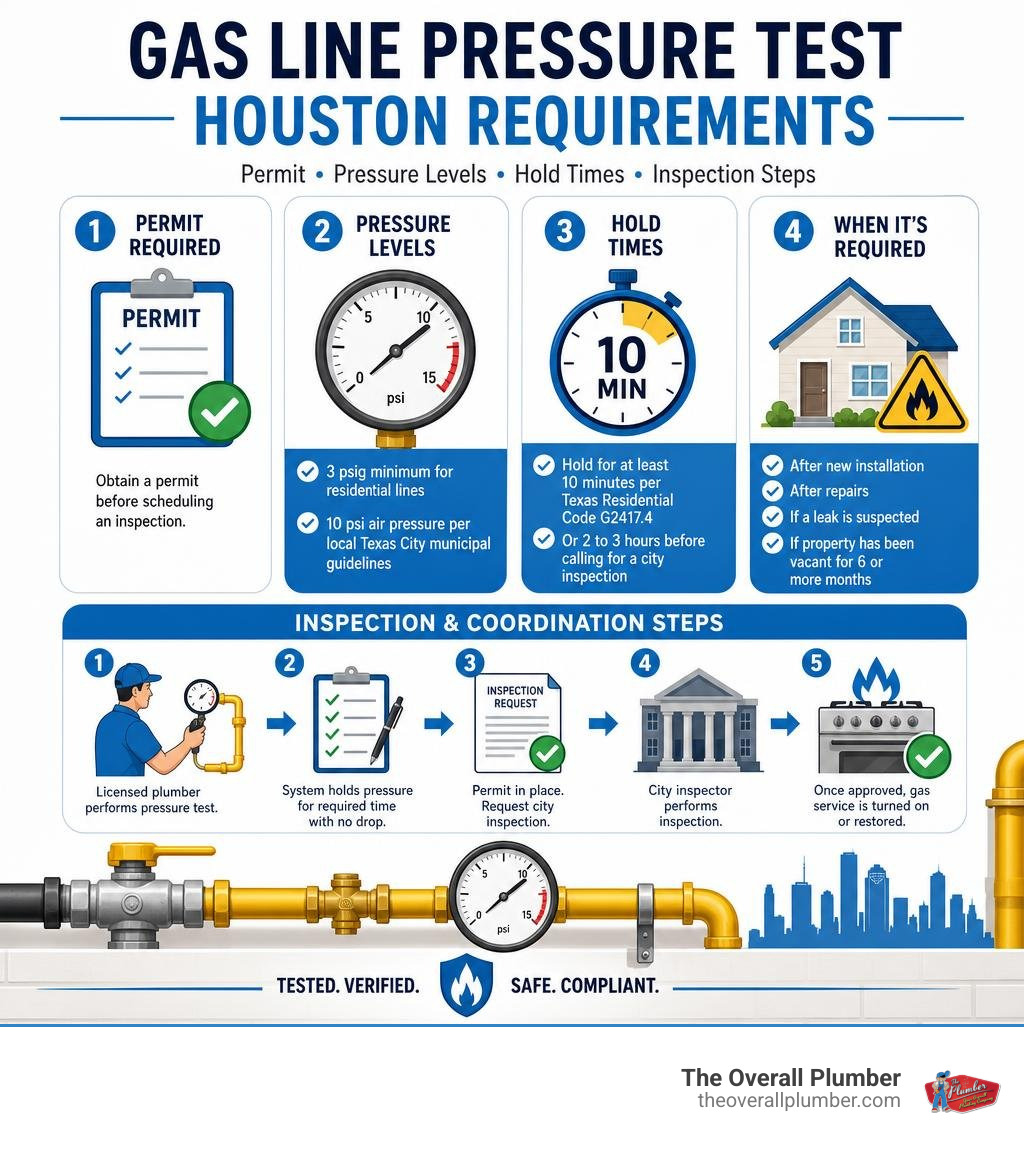
If you need a gas line pressure test in Houston, here’s what to know right away:
- Who can do it: A licensed plumber (or a homeowner for their own homestead only)
- Minimum test pressure: 3 psig for residential lines, or 10 psi air pressure per local Texas City municipal guidelines
- Hold time: At least 10 minutes per Texas Residential Code G2417.4 — or 2 to 3 hours before calling for a city inspection
- Permit required: Yes — obtain one before scheduling an inspection
- When it’s required: After new installation, after repairs, if a leak is suspected, or if a property has been vacant for 6 or more months
- Who coordinates after: CenterPoint Energy and your local city inspector
Gas lines don’t forgive mistakes. A small, undetected leak can silently build to dangerous levels — creating fire risk, carbon monoxide exposure, or worse. In Houston and the surrounding Gulf Coast area, local codes and utility partnerships (like those with CenterPoint Energy) require a certified pressure test before gas service can be turned on or restored. Yet many homeowners don’t know the exact steps, pressure requirements, or permit rules until they’re already in the middle of a problem.
This guide breaks it all down clearly — from legal requirements and testing methods to what happens after your line passes (or fails) inspection.
I’m Dayton Whitworth, a second-generation plumber serving Greater Houston, Galveston County, and Brazoria County, with hands-on experience performing gas line pressure tests in Houston and surrounding communities from Texas City to Pearland. Read on for everything you need to get your gas system tested, approved, and safely back in service.
Why You Need a Gas Line Pressure Test in Houston
A gas line pressure test is a safety procedure used to verify that your gas piping system is completely airtight. Because natural gas is highly flammable and pressurized, even a microscopic gap in a threaded joint or a tiny corroded pinhole in an old iron pipe can result in disaster.
Beyond general safety hazards and fire prevention, there are very specific real-world scenarios where local regulations make a pressure test mandatory:
- New Gas Line Installations: Any time a new gas line is run—whether to a new home addition, an outdoor kitchen in League City, or a new tankless water heater in Friendswood—the line must be pressure tested before it can be connected to the gas supply.
- Following Repairs or Modifications: If we perform a repair on an existing line, we must run a pressure test to guarantee the repair is completely sealed.
- The Six-Month Vacancy Rule: This is the most common surprise for new property owners and landlords in the Houston area. If a residential or commercial property has sat vacant with the gas turned off for six months or longer, CenterPoint Energy will lock the meter. They will not restore service or unlock the meter until a licensed plumber performs a certified Centerpoint Gas Pressure Test, the local city inspector signs off on it, and a “green tag” is issued.
Skipping a pressure test is not just illegal under Texas building codes; it’s an extreme safety hazard. Undetected gas leaks can lead to catastrophic explosions, property destruction, and severe liability issues.
Houston Plumbing Codes and Legal Requirements for Gas Testing
When it comes to plumbing and gas work, the rules in the Greater Houston area are strict. Gas line testing is governed by several layers of authority, including the Texas Residential Code, local municipal amendments (such as the City of Houston or Texas City building codes), and the Texas Windstorm Insurance Association Residential Code for homes closer to the coast in Galveston County.
According to state and local laws, only a licensed plumber registered with the Texas State Board of Plumbing Examiners is authorized to perform gas line pressure testing on commercial properties, rentals, or multi-family buildings. While a homeowner may legally pull a “homestead permit” to test their own primary residence, doing so requires a deep understanding of code specifications, specialized tools, and the physical presence to meet the city inspector.
To understand the baseline legal code, we look to (406.4) Test Pressure Measurement | UpCodes, which outlines how gas line tests must be conducted across Texas. Additionally, regional guidelines like the Procedures for Gas Line or Gas Test Inspections detail municipal enforcement policies in nearby Texas City and neighboring coastal areas.
Understanding the Gas Line Pressure Test Houston Code Specifications
The technical requirements for a residential gas line pressure test in Houston depend on the specific code being enforced, but they generally follow these parameters:
- Minimum State Code Test Pressure (Texas Residential Code G2417.4): The test pressure must be at least 1.5 times the proposed maximum working pressure of the system, but not less than 3 psig (pounds per square inch gauge).
- Local Municipal Standards: Many cities in Harris County and Galveston County enforce tougher standards to ensure absolute safety. For example, local guidelines often require the system to hold 10 psi of air pressure (or 6 psi on a highly sensitive residential diaphragm gauge).
- State Code Test Duration: Under state rules, the test must hold pressure for a minimum of 10 minutes without any drop.
- Municipal Inspection Hold Times: To ensure the line is truly secure before the inspector arrives, local municipal guidelines require the plumber to set up the gauge and let the pressure hold for 2 to 3 hours prior to the official inspection.
- The 5x Gauge Scale Rule: This is a critical technical detail that many DIYers miss. The mechanical pressure gauge used for the test must have a maximum scale range of no more than five times the test pressure. If you are testing a line at 3 psi, your gauge cannot have a maximum scale higher than 15 psi. Using a 100 psi gauge to test a 3 psi line is a code violation because the increments are too large to accurately show a minor pressure drop.
How to Prepare and Perform a Gas Line Pressure Test Houston Residents Can Trust
Preparing a gas system for a pressure test is a meticulous process. You can’t just hook up an air compressor and start pumping.
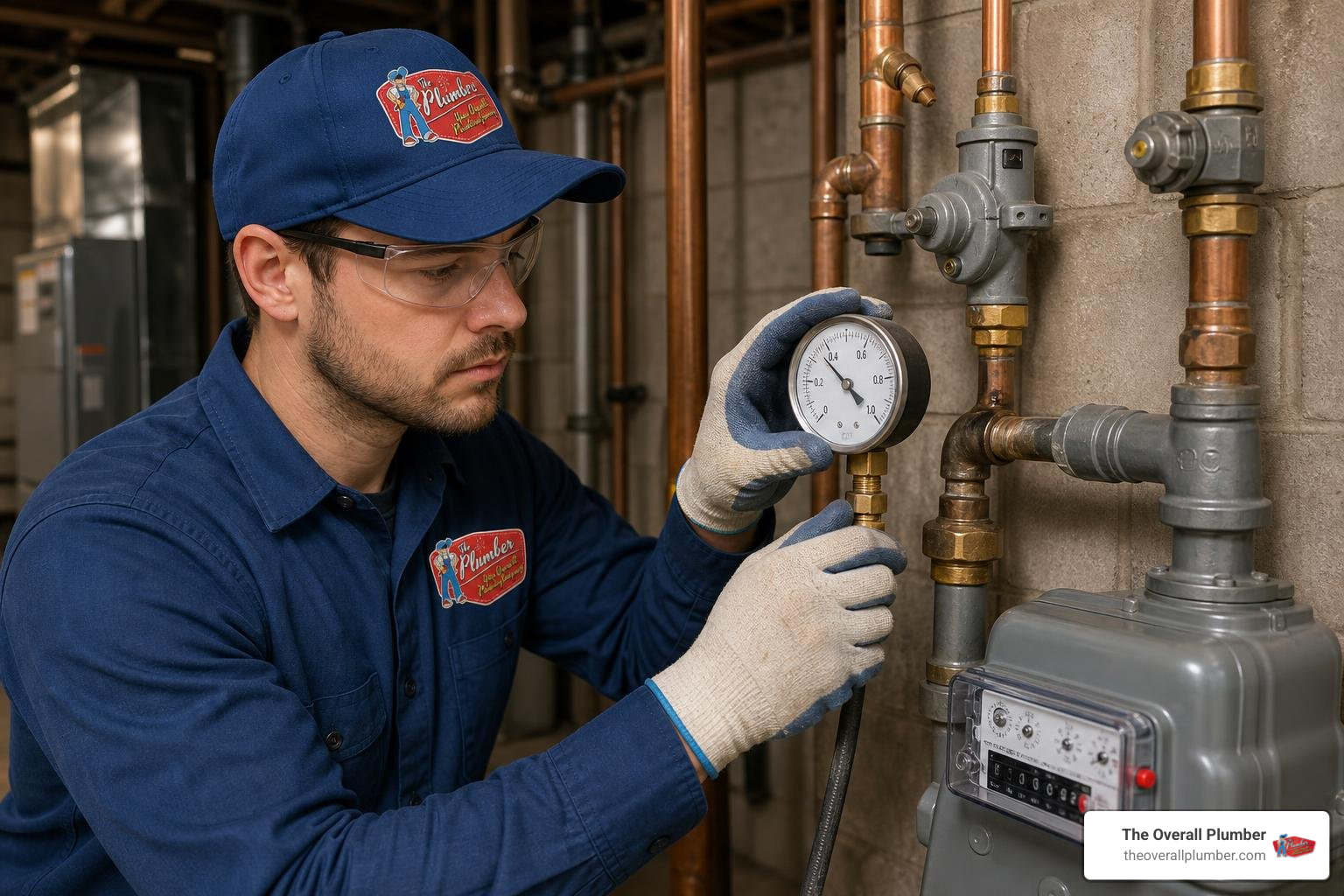
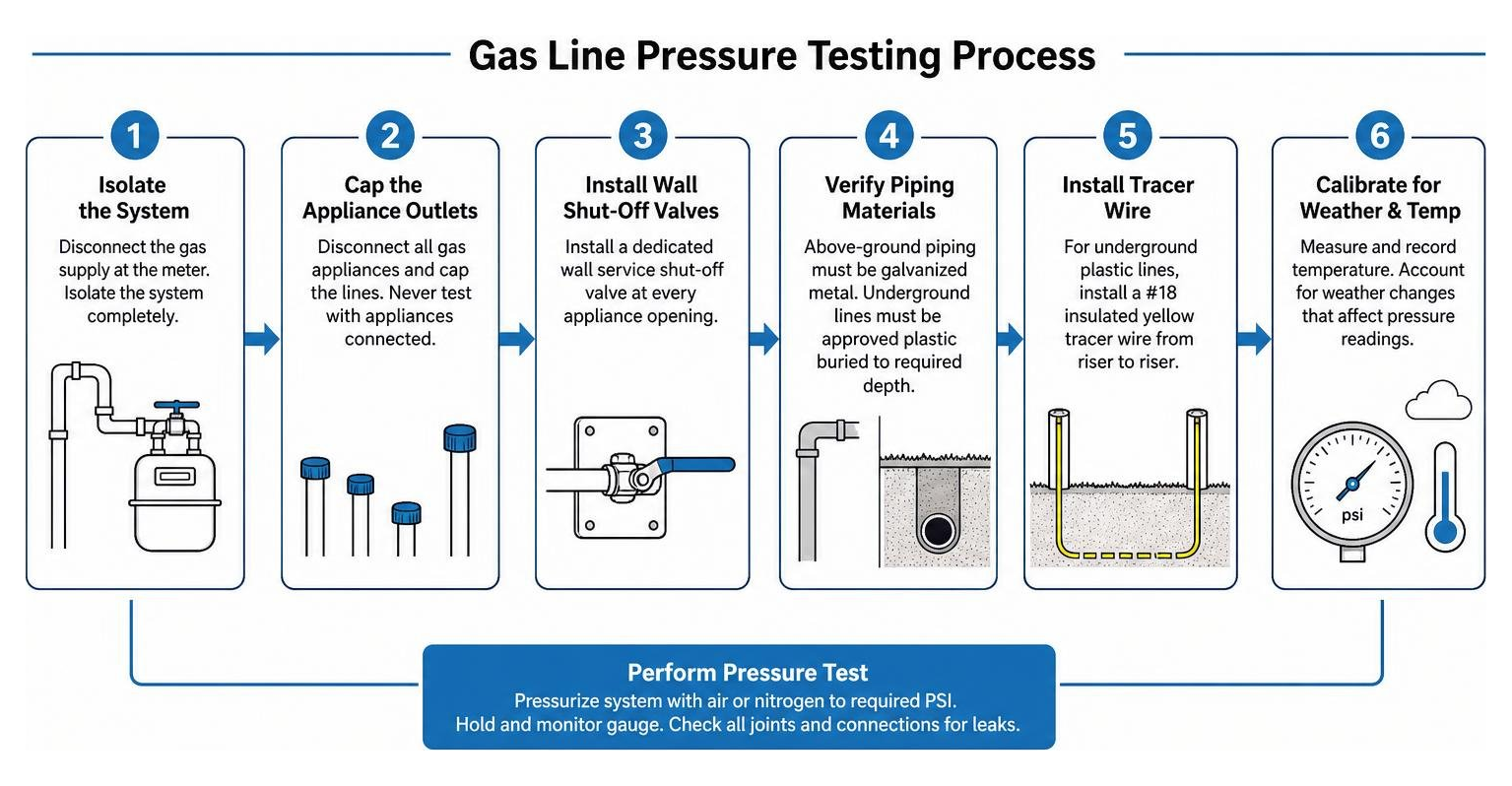
Here is how our team at The Overall Plumber prepares a system for a successful test:
- Isolate the System: We completely disconnect the gas supply at the meter. The pressure source must be entirely isolated before the test begins.
- Cap the Appliance Outlets: We disconnect all gas appliances (furnaces, water heaters, stoves) and cap the lines. Testing gas lines with appliances connected can destroy their delicate internal gas valves, which are only designed to handle a fraction of a single PSI.
- Install Wall Shut-Off Valves: Code requires a dedicated wall service shut-off valve at every appliance opening.
- Verify Piping Materials: Above-ground gas piping must be galvanized metal, properly wrapped or coated where exposed to corrosion. If there are underground lines (such as a line running to a pool heater or detached garage), they must be approved plastic gas piping buried at a minimum depth of 12 inches (or 36 inches for horizontal runs under certain local rules).
- Install Tracer Wire: For underground plastic lines, we install a #18 insulated yellow tracer wire from riser to riser. This allows future utility locators to find the plastic pipe underground.
- Calibrate for Weather and Temperature: Outdoor temperature and weather fluctuations directly affect pressure test results. If we pump air into a pipe on a hot afternoon, the air will expand. If the temperature drops rapidly during a storm, the pressure gauge will drop slightly—not because of a leak, but because of thermal contraction. We always note the system’s temperature and account for these local weather shifts.
Pneumatic vs. Hydraulic Testing Methods
There are two primary ways to pressure test pipes: pneumatic (using air or an inert gas like nitrogen) and hydraulic (using water).
For gas lines, pneumatic testing is the industry standard and the only safe method for residential properties. Pumping water into a gas line (hydraulic testing) is highly destructive; water causes rapid interior rusting of galvanized steel pipes and can ruin gas appliances. However, hydraulic testing is sometimes used in heavy industrial settings for extremely high-pressure pipelines because water does not compress, making a sudden pipe rupture much less violent than a compressed air explosion.
| Feature | Pneumatic Testing (Air/Nitrogen) | Hydraulic Testing (Water/Hydrostatic) |
|---|---|---|
| Primary Fluid | Compressed air or nitrogen | Water (sometimes mixed with dye) |
| Common Application | Residential & commercial gas lines | High-pressure industrial pipelines |
| Pressure Range | Low to moderate (3 to 10 psi typical) | High pressure (exceeding 125 psi) |
| Water Damage Risk | None | High (strictly prohibited in residential gas systems) |
| Leak Detection Tool | Bubble solutions or electronic sniffers | Visible water drops or colored dye |
What Happens After the Test: Inspections, Green Tags, and Failures
Once we pump the system to the required pressure and verify that the gauge is holding steady, we schedule the municipal inspection.
The city inspector will visit the property to verify the gauge pressure. If the system has held pressure perfectly, the inspector will sign off and place a green tag on the line or meter loop.
- The 30-Day Green Tag Rule: A passed inspection green tag is only valid for 30 days. If you do not coordinate with CenterPoint Energy to have your meter unlocked and gas restored within that 30-day window, the tag expires. You will have to pull a new permit, pay the fees, and have us perform the entire pressure test again.
- What If the Test Fails? If the needle on the gauge drops, even a fraction of a hair, there is a leak. We will use specialized leak detection solutions (which bubble up at the source of escaping air) or electronic gas sniffers to locate the leak. Once found, we perform the necessary repairs. If you need immediate assistance with a suspected leak, our 24 Hour Emergency Plumbers are ready to help. For residents in the southern part of our service area, we also offer expert Gas Line Repair in Santa Fe• Same-Day Service Available to get your system repaired and ready for a re-test in no time.
Frequently Asked Questions About Gas Line Pressure Testing
How often should a gas line pressure test Houston property owners schedule be performed?
For standard residential properties, you do not need to perform annual pressure tests. A residential test is typically only required during home sales, after gas line repairs, when installing new gas appliances, or if the property has been vacant for 6+ months. However, commercial buildings and industrial facilities often require annual pressure testing as part of their routine safety and preventative maintenance programs to comply with local fire codes.
Can a pressure test damage my existing gas pipes?
When performed by a professional, no. We test residential systems at safe, controlled pressures (usually between 3 and 10 psi). However, if an amateur over-pressurizes an old, corroded line, they can cause the joints to rupture. This is why we carefully evaluate the age and material of your pipes before applying pressure, ensuring we never exceed safe hoop stress limits.
How do I get a permit for a gas line inspection in the Houston area?
Permits must be obtained through your local city hall or municipal permits office (such as the City Hall Annex in Texas City or the Houston Permitting Center). Permit fees vary by municipality but are generally modest (for example, Texas City charges a $15.00 permit fee). While homeowners can pull permits for their primary homesteads, rental properties, commercial spaces, and complex installations require a licensed plumbing company to pull the permit. You can view our full range of certified plumbing Services to see how we handle the permitting process for you.
Schedule Your Professional Gas Line Pressure Test Today

Ready to schedule your test? At The Overall Plumber, we serve communities across Harris County, Galveston County, and Brazoria County—including Houston, Pearland, Pasadena, League City, Santa Fe, and Texas City. We stand behind our work with The Plumber Guarantee, offering priority scheduling, no trip charges, and absolutely no overtime fees.
Trust your home to a Certified Plumber for Gas System Testing. Contact us today to schedule your professional gas line pressure test in Houston, Texas. Call us now at tel:1-281-668-8055 for fast, reliable service!